

{{First_Name|Explorer}}, welcome back!🚀
The new year is already accelerating across science, defense and commercial space. Meanwhile, I’ve been diving deeper into the financialization of space and the emerging geopolitics of deterrence.
So, to brush up, financialization is the process by which economic activity becomes organized around financial markets, firms behave like financial actors rather than producers and assets are treated like vehicles for return and speculation.
Space systems, that were once state‑funded, mission‑driven, and strategically motivated, are now shaped by financial markets, investment logics, and return‑seeking behavior.
Space infrastructures, like satellites, constellations, and data infrastructures, are now treated as financial assets. VC and PE firms now decide which space startups survive; push for dual‑use applications (ISR, autonomy, comms) because they scale faster, demand recurring contracts, and predictable cash flows. Think of Earth‑observation data monetized as subscription services.
Dual‑use systems attract investment because they promise defense‑grade returns: defense contracts are sticky, margins are high, governments are reliable buyers and geopolitical crises increase demand.
Food for thought.
Click below for the full newsletter experience.
Happy reading 📡

IMAGES
Scientific Balloon in Antarctica : NASA
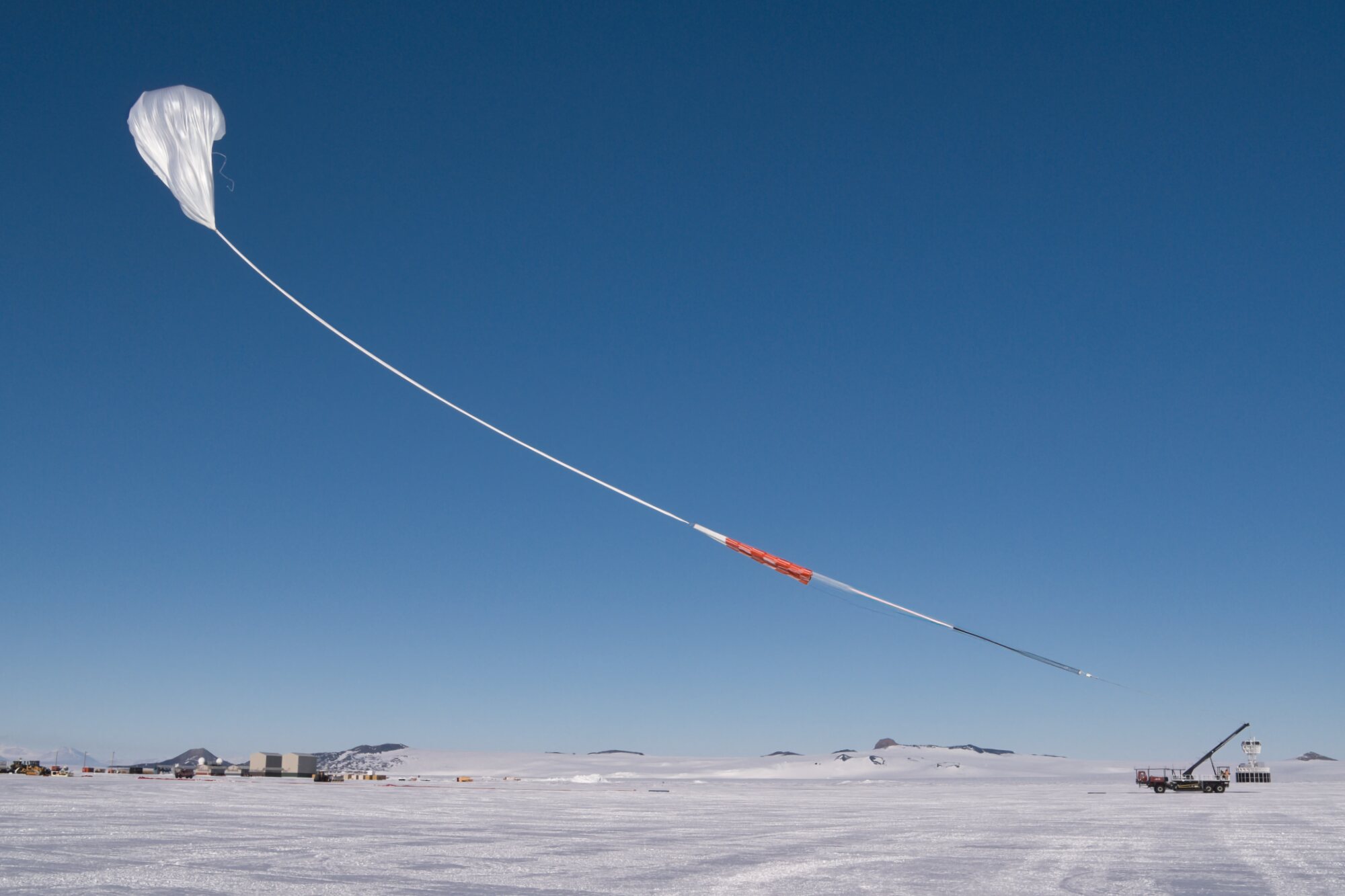
A NASA scientific balloon begins its ascent over Antarctica, carrying the Payload for Ultrahigh Energy Observations (PUEO) mission to detect radio signals produced when high‑energy neutrinos interact with the ice. Track the balloons in realtime. (Credit: NASA/Scott Battaion)
Meltwater Turns Decades Old Iceberg Blue : MODIS

Iceberg A‑23A, one of the largest and longest‑tracked Antarctic icebergs, is rapidly deteriorating as it drifts through warmer South Atlantic waters. NASA imagery shows the berg streaked with vivid blue meltwater, a sign of accelerated surface melting and structural weakening. (Credit: NASA)

Once nearly twice the size of Rhode Island, it has shrunk to about 1,182 square kilometers after multiple breakups in 2025. Scientists note that its current state suggests the decades‑old iceberg is nearing complete disintegration. Its striking blue streaks come from surface meltwater pooling and refreezing in older, denser ice. When meltwater fills crevasses and refreezes without air bubbles, it absorbs red wavelengths and reflects blue, producing the vivid color seen in recent NASA imagery. (Credit: NASA)

Iceberg A‑23A is more than three decades old, having calved from Antarctica’s Filchner Ice Shelf in 1986, which makes it one of the longest‑lived icebergs ever tracked. After spending years grounded in the Weddell Sea, it only began drifting again in 2020. (Credit: NASA)
Wildfires in the Argentine Patagonia : Aqua - MODIS

A series of fast‑moving wildfires is burning through Argentina’s Chubut province, threatening parts of Los Alerces National Park, a UNESCO World Heritage site known for its ancient Fitzroya forests. NASA’s Aqua satellite detected the first major activity on January 6, with imagery on January 8 showing dense smoke from two large fires advancing across steep, wind‑exposed terrain. (Credit: NASA)

The blazes are moving through valleys and lakeshores near Lago Rivadavia, Futalaufquen, Menéndez, and Epuyén, areas that typically draw summer tourism. Dry conditions and strong winds have accelerated the spread, raising concerns for ecosystems that include some of the world’s oldest trees. Satellite-based estimates from the Global Wildfire Information System indicate that fires charred more than 175 square kilometers (67 square miles) across Patagonia between January 5 and 8. (Credit: NASA)
Lighting Above Milan : NASA astronaut Nichole Ayers

NASA released a new image captured from the International Space Station showing a lightning strike over Milan, Italy, taken by astronaut Nichole Ayers while orbiting more than 250 miles above Earth. The photograph is part of an ongoing effort to document atmospheric activity from orbit, providing data that helps researchers study how storms interact with the upper atmosphere and influence weather models, communications, and aviation systems. (Credit: NASA/Nichole Ayers)
Sparkling Dwarf Stars in Westerlund 2 : James Webb Space Telescope

A new James Webb Space Telescope image captures a dense field of dwarf stars in the young star cluster Westerlund 2, located roughly 20,000 light‑years away in the constellation Carina. Webb’s NIRCam and MIRI instruments reveal hundreds of low‑mass stars embedded in dust, offering a clearer view of early stellar evolution than previous optical observations. The infrared data expose structures normally obscured by gas, enabling researchers to study how small stars form and interact within crowded clusters. Westerlund 2 is a key laboratory for understanding how dense environments shape the earliest stages of star formation. (Credit: ESA/Webb, NASA & CSA, V. Almendros-Abad, M. Guarcello, K. Monsch, and the EWOCS team)

SCIENCE
NASA Selects New Technologies and Servicing Study to Strengthen the Search‑for‑Life Exoplanet Mission, Habitable Worlds Observatory

An animated visualization showing multiple engineering architecture concepts for NASA’s Habitable Worlds Observatory, a planned flagship telescope intended to detect and study Earth‑like planets around nearby sunlike stars. (Credit: NASA Goddard Space Flight Center/Conceptual Image Labs)
5 January, 2026
NASA is advancing early work on the Habitable Worlds Observatory (HWO), selecting seven industry proposals to develop technologies for a future flagship telescope designed to directly image Earth‑like planets and analyze their atmospheres for potential biosignatures. The agency emphasized the need for a highly stable optical system and next‑generation starlight suppression, framing the selections as foundational steps toward a mission expected to launch in the 2040s.
NASA has selected proposals for three-year, fixed-price contracts from the following companies:
Astroscale U.S. Inc., Denver
BAE Systems Space and Mission Systems, Inc., Boulder, Colorado
Busek Co. Inc, Natick, Massachusetts
L3Harris Technologies Inc., Rochester, New York
Lockheed Martin Inc., Palo Alto, California
Northrop Grumman Inc., Redondo Beach, California
Zecoat Co. Inc., Granite City, Illinois
Alongside the technology push, Astroscale U.S. will study on‑orbit servicing options for HWO, exploring how refueling, repairs, or upgrades could extend the observatory’s operational life and reduce long‑term program risk. The study is in line with NASA’s interest in making future flagship missions maintainable rather than single‑use assets.
Parallelly, new high‑resolution speckle‑imaging work is refining the target list for HWO by characterizing nearby stars that may host detectable exoplanets. The analysis combines archival and newly acquired observations to identify stellar companions or variability that could complicate direct imaging efforts, also illustrating how precursor science is shaping mission design and target prioritization.
CNSA Conducts Cave‑Survival Training with Astronauts as Chang’e‑7 Prepares for Lunar South Pole Water‑Ice Search

Astronauts take part in cave‑survival training in December in Chongqing’s Wulong district. (Credit: Xinhua)
5 January, 2026
China National Space Administration (CNSA) has completed its first month‑long astronaut cave‑training campaign, a program designed to expose crews to isolation, darkness and constrained communication in preparation for future lunar surface missions. According to official statements, 28 astronauts were divided into four teams and spent nearly a week each inside a natural cave system in Chongqing’s Wulong district, where temperatures hovered around 8°C and humidity approached 99%. The training covered environmental monitoring, cave mapping, simulated space‑to‑ground communications and psychological resilience exercises. Reports from participants described the environment as mentally taxing, with limited sensory input and no external connectivity, conditions Chinese planners say mirror aspects of lunar exploration more realistically than traditional simulators.
State media framed the program as a step toward China’s first crewed lunar landing later this decade, emphasizing the need for teams to operate autonomously in unfamiliar terrain. The exercise also aligns with broader efforts to diversify astronaut preparation beyond microgravity and spacecraft‑based training. While the program’s technical value is difficult to independently assess, it illustrates China’s continued investment in human‑factors research as it advances toward sustained lunar operations.

Shackleton Crater sits at the lunar south pole, its rim receiving near‑constant sunlight while its deep interior remains in permanent darkness. (Credit: NASA/GSFC/Arizona State University)
Meanwhile, China is preparing to launch its next major lunar mission, Chang’e‑7, a multi‑spacecraft robotic campaign aimed at surveying the moon’s south pole for water ice and potential outpost sites. The mission, scheduled to lift off later this year, will deploy an orbiter, lander, rover and a dedicated hopping probe designed to enter permanently shadowed craters, regions considered the most promising locations for trapped volatiles and water ice.

The proposed landing area for China’s Chang’e‑7 lunar lander. (Credit: Yang Liu/Wang C. et al.)
A key instrument suite focuses on detecting and mapping water molecules, with the hopper designed to descend into craters that never see sunlight, while the orbiter will spend up to two months scouting the landing zone based on lighting and terrain conditions. Chang’e 7 is part of “phase four” of China’s methodical lunar program, following orbiters (Chang’e 1–2), near-side landers and rovers (3–4) and recent sample returns from both near and far sides (5–6). It is framed as a precursor to the International Lunar Research Station, a planned south‑pole outpost led by China and Russia with additional partner nations.
Chang’e‑7’s payload list also includes the ILO‑C telescope, a collaboration between the University of Hong Kong’s Laboratory for Space Research and the International Lunar Observatory Association. The small, wide‑field instrument has passed full flight‑model qualification and is cleared for integration on the lunar lander. It is set to fly on Chang’e‑7’s planned November 2026 landing near the rim of Shackleton Crater, where it will conduct galactic‑plane imaging to support scientific observations and public engagement.
"This advanced astronomical camera is set to launch aboard China's Chang'e 7 mission, scheduled to land near the illuminated rim of Shackleton Crater in the lunar south pole region in November 2026.
"The telescope aims to capture stunning images of the galactic plane, contributing to lunar science and inspiring future generations."
If launched on schedule, Chang’e 7 could give China an early operational lead in polar resource prospecting and site selection, a capability increasingly tied to both scientific and strategic ambitions, even as technical details and data policies remain closely managed.
Hubble Discovers Cloud‑9, a New Starless Dark‑Matter Object Near Messier 94

This image pinpoints the location of Cloud‑9, about 14 million light‑years away. The magenta overlay shows radio data from the Very Large Array, highlighting the cloud’s signal, with the dashed circle marking the peak emission where astronomers searched for stars. Hubble’s Advanced Camera for Surveys later confirmed that no stars exist within the cloud; the few visible objects are background galaxies. Prior to these observations, Cloud‑9 could have been interpreted as an extremely faint dwarf galaxy, but Hubble data show it is truly starless. (Credit: NASA, ESA, VLA, Gagandeep Anand (STScI), Alejandro Benitez‑Llambay (University of Milano‑Bicocca); Image Processing: Joseph DePasquale (STScI))
5 January, 2026
NASA’s Hubble Space Telescope has confirmed the first known example of a starless, dark‑matter–dominated gas cloud, an object researchers have long theorized but never previously observed. Nicknamed Cloud‑9, the structure sits roughly 14 million light‑years away on the outskirts of the spiral galaxy Messier 94. Follow‑up Hubble imaging showed no stars within the cloud, supporting models of so‑called Reionization‑Limited H I Clouds, or RELHIC (where “H I” refers to neutral hydrogen), primordial remnants from the early universe that accumulated gas but never reached the conditions needed for star formation.
Scientists describe Cloud‑9 as a “failed galaxy,” a small dark‑matter halo that retained hydrogen but remained inert, offering a rare observational window into early galaxy‑assembly processes. Its confirmation provides empirical support for long‑standing predictions about low‑mass halos that should exist but are difficult to detect because they emit no light.
Researchers say Cloud‑9 could help test dark‑matter models and refine theories of how the first galaxies formed, particularly the threshold conditions that separate luminous systems from those that never ignite.
Vera Rubin Observatory Discovers 2025 MN45, the Fastest‑Spinning Large Asteroid Ever Recorded

A render from the Vera C. Rubin Observatory’s early commissioning data highlights 2025 MN45, a main‑belt asteroid roughly 710 meters wide that completes a full rotation every 1.88 minutes—making it the fastest‑spinning large asteroid ever measured.
The discovery was made using data from NSF–DOE Vera C. Rubin Observatory, jointly funded by the U.S. National Science Foundation and the U.S. Department of Energy's Office of Science. (Credit: NSF–DOE Vera C. Rubin Observatory/NOIRLab/SLAC/AURA/P. Marenfeld)
7 January, 2026
Astronomers using early commissioning data from the Vera C. Rubin Observatory have identified 2025 MN45, now confirmed as the fastest‑spinning large asteroid ever observed. The object, located in the main asteroid belt, measures roughly 710 meters / 0.4 miles across and completes a full rotation in just 1.88 minutes, a rate so extreme that researchers conclude it must be a cohesive, monolithic body rather than a loose rubble pile.
The discovery emerged from Rubin’s pre‑survey observations, which captured thousands of asteroids, including 19 super‑ and ultra‑fast rotators. MN45 stands out because objects of its size are not expected to withstand such rapid spin without breaking apart, offering new constraints on asteroid structure and formation models.
NOIRLab, which operates Rubin, emphasized that these early results preview the observatory’s capacity to map small‑body populations once full operations begin. The findings also demonstrate how Rubin’s high‑cadence imaging can reveal rotational properties that ground‑based surveys often miss.
NASA Prepares Early Return of Crew‑11 After ISS Medical Issue While Artemis II Remains on Track

Captured from 263 miles above the Indian Ocean, this long‑exposure ISS image shows blurred cloud tops, a band of airglow along Earth’s horizon, and faint star trails across the sky. The SpaceX Dragon cargo spacecraft appears in the lower foreground, seen through a window of the crewed Dragon vehicle. (Credit: NASA)
8 - 11 January, 2026
NASA is preparing for the first medical evacuation in the 25‑year history of the International Space Station, following a medical issue involving one member of the four‑person Crew‑11 mission. The unidentified astronaut is stable, but the condition prompted NASA to cancel a planned January 8 spacewalk and accelerate the crew’s return schedule. The departing Crew‑11 astronauts are Commander Zena Cardman (NASA), Pilot Mike Fincke (NASA), Mission Specialist Kimiya Yui (JAXA), and Mission Specialist Oleg Platonov (Roscosmos). The agency has set January 14 as the target undocking date for SpaceX’s Dragon Endeavour, ending the mission roughly a month early.

The four crew members of NASA’s SpaceX Crew-11 mission to the International Space Station train inside a SpaceX Dragon spacecraft in Hawthorne, California. From left to right: Roscosmos cosmonaut Oleg Platonov, NASA astronauts Mike Fincke and Zena Cardman, and JAXA astronaut Kimiya Yui. (Credit: SpaceX)
In advance of departure, astronaut Mike Fincke, who tied NASA’s spacewalking record earlier in the week, will transfer station command to Russian cosmonaut Sergey Kud‑Sverchkov in a ceremony on January 12. Once Crew‑11 departs, the ISS will be operated by a three‑person skeleton crew, including NASA astronaut Christopher Williams and Roscosmos cosmonaut Sergei Mikayev, until Crew‑12 can be launched ahead of its original schedule. NASA officials have emphasized that the situation does not constitute an emergency deorbit but requires medical capabilities unavailable on orbit.
The evacuation comes as NASA simultaneously advances preparations for Artemis II, the first crewed lunar mission of the program. Final integration and rollout steps for the Space Launch System and Orion spacecraft continue at Kennedy Space Center. NASA Administrator Jared Isaacman said the ISS medical evacuation and Artemis campaign are “totally separate,” adding that no delays are expected for the lunar mission’s schedule.
NASA officials have framed the dual‑track response as evidence of operational resilience, though the reduced ISS crew and accelerated timelines highlight the fragility of station staffing during unplanned events

GOVERNANCE
US Lawmakers Approve $24.4 Billion NASA Budget for FY 2026, Preserving Key Missions, Rejecting Trump Admins Proposed Science Cuts

Credit: NASA
5 January, 2026
U.S. Congress has moved to largely reverse the Trump administration’s proposed $18.8 billion NASA budget for FY 2026, restoring funding to $24.4 billion and rejecting deep cuts to the agency’s science portfolio. The White House request would have reduced science spending by nearly 50%, prompting NASA to prepare closeout plans for dozens of missions over the summer. Lawmakers instead opted to maintain science funding near current levels, halting those shutdown preparations and preserving programs across planetary, heliophysics, Earth science, and astrophysics.
The bipartisan Commerce‑Justice‑Science conference bill frames the reversal as part of a broader rejection of “draconian” reductions to federal research and competitiveness initiatives. While the final number remains slightly below NASA’s 2025 budget, it avoids the termination of 55 missions and protects work on major efforts such as Mars Sample Return, Earth‑system observatories, and the Artemis program.
FCC Approves SpaceX Plan for 7,500 Starlink Gen2 Satellites in Low Earth Orbit

A Starlink mission launch in 2023. (Credit: SpaceX)
9 January, 2026
SpaceX has received U.S. approval to deploy 7,500 additional second‑generation Starlink satellites, expanding its authorized Gen2 constellation to 15,000 spacecraft. The FCC said the decision will support higher‑capacity broadband, lower latency, and expanded mobile and direct‑to‑device coverage, including operations across five frequency bands previously restricted under earlier licenses.
The authorization remains only a partial response to SpaceX’s request to operate nearly 30,000 Gen2 satellites. Regulators deferred action on the remaining units, citing the need for further review of orbital‑debris risks, spectrum coordination, and space‑safety concerns raised by competitors and government agencies. The FCC also maintained deployment deadlines requiring SpaceX to place half of the approved satellites into orbit by 2028, with the remainder due by 2031.
The move marks another incremental expansion of Starlink’s footprint and adds a large tranche of spacecraft to an already crowded low‑Earth‑orbit environment, even as scientists, competitors, and government agencies continue to warn that current regulatory frameworks lag behind the scale of planned megaconstellations. The FCC advanced the request without addressing long‑standing concerns about orbital congestion, interference, and debris management.

MILITARY
L3Harris Sells Majority Stake in Space Propulsion Business to AE Industrial and Gains US Security‑Cleared Approval for International ISR Terminal Sales
L3Harris is restructuring its space and defense portfolio, announcing a major divestment alongside an internal reorganization and new export approvals for key communications systems.

The modernized RS‑25 engines from Aerojet Rocketdyne will power Artemis IV, debuting the SLS Block 1B and marking the final flight of shuttle‑program engines. (Credit: L3Harris)
5 January, 2026
The company will sell a 60% stake in its Space Propulsion and Power Systems business to private‑equity firm AE Industrial Partners in a deal valued at $845 million. The unit includes long‑running programs such as the RL10 upper‑stage engine, electric‑propulsion systems, and spacecraft power hardware. L3Harris will retain a 40% minority stake, while keeping the RS‑25 engine program used for NASA’s Artemis missions. While “Aerojet Rocketdyne” as a trademarked brand remains with L3Harris, because that’s the entity they acquired in 2023, AE Industrial plans to revive the Rocketdyne name for the acquired business, citing its historical role in U.S. propulsion development. The transaction is expected to close in the second half of 2026, pending regulatory review.
The sale coincides with an overarching corporate reorganization. L3Harris is consolidating its operations from four business segments to three, Space & Mission Systems, Communications & Spectrum Dominance, and Missile Solutions, aiming to align more closely with U.S. defense priorities and streamline internal investment. Leadership changes accompany the shift, including new appointments in engineering and innovation roles.

The ROVER 6S Transceiver. (Credit: L3Harris)
7 January, 2026
Separately, the company received NSA approval for international sales of its ROVER 6Sc and Tactical Network ROVER 2c ISR terminals. The certification allows approved foreign partners to operate the systems with U.S. encryption modules for the first time, expanding coalition interoperability under State Department oversight.
ROVER 6S is a portable receiver that lets troops on the ground see live video and sensor feeds from aircraft overhead. When a drone, helicopter, or fighter jet is watching an area, ROVER 6S can pick up that video in real time and show it to people who need to make quick decisions. It works across several radio bands, so it can connect to many different aircraft and mission setups, and it uses secure encryption so the data can’t be intercepted. In practice, it helps ground teams understand what’s happening around them, coordinate with pilots, and respond faster during surveillance or targeting missions.
ROVER 6Sc is the export‑ready version of the ROVER system, designed so approved international partners can securely receive live video and sensor feeds from aircraft. The key difference is its NSA‑approved encryption module, which allows foreign militaries to use the system under U.S. security rules. This makes 6Sc suitable for coalition operations where forces from different countries need to share ISR (Intelligence, Surveillance, and Reconnaissance) data quickly and securely without compromising protected communications.
Space Force Awards Falcon ExoDynamics Contract for Handle 2.0 to Enable Modular Satellite Standardization

Slingshot-1 CubeSat prototype. (Credit: Aerospace Corporation)
5 January, 2026
The U.S. Space Force has selected California-based defense contractor Falcon ExoDynamics to advance Handle 2.0, a modular satellite interface intended to become a standardized, commercially supported component for future military spacecraft. The $3.3 million contract, issued through the Space Safari office, aims to transition Handle from an Aerospace Corporation research prototype into an operational system that can shorten satellite integration timelines. Originally demonstrated on Aerospace’s Slingshot‑1 mission in 2022, the interface provides a common power‑and‑data connection between satellite buses and payloads, allowing sensors to be swapped late in assembly without redesigning the spacecraft.
Handle 2.0 expands the range of compatible payloads and formalizes a plug‑and‑play model in which buses can be built or stored in advance, with mission‑specific sensors installed only when needed. By separating the bus from the payload, the Space Force hopes to cut months from traditional development cycles and support rapid‑launch missions under the Tactically Responsive Space program.
The Space Safari Office is a U.S. Space Force program office that handles urgent, fast‑turnaround space missions, especially those that support the military’s need for tactically responsive space. It sits within Space Systems Command (SSC) and was originally established under the former Space and Missile Systems Center.
Handle 2.0 is slated to fly on the Victus Salo mission in 2026, part of the Tactically Responsive Space program. Victus Salo will use an Impulse Space maneuvering vehicle and a Lincoln Laboratory payload to demonstrate rapid launch and on‑orbit repositioning, reflecting the Space Force’s push for faster, more flexible responses to emerging counterspace threats
Space Force Awards $739 Million in Phase 3 Lane 1 Launch Orders to SpaceX for New Missile‑Warning and Tracking Satellites

A SpaceX Falcon 9 lifts off carrying SDA missile‑tracking satellites, part of the expanding low‑Earth‑orbit architecture for U.S. missile‑warning and tracking missions, in October 2025. (Credit: SpaceX)
9 January, 2026
Space Systems Command has issued nine National Security Space Launch (NSSL) Phase 3 Lane 1 task orders to expand U.S. missile warning and missile‑tracking (MW/MT) capacity, awarding all associated launches to SpaceX. The $739 million set of awards supports missions for both the Space Development Agency (SDA) and the National Reconnaissance Office (NRO), reflecting the Pentagon’s continued reliance on commercial launch providers for flexible‑requirement national security missions.
According to SSC, the task orders will place new missile‑warning and tracking satellites into low Earth orbit as part of broader efforts to detect and follow advanced missile threats from space. The package includes five launches carrying 44 SDA spacecraft—36 Tranche 2 Tracking Layer satellites built by L3Harris and Lockheed Martin, along with eight fire‑control demonstration satellites from Millennium Space Systems.
Phase 3 Lane 1 task orders are small‑to‑medium national security launch contracts awarded under the Space Force’s NSSL Phase 3 program. Lane 1 is specifically designed for commercial launch providers that can offer flexible, lower‑cost missions for payloads with less demanding requirements, as opposed to the heavier, more complex missions in Lane 2.
The launches begin in fiscal year 2026 and form a key tranche of the proliferated missile‑tracking architecture now under construction across multiple agencies.
Space Force Selects Rhea Space Activity to Develop GPS‑Denied, Vision‑Based Autonomous Navigation for On‑Orbit Maneuvers

Concept image showing a Vanguard‑equipped satellite guided by ground instructions, autonomously determining a rendezvous approach to a resident space object, and entering harmonic orbits for passive, optical observation. (Credit: Rhea Space Activity)
9 January, 2026
Autonomous navigation systems developer, Rhea Space Activity has been awarded a U.S. Space Force contract to adapt NASA‑developed autonomous navigation software for military use, aiming to reduce satellites’ dependence on GPS in contested orbital environments. The company is one of ten firms selected under SpaceWERX’s Sustained Space Maneuver Challenge, each receiving a $1.9 million Direct‑to‑Phase‑2 SBIR award sponsored by U.S. Space Command to mature technologies that support more resilient on‑orbit maneuvering.
Under its award, Rhea Space is developing Vanguard, a vision‑based navigation and guidance system built on AutoNav, a Jet Propulsion Laboratory software suite now owned by the company. AutoNav uses onboard cameras to identify stars and known satellites, compare them to stored ephemerides, and compute a spacecraft’s position and trajectory without continuous ground input. Vanguard extends this capability to autonomous rendezvous and proximity operations, a key requirement for inspection and characterization missions. The software is currently being tested in physics‑based simulations, with potential future demonstrations on Space Force satellites.
US Defense Secretary Hegseth Highlights Space Manufacturing’s Role in Industrial Base Expansion During “Arsenal of Freedom” Tour

US Secretary of War Pete Hegseth speaks during a stop on the nationwide “Arsenal of Freedom” tour in Los Angeles on Jan. 9, 2026. (Credit: Air Force Staff Sgt. Maddy Keech, DoW)
9 January, 2026
U.S. Defense Secretary Pete Hegseth continued his “Arsenal of Freedom” tour with a stop at a Los Angeles–area space manufacturer, using the visit to emphasize the administration’s focus on expanding domestic defense production. The tour, which highlights companies tied to military supply chains, has drawn attention for blending policy messaging with factory‑floor outreach.
In Long Beach, Hegseth also toured Rocket Lab’s engine development facility, located in the former Virgin Orbit headquarters. He pointed to the company’s recent $805 million military satellite award as evidence of the growing role commercial firms play in national security programs, though the visit offered few specifics on how the Pentagon plans to address long‑standing industrial base bottlenecks.
Across both stops, Hegseth noted industrial capacity as a strategic priority, positioning space manufacturing as central to future deterrence. The tour is part of the administration’s overarching effort to signal support for defense contractors amid rising demand for launch, propulsion and satellite production.
India’s First Launch of 2026 Ends in Apparent Anomaly Affecting Military Earth‑Observation Satellite

India’s EOS‑N1 satellite ahead of encapsulation inside the PSLV fairing. (Credit: ISRO)
11 January, 2026
India conducted its first launch of 2026 with a Polar Satellite Launch Vehicle (PSLV‑C62) mission carrying the EOS‑N1 Earth‑observation satellite and 15 co‑passenger payloads, including international and commercial spacecraft. EOS‑N1, also referred to as Anvesha, and developed by the Indian Defence Research and Development Organisation (DRDO) is described as a strategic, advanced imaging satellite intended to strengthen India’s reconnaissance and remote‑sensing capabilities. The mission was executed by NewSpace India Limited, ISRO’s commercial arm, and targeted a sun‑synchronous orbit for most payloads, with a separate re‑entry trajectory planned for a technology demonstrator capsule.
However, early post‑launch data indicated a possible anomaly late in the third‑stage burn, with unexpected roll‑rate disturbances and a deviation from the intended flight path, prompting an ongoing assessment by ISRO. This marked the PSLV’s second consecutive failure, following the unsuccessful PSLV‑C61 mission in May 2025, with both incidents traced to third‑stage anomalies.

COMMERCIAL
Array Labs Raises $20 Million Series A for Formation‑Flying Radar Satellites and High‑Resolution 3D Imaging

Credit: Array Labs
5 January, 2026
Array Labs, a Silicon Valley radar‑imaging startup, has raised $20 million in Series A funding, bringing its total capital to $35 million. The round, led by Catapult Ventures with participation from Washington Harbour Partners, Kompas VC, Y Combinator, and others, will support scaling engineering and manufacturing as the company prepares to launch its first formation‑flying radar satellite cluster.
The company argues that today’s radar‑satellite market resembles pre‑SpaceX launch economics, dominated by bespoke, high‑cost systems built by large defense contractors. Array Labs claims its architecture, which adapts manufacturing techniques from consumer electronics and telecommunications, can deliver higher‑power radar at dramatically lower cost, enabling mass production and broader deployment.
Over the past two years, Array has secured multiple competitive U.S. government awards from the Air Force, Space Force, Navy, Army, SOCOM, and DARPA to advance work on high‑power antenna architectures, high‑bandwidth communications, 3D reconstruction algorithms, and related technologies.
In a parallel update, the company outlined progress on its radar payloads, sovereign‑system offerings, and 3D data products, positioning itself to serve defense, intelligence, and commercial customers. The funding is intended to accelerate production capacity ahead of a planned multi‑satellite launch.
SkyFi Integrates Vantor (Formerly Maxar Intelligence) to Deliver On‑Demand High‑Resolution Geospatial Imagery

A Venezuelan oil tanker detained by U.S. authorities during a widely disputed operation is shown transiting southwest through the Caribbean Sea near Guadeloupe. Its position was confirmed using AIS signals and high‑resolution satellite imagery, which enabled near‑real‑time identification and tracking of the vessel’s movement. (Credit: Vantor)
5 January, 2026
Texas-based SkyFi has integrated Vantor, the rebranded Maxar Intelligence, into its Earth‑intelligence platform, expanding access to high‑resolution satellite imagery and analytics for government and commercial users. The partnership connects SkyFi directly to the Vantor Hub, enabling on‑demand tasking of Vantor’s satellites and delivery of its spatial‑content products, including high‑accuracy imagery, advanced geospatial datasets, 20-plus years of archival imagery available with a 1 km² minimum order, detailed 3D terrain data, and global-scale 2D imagery basemaps..
SkyFi frames the move as part of its effort to build a “virtual constellation” by aggregating data from multiple providers, aiming to simplify procurement and reduce the friction traditionally associated with high‑end Earth‑observation systems. Vantor, for its part, positions the integration as a way to broaden distribution through SkyFi’s rapidly growing user base and streamlined interface.
Commercial platforms are increasingly acting as intermediaries between large satellite operators and end users, offering consolidated access to imagery, analytics, and tasking tools without requiring direct engagement with legacy providers. No pricing, contract value, or commercial structure for this partnership was made public.

RESEARCH SPOTLIGHT
Scientists Demonstrate RNA Building Blocks Form Without Enzymes or Cells
A new set of laboratory experiments is offering fresh support for the RNA world hypothesis, suggesting that RNA’s building blocks could have formed far more easily on early Earth than previously assumed. Researchers simulated conditions from 4.3 billion years ago, combining ribose, nucleobases, phosphates, borates, and basalt, then subjecting the mixture to heating and drying cycles. The reactions produced RNA components without directed intervention, indicating that prebiotic chemistry may have been rapid and robust under Hadean surface conditions.
The study also reinforces the role of borates, which stabilize ribose and facilitate phosphate availability—contradicting earlier assumptions that they hinder RNA (ribonucleic acid) formation. Scientists note that impacts from ancient protoplanets could have delivered additional organic precursors, linking early Earth chemistry with extraterrestrial sources. The findings align with broader astrobiology research indicating that RNA, a simpler and more versatile cousin of DNA, may arise readily on rocky planets. Similar chemical pathways could operate elsewhere in the cosmos, implying that prebiotic chemistry is not unique to Earth and that RNA‑like molecules may be widespread.
These findings have also been bolstered by new discoveries about the sample of material brought to Earth from the asteroid Bennu by NASA’s OSIRIS‑REx mission. In particular, with the recent announcement of the discovery of ribose in the Bennu sample, all the ingredients of RNA have now been identified in the 120 grams of dirt and stones returned from the asteroid.
The team of biochemists led by Yuta Hirakawa of Tohoku University in Japan and the Foundation for Applied Molecular Evolution in Florida, published their findings in the journal Proceedings of the National Academy of Sciences.
Despatch Out. 👽🛸
