

{{First_Name|Explorer}}, welcome back!🚀
We are heavy on space science developments this week and some unprecedented developments in commerce.
Having trouble with links? Click the link below to read the unclipped publication. ↓
Hope you enjoy this Space!

IMAGES
Crystal Ball Nebula : Gemini North Telescope

The Gemini North telescope captured a detailed new image of NGC 1514, the “Crystal Ball Nebula,” revealing an asymmetric shell shaped by the binary star system at its center. The 8.1‑meter telescope on Maunakea in Hawai’i recorded glowing gas structures that trace the aftermath of an earlier stellar death while showing how the surviving pair continues to sculpt the nebula. Gemini North is part of the International Gemini Observatory, operated by NOIRLab. (Credit: International Gemini Observatory/NOIRLab/NSF/AURA)
Martian South Pole : Psyche Mission, NASA
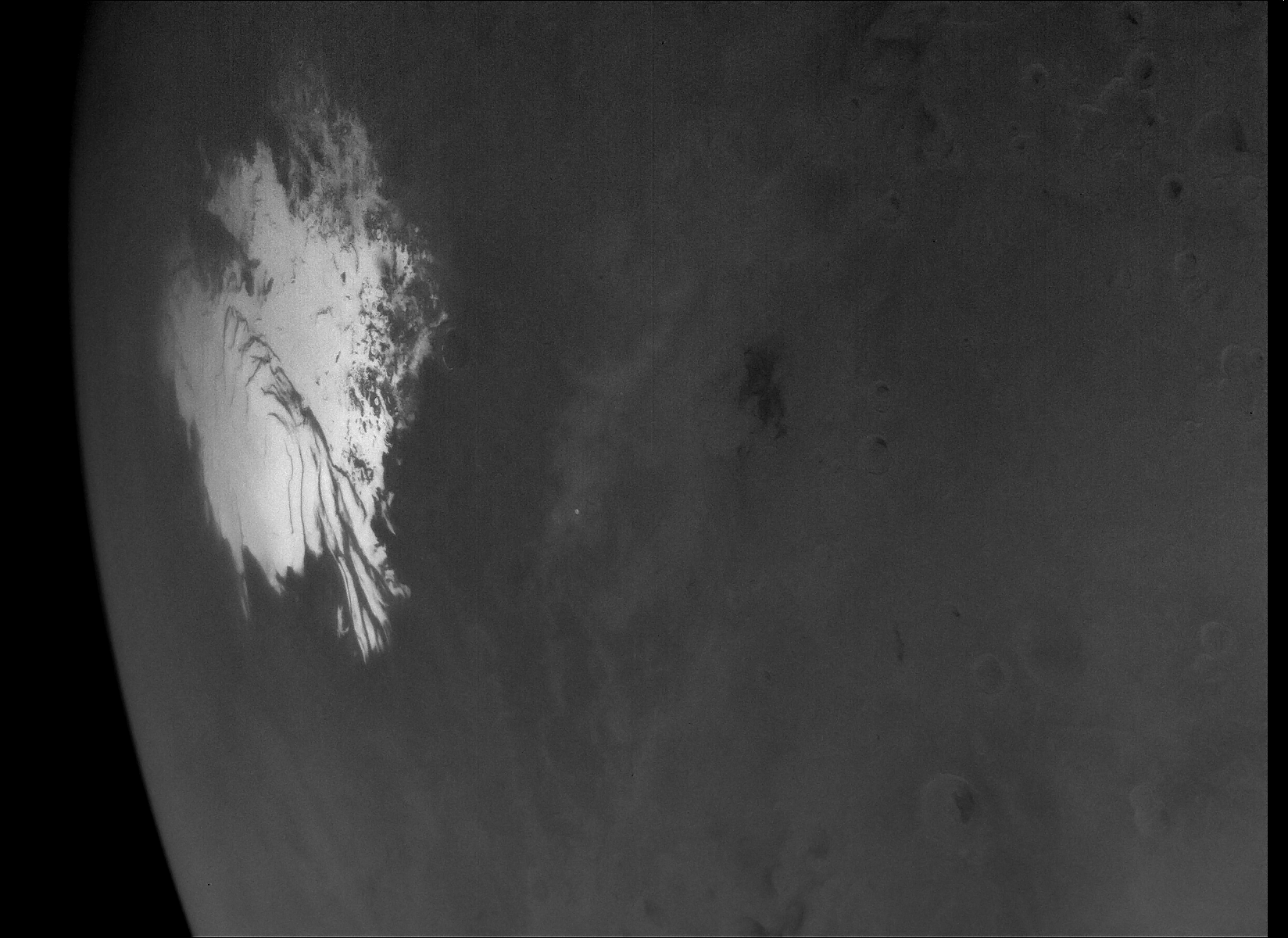
This high‑resolution image shows Mars’ water‑ice‑rich south polar cap as seen by NASA’s Psyche spacecraft during its May 15, 2026, gravity‑assist flyby. Imager A on the spacecraft captured the view at 1:53 p.m. PDT with a scale of about 0.7 miles / 1.14 kilometers per pixel; the cap spans more than 430 miles / 700 kilometers. With the maneuver complete, Psyche will resume solar‑electric propulsion and head for the main asteroid belt, where it is scheduled to enter orbit around the metal‑rich asteroid Psyche in August 2029. (Credit: NASA/JPL Caltech/ASU)

Credit: NASA/JPL-Caltech/ASU
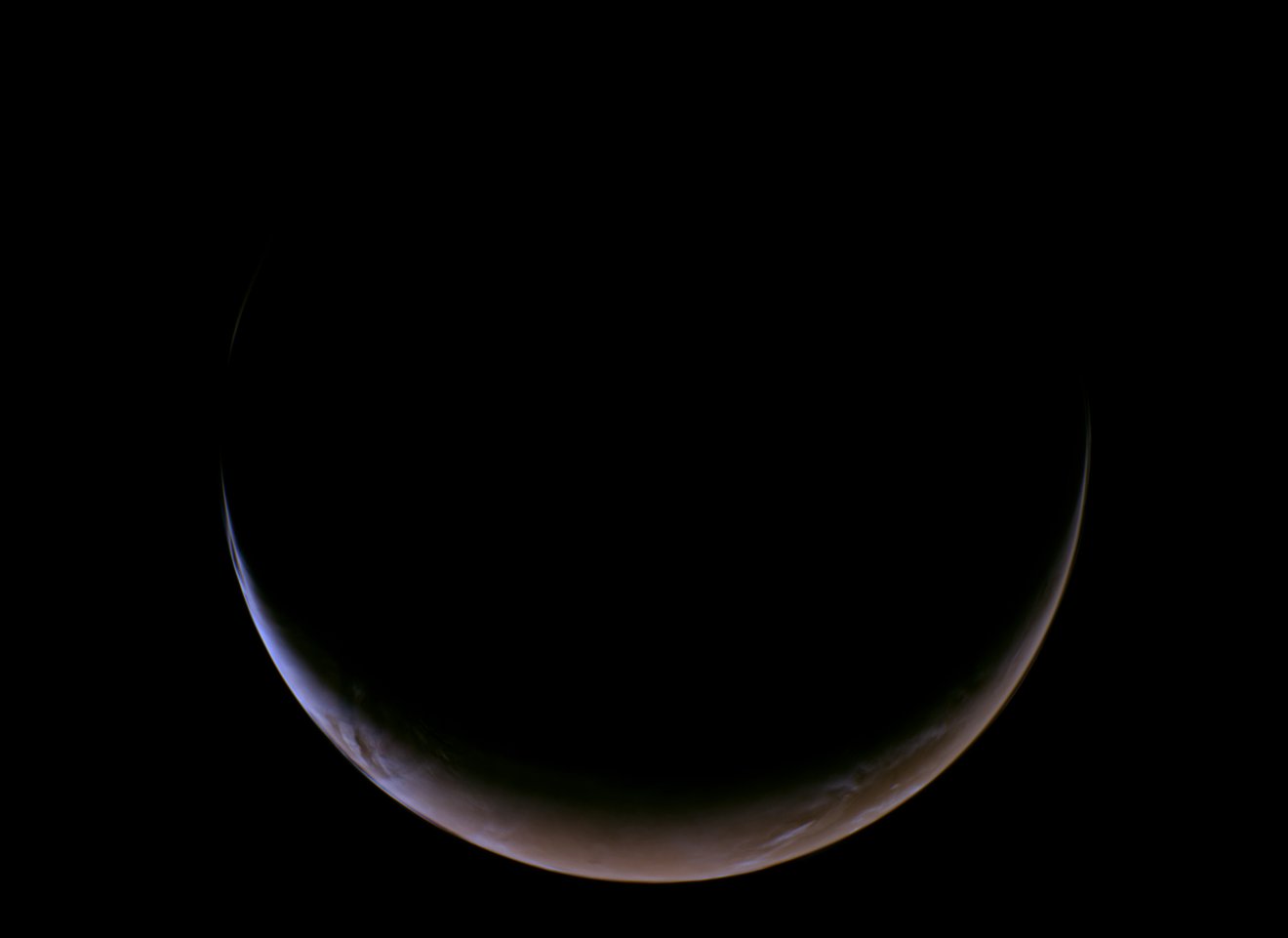
The crescent Mars was imaged on May 15, 2026 by the Psyche spacecraft during its gravity‑assist flyby. The natural‑color view was produced from red, green and blue data collected by the mission’s multispectral imager. Psyche passed 2,864 miles / 4,609 kilometers above the surface, using Mars’ gravity to increase its speed and adjust its orbital plane without expending propellant, setting the spacecraft on course for the metal‑rich asteroid Psyche. (Credit: NASA/JPL‑Caltech/ASU)
A Growing Wildfire : Landsat 9
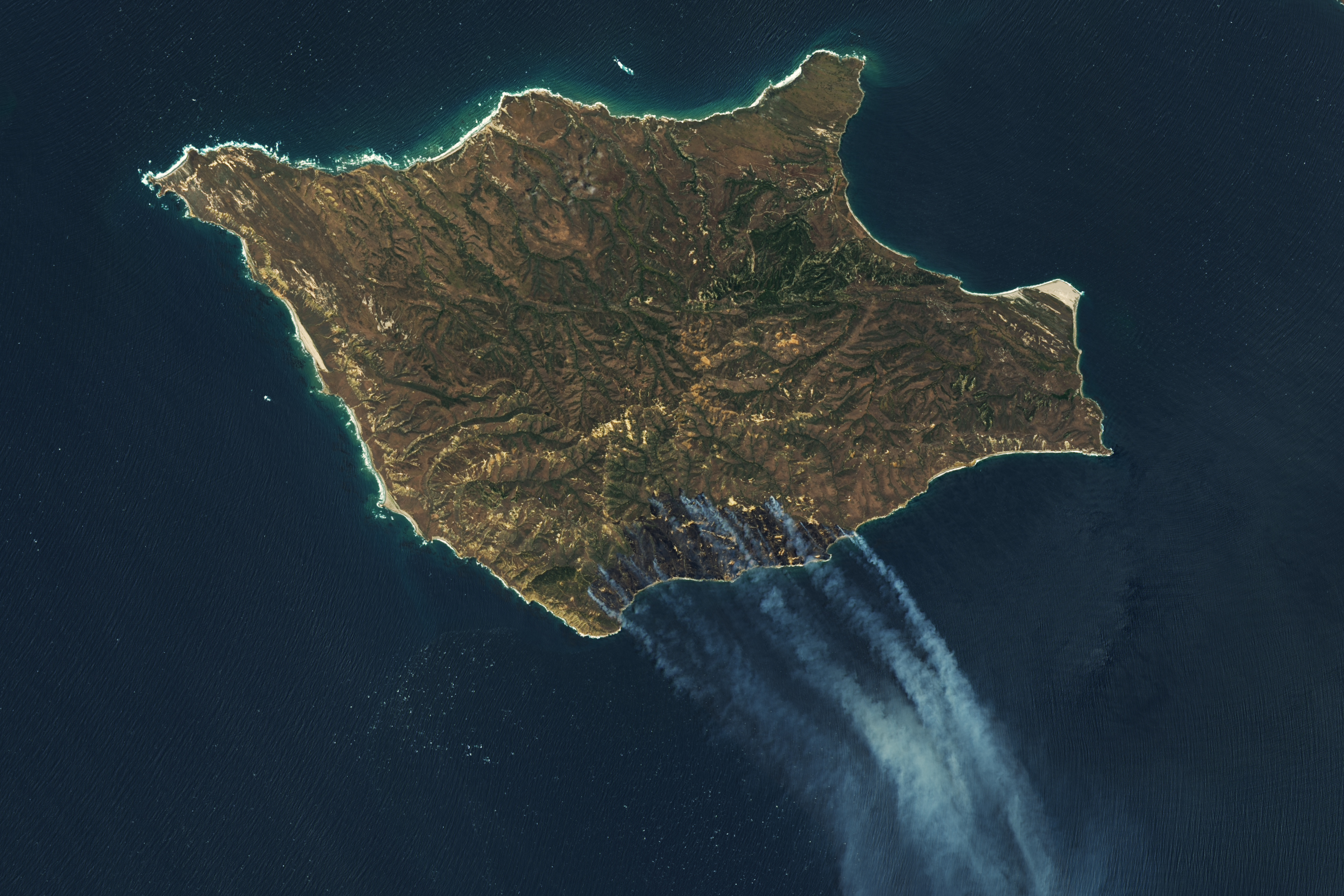
This natural‑color Landsat 9 image captures thick smoke streaming off Santa Rosa Island in California’s Channel Islands National Park, on May 16, 2026, as firefighters worked to contain a human‑caused wildfire that later expanded to 16,600 acres / 6,700 hectares by May 19. The smoke drifted over the Pacific while flames advanced near a rare stand of Torrey pines, a species that grows naturally only on Santa Rosa Island and near San Diego (US). (Credit: NASA Earth Observatory / Lauren Dauphin)
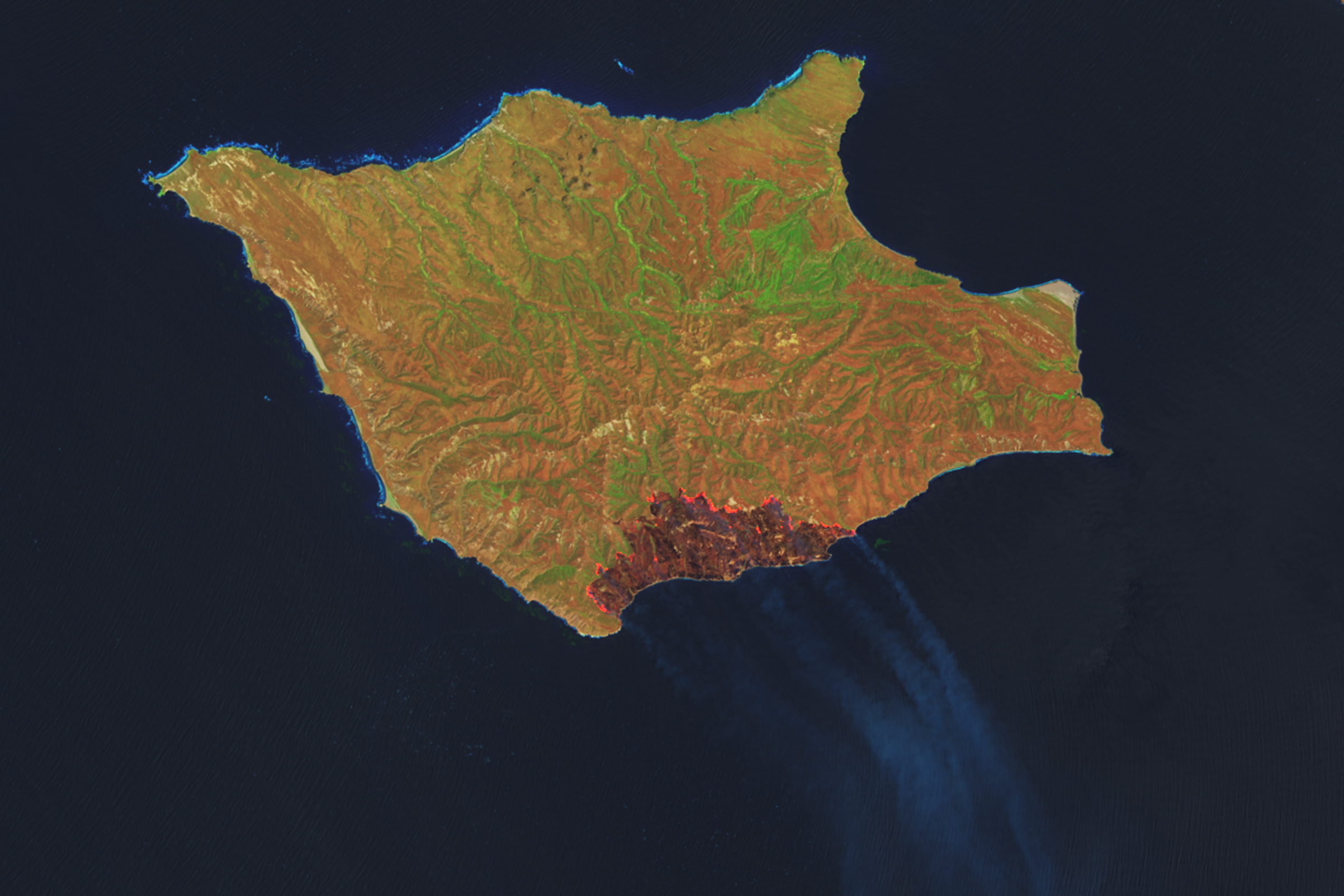
The false‑color Landsat 9 view from May 16, 2026, shows the 5,690‑acre / 2,300-hectares burn scar on Santa Rosa Island as dark brown, with the active fire front glowing orange through the smoke. The image highlights how the blaze spread across grassland, coastal sage scrub and island chaparral (a semi-arid, shrub-dominated plant biome) after being first spotted on May 15. The southeastern quadrant of the island would ultimately see the most extensive burning. (Credit: NASA Earth Observatory / Lauren Dauphin)
Starship V3 Test Launch : Vantor, SpaceX

A Vantor satellite captured a high‑resolution view of SpaceX’s Starship V3 stacked on the launch pad at Starbase in South Texas on May 21, showing the fully integrated vehicle ahead of its first test flight on May 22. (Credit: Vantor)

Starship V3 lifted off from Starbase on May 22, 2026, marking the first flight of the upgraded vehicle, its Raptor 3 engines and the debut of launches from Pad 2. (Credit: SpaceX)

During ascent, Starship lost a Raptor 3 vacuum engine but maintained its planned trajectory and later deployed 20 Starlink simulators and two modified Starlink satellites. (Credit: SpaceX)

Starship gathered heatshield and structural data during re‑entry, executed flap‑controlled guidance and completed a landing flip, landing burn and splashdown in the Indian Ocean. (Credit: SpaceX)

The Super Heavy booster completed ascent and hot‑staging before a partial boostback burn and a hard splashdown that ended in an explosion, in the Gulf of Mexico after attempting its landing burn. (Credit: SpaceX)

SCIENCE
NASA To Test Cryogenic Fuel Storage And Refueling In Space

The LOXSAT payload in the Photon bus at Rocket Lab’s Spacecraft Production Complex in Long Beach, California. (Credit: Rocket Lab)
NASA will launch the Liquid Oxygen Flight Demonstration, or LOXSAT, later this year to test technologies for storing and transferring cryogenic propellants in orbit, a capability the agency says is essential for future lunar and Mars missions. The nine‑month mission will fly to low Earth orbit on a Rocket Lab Electron no earlier than July 17, using a Photon bus to evaluate 11 components of cryogenic fluid management developed with Eta Space, an aerospace company that specializes in cryogenic fluid management (CFM), under NASA’s Tipping Point initiative. The effort is part of a broader portfolio involving Marshall, Glenn and Kennedy centers. LOXSAT will demonstrate technologies to address challenges of using cryogenic propellants in microgravity, such as minimizing boil-off, transferring propellant, maintaining tank pressure, and gauging propellant levels. The data will aid in developing in-space propellant and refueling depots for refueling spacecraft on missions to the Moon, Mars, or beyond.
The work comes as both Artemis Human Landing System providers advance cryogenic lander development. SpaceX just conducted Starship’s twelfth test flight, the first for its Version 3 vehicle, while Blue Origin continues testing its Blue Moon MK1 cargo lander amid New Glenn’s grounding after a second‑stage failure. NASA is targeting late 2027 for Artemis 3, which will require on‑orbit refueling and docking demonstrations.
New Method Finds An Efficient Gravity Based Trajectory Between Earth And Moon That Reduces Fuel Consumption

The plot shows a fuel‑efficient Earth–Moon transfer route computed using the Theory of Functional Connections (TFC). It highlights the TFC transfer orbit, the Lyapunov orbit around the L1 point, and the stable and unstable manifolds—natural gravitational pathways that spacecraft can follow with minimal fuel. The labeled points P2 and P3 mark positions along the Lyapunov orbit near the Moon, commonly used as reference points when analyzing how trajectories enter or exit the L1 region. (Credit: Allan Kardec de Almeida Júnior et al./Astrodynamics)
An international research team supported by the São Paulo Research Foundation (FAPESP) have developed a new mathematical method that identifies more fuel‑efficient transfer routes between celestial orbits, via the L1 Lagrange point (a region between Earth and the Moon where the gravitational pull of the two bodies cancels out.).
The study, appearing in Astrodynamics, uses functional connection theory to lower computational cost, enabling 30 million simulated trajectories of which 280,000 were referenced in the study. Functional connection theory is a mathematical framework that reduces the computational cost of solving complex dynamical problems by expressing system variables through analytical functional relationships rather than numerically integrating every equation.
The study mapped a trajectory from Earth orbit to lunar orbit that reduces fuel requirements by 58.80 meters per second compared with the previously cheapest known route, a meaningful savings against the roughly 3,343 m/s total cost of the trip.
The optimal trajectory sends a spacecraft toward the lunar‑orbit variate but enters it from the Moon‑facing branch rather than the Earth‑proximal side assumed in most models, taking greater advantage of gravity‑driven motion along the Interplanetary Transportation Network. The route also maintains continuous communication with Earth, avoiding outages like those experienced during Artemis II. The authors note that including additional gravitational influences, such as the Sun, could yield even cheaper solutions tied to specific launch dates.
Interstellar Cloud Leaves Detectable Signature In Ancient Antarctic Ice

The Solar System’s route through the Local Interstellar Cloud is shown here, with Antarctic ice preserving a chemical record of the cloud’s structure like an interstellar fingerprint. (Credit: B. Schröder/HZDR/ NASA/Goddard/Adler/U.Chicago/Wesleyan)
A team of researchers has confirmed that iron‑60 found in Antarctic ice originates from the Local Interstellar Cloud, indicating the Solar System has been collecting supernova‑produced material for tens of thousands of years.
Currently our Solar System is moving through the Local Interstellar Cloud, a sparse mix of gas and dust, and Earth picks up traces of iron‑60 (radioactive isotope created inside stars and ejected in ancient stellar explosions) along the way. An international team led by the Helmholtz‑Zentrum Dresden‑Rossendorf has now confirmed this influx by analyzing Antarctic ice tens of thousands of years old. The varying levels of iron‑60 indicate the material has been stored in the cloud since a long‑ago supernova.
The researchers analyzed 40,000 to 80,000‑year‑old ice from the European ice drilling project called EPICA and found deposition levels lower than those in recent snow and marine sediments, suggesting the Solar System previously moved through a region with less iron‑60 or that the cloud itself varies in density.
The study rules out lingering fallout from million‑year‑old supernovae as the source and instead links the isotope to material stored within the cloud. Detection required processing nearly 300 kilograms of ice and isolating only a few atoms using accelerator mass spectrometry, including measurements at the Heavy Ion Accelerator Facility in Australia. The findings provide new constraints on the structure and origin of nearby interstellar clouds and support plans to analyze even older ice predating the Solar System’s entry into the cloud.
Megaconstellations Drive Sharp Rise In High Altitude Pollution From Rocket Activity

A rocket plume, often nicknamed a "jellyfish nebula," created by a SpaceX Falcon 9 rocket launch. (Credit: SpaceX)
18 May, 2026
A new study warns that rapid growth in satellite megaconstellations is driving a sharp rise in high‑altitude pollution from rocket launches and satellite re‑entries, with researchers projecting that by 2030 the space sector will emit more climate‑altering chemicals than the United Kingdom. The analysis, led by University College London atmospheric chemist Eloise Marais, finds that by 2029 launches for constellations such as Starlink, Amazon LEO, Guowang and Qianfan will account for more than 40% of space‑industry pollution.
"Most mega-constellation launches today are burning kerosine fuel, because they usually rely on Falcon 9 rockets, which are producing black carbon. This black carbon is being released into the higher layers of the atmosphere where it stays for 2.5 to 3 years. Because of that, that black carbon has about 540 times bigger climate effect than black carbon that's released from surface sources like ships, cars and power plants."
Most current launches rely on kerosene‑fueled rockets that release black carbon into the upper atmosphere, where it persists for years and has a far stronger warming effect than surface emissions. Re‑entries add aluminum oxides that can deplete ozone. ESA data show operational satellites have tripled since 2020 to more than 15,000, with as many as 100,000 expected by 2030. The study, published May 13 in Earth’s Future, concludes that unregulated growth risks accumulating pollutant levels capable of altering climate and urges expanded research and regulatory action.
Astrolab's FLIP Rover Will Carry Four NASA Payloads On Griffin-1 Lunar South Pole Mission

Astrolab’s FLIP rover stands inside the company’s Hawthorne, California facility. The rover will deliver four NASA payloads to the Moon’s south polar region aboard Astrobotic’s Griffin‑1 lander under NASA’s Commercial Lunar Payload Services program. Launch is targeted for late 2026. (Credit: Astrolab)
18 May, 2026
Commercial planetary rover developer, Astrolab, has finalized an agreement with four NASA Centers to carry four instruments on its FLEX Lunar Innovation Platform or FLIP rover and deliver them to the lunar South Pole. The rover will ride on Astrobotic’s Griffin‑1 lander, launching later this year on SpaceX’s Falcon Heavy.
The company reached non-reimbursable Space Act Agreements with the NASA centers to fly the Moon Exploration for Titanium with Active Lighting METAL helium‑3 prospecting instrument (a camera and radiometer) from Ames in partnership with Interlune, a retroreflector array from Goddard, the Lunar Dust level sensor and Effects on Surfaces, or LDES (to study degradation of spacecraft systems cause by lunar dust) from Johnson, and a lidar demonstration from Marshall. FLIP is entering environmental testing and is expected to be delivered for integration by the end of summer ahead of a Falcon Heavy launch from Kennedy Space Center.
A nonreimbursable Space Act Agreement (SAA) is a type of legal agreement NASA uses to collaborate with companies, universities, or other organizations without exchanging funds.
Meanwhile, Astrolab is also revising its proposal for NASA’s Lunar Terrain Vehicle (LTV) program after the agency requested smaller, CLPS (Commercial Lunar Payload Services)‑compatible rover designs at its March Ignition event. NASA will now handle lunar delivery, imposing tighter mass and volume limits. Updated concepts were submitted May 1, with awards expected May 22. Companies must deliver flight‑ready rovers within 18 months, a schedule Astrolab says it can meet using technologies proven on FLIP.
Permanently Shadowed Lunar Craters May Enable A GPS-Like System For Cis-Lunar Space

A lunar laser stabilized by an ultrastable silicon optical cavity placed inside one of the Moon’s permanently shadowed craters could provide the foundation for a lunar time standard, support Earth‑Moon optical communications, enable satellite‑based distance measurements and imaging, and form part of a space‑based optical atomic clock. (Credit: J. Ye/NIST with lunar background image produced by NASA’s Visualization Studio)
18 May, 2026
An international team of researchers have proposed placing ultrastable lasers inside permanently shadowed craters near the lunar south pole to support future lunar navigation systems and precision measurements. The study, published May 8 in Proceedings of the National Academy of Sciences, argues that the craters’ extreme cold (about 50 kelvins, potentially cooling to 16 K through radiative heat loss), high vacuum and darkness could naturally provide the thermal stability needed for silicon optical cavities, which maintain laser frequencies with high precision. Such lasers could serve as timing references for lunar positioning, navigation and communication networks, and measure distances between lunar objects with sensitivity high enough to detect gravitational waves. It would help reduce reliance on Earth‑based tracking as Artemis activity expands.
Permanently shadowed craters remain around -370 °F / -223 °C, conditions that typically require complex cryogenic systems on Earth. The researchers suggest that a stabilized laser signal could function as a GPS‑like beacon for spacecraft landings in poorly illuminated regions and link with satellite atomic clocks to form part of an extraterrestrial optical clock. The proposed system would be assembled on Earth, lowered into a crater by rover and powered by a nearby commercial laser. Researchers estimate demonstrations in low Earth orbit within two years and lunar deployment within three to five years.
The team included researchers from U.S. National Institute of Standards and Technology, JILA (a joint institute of NIST and the University of Colorado Boulder), NASA’s Jet Propulsion Laboratory, Germany’s Physikalisch-Technische Bundesanstalt (PTB) and Lunetronic Inc., a space technology company. NASA and other agencies have explored multiple lunar GPS concepts, including satellites, radio beacons and atomic clocks, as operations move toward the south polar region.
A Novel Solution To The Traveling Salesperson Problem In Deep-Space

The top‑down solar‑system diagram shows the full Lucy mission in a Jupiter‑rotating reference frame, where Jupiter remains fixed and two clusters of Jupiter Trojan asteroids appear along its orbit, with Earth in green, Lucy in blue, Jupiter in orange, and the mission’s fly‑by targets in white. (Credit: NASA's Scientific Visualization Studio)
19 May, 2026
A team of researchers from Polytechnique Montréal and Universität Bielefeld has developed a new optimization method for planning spacecraft visits to multiple moving targets, reframing the classic Traveling Salesperson problem as the Asteroid Routing Problem. The approach calculates the best sequence for visiting several asteroids while minimizing both fuel use and travel time, a task complicated by constantly shifting orbital positions. The method integrates solutions to Lambert’s problem (the task of finding the orbital path and travel time needed for a spacecraft to move between two points in space at two specified times) for determining transfer trajectories and uses Decision Diagrams to reduce the number of required computations.
Decision diagrams are a compact way to represent all possible choices in a complex decision process by merging identical sub‑problems into single nodes, which reduces computation and makes large optimization problems more tractable.
The researchers report performance gains of about 20% compared to standard techniques, with larger improvements for more complex cases. While current missions such as NASA’s Dawn and Lucy have limited opportunities for multi‑asteroid routing, the team notes that even small efficiency gains could translate into meaningful savings. The work, published in the INFORMS Journal on Computing, may also have applications in terrestrial logistics involving dynamic conditions.

GOVERNANCE
NASA Admin Expects A Chinese Circumlunar Flight In 2027

China’s Lanyue crewed lunar lander during a trial in 2025 at a test site in Huailai County, north China's Hebei Province. (Credit: Zhang Bin/Xinhua)
20 May, 2026
NASA Administrator Jared Isaacman said that he expects China to conduct a crewed circumlunar mission in 2027, warning that the next astronauts to fly around the moon will “likely be taikonauts.” Speaking May 19 at the ASCEND conference, Isaacman linked the prediction to what he has described as a tightening race between the United States and China to return humans to the lunar surface. China has not announced such a mission, though officials have signaled plans for a crewed landing before 2030.
Isaacman has used China’s pace to justify recent changes to NASA’s Artemis program, including shifting Artemis 3 from a 2028 lunar landing to a low Earth orbit test flight in 2027 and moving the first landing attempt to Artemis 4 in 2028. He also canceled the Gateway outpost in favor of a lunar base and called for more frequent robotic lander missions. At an April 27 House appropriations hearing, Isaacman said China had been ahead before the revisions, a view that has resonated with lawmakers who subsequently advanced a fiscal 2027 spending bill increasing exploration funding.
NASA To Open JPL Operations Contract To Competition Amid Major Agency-Wide Reorganization

JPL is a research and development lab federally funded by NASA and managed by Caltech. (Credit: NASA/JPL-Caltech)
22 May, 2026
In a major administrative change, NASA will open the Jet Propulsion Laboratory’s operations contract to competition after Caltech’s long‑standing management agreement ends on Sept. 30, 2028. Caltech, which founded JPL in 1936 and has managed it for NASA since 1958 (when NASA was founded), said it had anticipated the decision and will respond to the forthcoming request for proposals. NASA’s move follows market research and an Industry Engagement Day in July 2025 to assess interest from potential bidders and ensure broad competition.
Caltech leadership emphasized recent restructuring, cost‑reduction measures, and new contracting mechanisms intended to strengthen JPL’s position as NASA’s primary center for robotic exploration. The institute highlighted JPL’s legacy achievements, including Mars rover missions, the first U.S. lunar soft landing, and Voyager’s entry into interstellar space, and noted upcoming missions such as FALCON, EAGLE, SkyFall, MoonFall and GRACE‑C planned for 2028.
NASA emphasized that JPL’s status as an Federally Funded Research and Development Center (FFRDC) will remain, but competition could reshape long‑standing operational and personnel ties between the lab and Caltech.
This change is part of a broader agency restructuring and the contract decision accompanied a major internal reorganization which is expected to streamline mission directorates, reduce bureaucracy and consolidate functions. NASA will merge the Exploration Systems Development and Space Operations directorates into a new Human Spaceflight Mission Directorate, and combine Aeronautics Research with Space Technology into the Research and Technology Mission Directorate. Leadership changes include John Bailey as associate administrator for Mission Support, Jamie Dunn as director of Goddard Space Flight Center, and Lori Glaze as associate administrator for the new human spaceflight directorate. Former JPL chief engineer Adam Steltzner will serve as NASA’s chief engineer for special projects.

MILITARY
European EO Firms Meet Imagery Demand As US Providers Restrict Iran And Strait Of Hormuz Coverage

This image, captured by a Hyperfield-1A, shows the nearby Strait of Khuran, just north of the main Strait of Hormuz, a narrow stretch of water connecting the Persian Gulf to the open ocean and normally carrying around 20% of the world’s oil trade. (Credit: Kuva Space)
18 May, 2026
European Earth‑observation companies are absorbing demand for imagery of Iran and the Strait of Hormuz after major U.S. providers restricted access to the region. Planet Labs on April4 said it would indefinitely withhold imagery of Iran and the wider conflict zone at the request of the Trump administration, following similar limits imposed by Vantor and Satellogic. The shift prompted energy traders, insurers, shipping firms and global news organizations to seek alternative sources as they tracked tanker movements, AIS‑dark vessels and infrastructure damage after Iran blocked the strait on February28.
At last week’s ESA EO Commercialization Forum, European firms said Copernicus, Airbus and Italy’s e‑GEOS have taken on redirected demand, while smaller operators such as Finland’s Kuva Space reported increased requests from U.S. media. Kuva data showed up to 97% of vessels transiting the strait had disabled AIS by March29. The episode also renewed calls for European strategic autonomy, with executives arguing the withdrawal of U.S. imagery reinforced the need for independent, unrestricted monitoring capabilities.
Space Force Plans 2027 GEO Mission To Test Refueling And Servicing Vehicles

An illustration of an Orbit Fab shuttle refueling Astroscale’s servicing spacecraft. (Credit: Orbit Fab)
20 May, 2026
The U.S. Space Force will launch multiple spacecraft to geostationary orbit in 2027 under the USSF‑23 mission to demonstrate in‑space refueling and satellite maneuvering capabilities. The mission includes Astroscale’s Provisioner servicer, Orbit Fab’s propellant depot on an Impulse Space platform, and Starfish Space’s Otter vehicle. Provisioner, developed under a $25.5million Space Force agreement with additional Astroscale funding, will attempt to refuel two AFRL Tetra‑5 satellites before replenishing its own hydrazine supply from Orbit Fab’s $13.3million depot.
Otter will conduct a two‑year “augmented maneuver” demonstration by docking with and relocating an unprepared, non‑operational satellite under a $37.5million cost‑share contract. Starfish also holds a separate $54.5million APFIT award for an operational mission launching in 2028. The Space Force plans to access Northrop Grumman and DARPA’s Mission Robotic Vehicle after its launch this summer and is expanding industry participation through a new $20million SpaceWERX In‑Domain Orbital Logistics Challenge.
Space Force Awards Rocket Lab And Viasat SES Major GEO Satellite Contracts

Rocket Lab’s two satellites will be built on their Lightning bus, adapted for the thermal, radiation, propulsion, and station-keeping conditions of GEO. (Credit: Rocket Lab)
22 May, 2026
Rocket Lab secured a $90million U.S. Space Force contract May21 to design, build and operate two geostationary satellites carrying Heimdall space‑domain‑awareness sensors. The award is Rocket Lab’s first GEO satellite production program and includes launch integration and up to five years of operations. The spacecraft will use the company’s Lightning bus and host electro‑optical payloads previously procured under an $80.7million contract with Geost, now part of Rocket Lab Optical Systems. The program shifts the Heimdall effort from prototyping to operational delivery as the Space Force expands distributed GEO surveillance capabilities.
Separately, the Space Force awarded Viasat and Intelsat General, the U.S. division of Luxembourg’s SES contracts totaling $437.6million for the Protected Tactical Satcom‑Global (PTS-G) program, which will field a jam‑resilient GEO communications network using smaller, commercially derived satellites. Budget documents indicate the first “Swarm1” batch will include four spacecraft, two each from Viasat and SES, for delivery by March 2029. The satellites will provide X‑band and military Ka‑band services. Viasat and SES were selected from a five‑company pool that also included Astranis, Boeing and Northrop Grumman. A second four‑satellite procurement is planned for 2028, with deployment targeted for 2031.

COMMERCIAL
Funding Rounds Advance Zenk Space’s Debut Zhihang‑1 Launch And Tomorrow.io DeepSky Expansion
14 May, 2026
Zenk Space, the Chinese commercial liquid-propellant launch vehicle developer, raised 180million yuan / $26million to support the June debut of its Zhihang‑1 rocket, according to Wenzhou municipal reports on May14. The round was led by Wenzhou Bay New Area Investment Group with participation from additional state‑owned investors and Yarong Ventures. The 49.8‑meter‑tall kerolox launcher, capable of placing 4,000kilograms into 500‑kilometer Sun-synchronous orbit (SSO), uses state-owned CASC’s Academy of Aerospace Liquid Propulsion Technology-built YF‑102 engines and R‑Space propellant tanks.
The first vehicle was transported to a rehearsal site May16 following a successful February static‑fire on the HOS‑1 sea platform. Zenk Space plans partial engine recovery as part of a broader reusable‑launcher roadmap and continues expanding manufacturing operations in Anhui amid growing provincial efforts to build local space clusters.
18 May, 2026
Tomorrow.io, the Boston-based weather tech company, raised an additional $35million on May18, bringing its SeriesF round to $210million to accelerate development of its next‑generation DeepSky weather‑sensing constellation. The new funding, from Pitango and Harel Insurance, follows the completion of the company’s 11‑satellite Gen1 network, which achieved a 60‑minute global revisit rate after launching on Falcon9 missions.
DeepSky satellites will be larger and carry multiple co‑located sensors, building on systems validated during last year’s Haven Demo mission. Tomorrow.io said the capital will also advance its AI efforts, including an agentic platform designed to convert atmospheric data into real‑time operational guidance for sectors increasingly affected by weather‑driven disruption.
Vast Expands Into Satellite Manufacturing With New High Power Spacecraft Line Following Haven Demo Success

An illustration of the 15 kW-class satellite bus of the Vast Satellite product line. (Credit: Vast)
19 May, 2026
Vast is expanding its business beyond commercial space stations and on May19, announced a new line of high‑power satellite buses built for communications, Earth observation, national security and future orbital data center constellations. The spacecraft leverage propulsion, power and avionics systems proven on last year’s Haven Demo mission, which launched in November, completed all on‑orbit tests and performed a controlled deorbit in February.
The first offering, a 15‑kilowatt‑class bus weighing 700 kilograms unfueled and supporting 350 kilograms of payload, is designed for five‑year operations in low Earth orbit, with a 10‑satellite inaugural batch planned for late 2027. Vast continues parallel development of its Haven station program, targeting a 2027 launch of the Haven‑1 pathfinder and a 2028 debut for the first Haven‑2 module, followed by additional modules every six months through the early 2030s. The company aims to have Haven‑2 operational before the International Space Station’s planned retirement.
A Look At SpaceX's Financials: IPO Documents Show Starlink Driving Revenue And Rising AI And Launch Investments

Credit: SpaceX
20 May, 2026
The space industry and the public got their first detailed look at SpaceX’s finances on May 20, when the company released initial filings for its planned IPO. SpaceX submitted its S‑1 registration to the Securities and Exchange Commission outlining its business and financials for prospective investors.
SpaceX moved toward a mid‑June public listing, seeking to raise up to $80billion at a valuation of about $2trillion. The filing provides the company’s first detailed financial disclosure, reporting 2025 revenue of $18.7billion and adjusted EBITDA (a measure of a company’s operating profit before interest, taxes, depreciation, and amortization) of $6.6billion, with first‑quarter 2026 revenue of $4.7billion and adjusted EBITDA of $1.1billion.
The connectivity segment, driven by 10.3million Starlink subscribers, generated $11.4billion in 2025 revenue, while the space segment recorded $4.1billion and continued heavy Starship investment, including $3billion in 2025 and $930million in early 2026. The AI segment, formed after acquiring xAI in February, produced $3.2billion in 2025 revenue but posted significant losses amid $12.7billion in R&D spending. SpaceX cites a $28.5trillion total addressable market and outlines plans for orbital data centers launching as early as 2028, alongside long‑term ambitions spanning lunar, Martian, and in‑orbit industries.
In short SpaceX’s filings show a fast‑growing company that now earns most of its money from Starlink while continuing to pour billions into Starship and its new AI division.
Meanwhile, SpaceX is using its IPO filing to position Starlink Mobile as a full‑scale competitor to terrestrial networks, outlining plans for next‑generation satellites and newly acquired EchoStar spectrum that would expand today’s text‑and‑voice service into broadband, IoT connectivity, and 5G‑like performance. The filing contrasts with more cautious assessments from partners such as T‑Mobile, whose CEO said satellite traffic represented just 0.0002% of network usage in May and is mainly bundled into premium plans.
SpaceX reported $632million in 2025 revenue from its mobile connectivity business, part of $11.4billion generated by its broader connectivity segment, and said roughly 7.4million devices used V1 Mobile satellites as of March 31. The company plans to begin deploying larger V2 Mobile satellites on Starship in 2027 and estimates a $740billion total addressable market for Starlink Mobile. Expansion depends on securing spectrum partnerships, regulatory approvals, and future handset modifications, while SpaceX also highlighted a far larger $26.5trillion AI opportunity tied to orbital data centers reliant on Starship.
Separately, SpaceX also conducted the first flight of its upgraded Starship V3 on May22, completing most planned objectives during the suborbital test from Starbase, Texas. The vehicle lifted off at 6:30p.m. Eastern after a scrub the previous day and experienced several engine shutdowns, including a failed Super Heavy boostback burn that led to a hard splashdown in the Gulf of Mexico. The FAA said it is assessing the booster anomaly and activated a debris response area. Starship’s upper stage continued its ascent despite one engine failing, deployed 20 Starlink mass simulators and two “Dodger Dogs” test spacecraft, and completed reentry before a planned soft splashdown in the Indian Ocean. The flight marked the debut of a redesigned Starship and Super Heavy intended for future orbital missions, including Artemis lander operations.
The launch followed a worker’s death on May15 at Starbase, now under OSHA investigation, and comes amid ongoing scrutiny of the site’s elevated injury rates and separate lawsuits related to workplace safety and launch impacts.
US Space Industry Supply Chains Exhibit Major Dependencies On China And Taiwan

The Altana report found more than 849,000 commercial space imports since 2022 contained components sourced from Chinese suppliers at Tier3 or deeper, with another 15,000 tied to Russian-origin parts. (Credit: Altana)
20 May, 2026
U.S.-based an AI-powered supply chain management intelligence provider, Altana released an analysis detailing significant dependence further up the supply chain to Chinese, Russian and Taiwanese suppliers across the U.S. commercial space industrial base, addressing the growing concerns over supply‑chain resilience as the Pentagon increases reliance on commercial providers. The report found more than 849,000 commercial space imports since 2022 contained components sourced from Chinese suppliers at Tier3 or deeper, with another 15,000 tied to Russian-origin parts. Tier3 refers to suppliers that sit three steps upstream from the final manufacturer. Tier1 is a direct supplier to the space company, Tier 2 supplies to the Tier 1 supplier (e.g., provides subcomponents), and Tier 3 supplies to Tier 2 (e.g., provides raw materials, specialty parts, or manufacturing processes).
Altana said 26.8% of semiconductor‑related imports showed direct or near‑upstream exposure to Taiwanese manufacturers, including radiation‑hardened chips used in spacecraft control, communications and scientific instruments. Vulnerabilities were concentrated in specialized components such as rad‑hard electronics, space‑grade rubber seals and coatings, and aluminum and steel structural hardware, all of which face long qualification cycles and limited alternative suppliers.
The report warned that tariffs, adversarial exposure and geopolitical risks could compound compliance and cost pressures for contractors. Defense agencies are increasingly using multi‑tier supply‑chain mapping tools to identify hidden dependencies and model disruptions, including scenarios involving a Chinese invasion of Taiwan. Altana’s analysis is based on data from 299 U.S. commercial space contractors and suppliers.
Starfighters Expands Microgravity Partnership And Secures New Investment
20 - 22 May, 2026
Supersonic flight services provider, Starfighters Space expanded its microgravity and air‑launch activities on May20, announcing an agreement to base Mu‑G Technologies’ modified Falcon50 aircraft at its Midland, Texas, facility as the companies jointly respond to NASA’s request for information on commercial parabolic flight services. The partnership, first formed in March, aims to offer microgravity missions using either dedicated aircraft or Mu‑G systems integrated with Starfighters’ F‑104 fleet. Starfighters said its support includes ground maintenance, chase‑plane and data services, pilot integration, and regulatory alignment as Mu‑G works toward FAA certification. The company is also awaiting approval for its own debut suborbital mission, a precursor to its F‑104‑based Starlaunch system.
Separately, Starfighters announced a $17.5million strategic equity investment led by institutional investors to advance Starlaunch development, expand infrastructure, and support mission readiness. The company reported no revenue for the first quarter, with $4.1million in operating expenses, a $4.3million net loss, and $1.4million in cash as of March31, noting continued operations depend on securing additional financing.

RESEARCH SPOTLIGHT
Data Review Reduces Certainty Of Europa’s Water Vapor Plumes

A new SwRI analysis of Hubble data has lowered confidence in earlier claims that Jupiter’s moon Europa emits water‑vapor plumes, first reported from 2012 observations. The reexamined dataset reduces the strength of the original evidence, though researchers note that plume activity remains possible and may still be detected in future observations. (Credit: NASA)
Southwest Research Institute (SwRI) scientists have reanalyzed 14 years of Hubble Space Telescope observations of Europa, reducing earlier confidence that the Jovian moon emits intermittent water‑vapor plumes. The new study revisits HST/STIS (Hubble Space Telescope’s Space Telescope Imaging Spectrograph) ultraviolet data focused on Lyman‑alpha emissions, finding that uncertainties in Europa’s image placement likely produced signals previously interpreted as plume activity. Lyman-alpha is a specific wavelength of ultraviolet light emitted and scattered by hydrogen atoms.
The team’s original 2014 analysis reported 99.9% confidence in plume detection; the updated assessment lowers that to below 90%, no longer meeting the threshold for a firm claim. Researchers emphasize that the data do not rule out plumes but instead provide improved constraints on the moon’s escaping neutral hydrogen atmosphere. Europa remains a target of interest due to evidence of a subsurface ocean and potential pathways for water to reach the surface. NASA’s Europa Clipper, arriving in 2030, is expected to investigate plume activity and the moon’s habitability potential. The findings of the research were published in the journal Astronomy & Astrophysics.
Clues Left In Medieval Japanese Poetry And Buried Trees Reveal A 1200CE Solar Event
Researchers at the Okinawa Institute of Science and Technology have identified a previously unknown solar proton event dating to 1200–1201 CE, using a combined analysis of medieval records and ultra‑precise carbon‑14 measurements from buried asunaro trees in northern Japan. The study, published in Proceedings of the Japan Academy, Series B, shows that earlier reports of “red lights” over Kyoto and low‑latitude auroras in China coincided with a period of unusually short, 7–8‑year solar cycles and elevated solar activity.

An Edo‑period portrait of Fujiwara no Teika appears at left, while the right image shows an Edo‑era hand‑copied page from his diary Meigetsuki, which includes a note about “red lights in the northern sky.” (Credit: (Left) Kikuchi Yosai. (Right) National Archives of Japan)
Most high-energy particles from solar proton events are blocked by Earth’s magnetic field, but some can slip in near the poles or during stronger bursts and react with the atmospheric gases to create carbon‑14. That carbon‑14 spreads worldwide and gets locked into trees and other organic material, letting scientists track past solar activity. By measuring the carbon-14 content in preserved organic material, such as buried trees, researchers can identify fluctuations in solar activity over the last 10,000 years. Ultra‑precise measurements can now reveal much smaller spikes, though the technique is slow, so researchers rely on historical accounts. In this case, the influential Japanese courtier and poet, Fujiwara no Teika (1162–1241) reported in 1204 of red northern skies in Kyoto.

The asunaro cypress tree samples, found at Shimokita Peninsula in northern Aomori Prefecture. The sample was provided by Tohoku University. (Credit: Hiroko Miyahara/OIST)
The carbon‑14 spikes indicate a sub‑extreme SPE, smaller than the rare, most powerful events but still hazardous to astronauts and spacecraft. The findings refine the long‑term record of solar behavior and demonstrate that historical literature, dendroclimatology (i.e., the science of reconstructing past climates and atmospheric conditions by analyzing annual tree growth rings) and high‑precision radiocarbon analysis can be combined to reconstruct past space‑weather conditions.
Despatch Out. 👽🛸
