

{{First_Name|Explorer}}, welcome back!🚀
The week was heavy on news from defense space. New images from the Artemis II lunar flyby, with some science and commerce updates.
Having trouble with links? Click the link below to read the unclipped publication. ↓
Hope you enjoy this Space!

IMAGES
Earthset And Lunar Flyby : Artemis II, NASA

Earthset is seen through an Orion spacecraft window at 6:41 p.m. EDT on April 6, 2026, during the Artemis II crew’s lunar flyby. A muted blue Earth with bright clouds descends behind the cratered Moon, with night covering the planet’s dark side and daytime clouds visible over Australia and Oceania. In the foreground, Ohm crater shows terraced walls and a flat floor marked by central peaks formed by the rebound of the lunar surface after impact. (Credit: NASA)

NASA’s Orion spacecraft captures the Moon and a crescent Earth in one frame at 6:42 p.m. ET on flight day six of Artemis II. Sunlight illuminates Orion’s right side as a waxing crescent Moon rises behind it and a smaller crescent Earth nears the lunar horizon. (Credit: NASA)

The Artemis II crew captures a faint view of a crescent Earth above the horizon on the Moon’s far side. (Credit: NASA)

About six minutes before Earthset, the Artemis II crew captured this crescent Earth slipping behind the Moon, with daylight clouds visible over Australia and Oceania. Lines of small pits on the lunar surface mark secondary crater chains created by debris from a major impact. (Credit: NASA)

This Earthset was captured at 6:41 p.m. EDT on April 6, 2026, as the crew passed behind the Moon’s far side during a seven‑hour flyby. The photo shows a crescent Earth descending behind the lunar horizon, with clouds and blue water visible over Oceania and nighttime covering the planet’s dark side. The frame also highlights overlapping craters and basins on the Moon’s surface, documented alongside additional flyby imagery. (Credit: NASA)
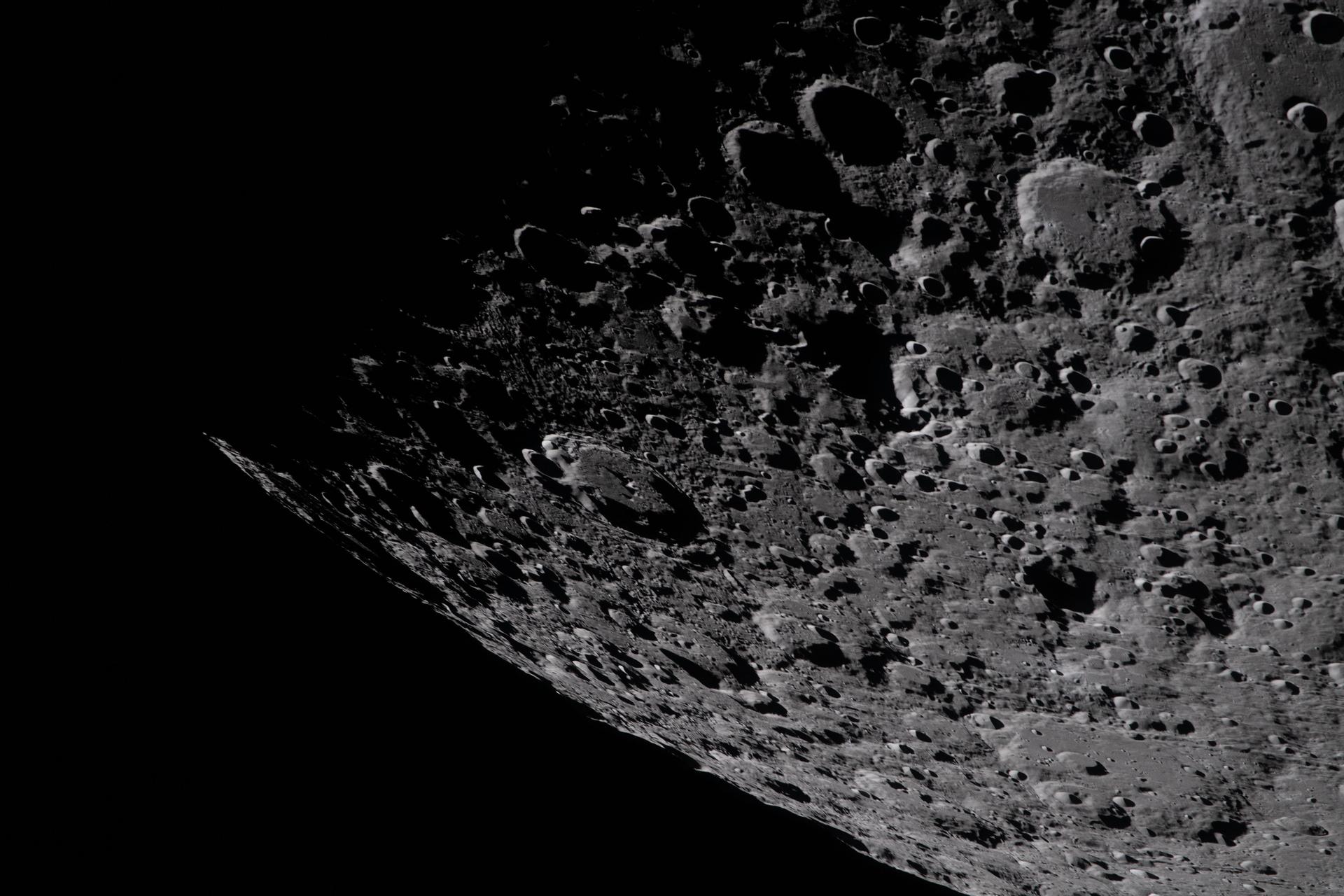
Captured by the Artemis II crew, the heavily cratered terrain of the eastern edge of the South Pole-Aitken basin is seen with the shadowed terminator – the boundary between lunar day and night – at the top of the image. The South Pole-Aitken basin is the largest and oldest basin on the Moon, providing a glimpse into an ancient geologic history built up over billions of years. (Credit: NASA)
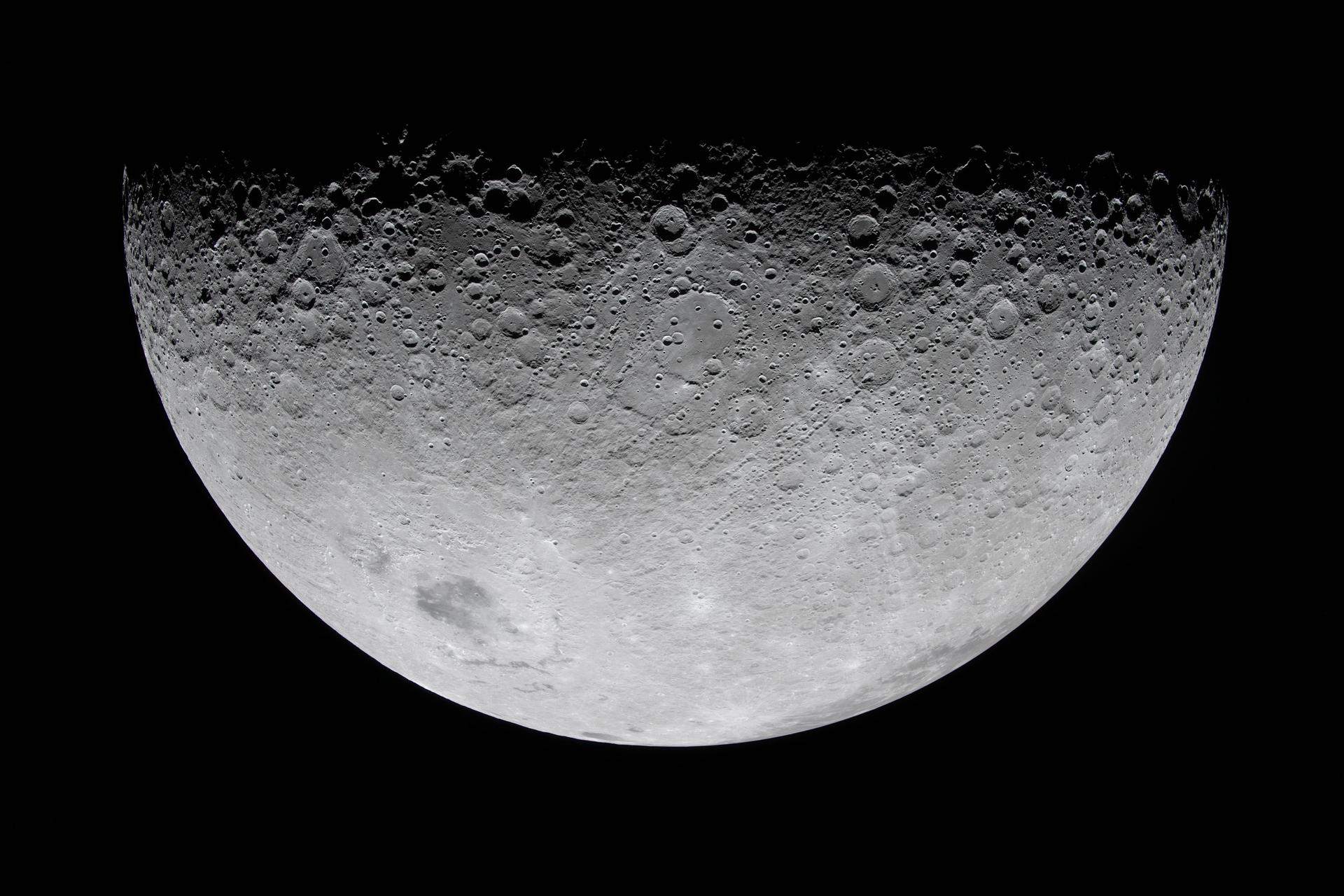
As the Artemis II crew flew over the terminator, the astronauts described this boundary between day and night as "anything but a straight line." Crater rims along the terminator stand out as "islands" in the night. Giant chains of craters emanating from the 3.7-billion-year-old Orientale basin can be seen scouring the surface, stretching almost to the terminator. This tells a geologic story: these crater chains produced by the Orientale impact event mar the surface of the relatively flat Hertzsprung Basin (center of this image), which means that Hertzsprung Basin must be even older than Orientale! (Credit: NASA)
The Moon Eclipses The Sun : Artemis II, NASA

Captured during the Artemis II lunar flyby on April 6, 2026, this image shows the Moon fully eclipsing the Sun, creating nearly 54 minutes of totality. A glowing halo surrounds the dark lunar disk, an effect under study as possible corona or zodiacal light. Stars appear in the darkened field, and faint Earthshine reveals the Moon’s nearside. (Credit: NASA)
Lava flow on Réunion Island : Copernicus Sentinel-2

The Copernicus Sentinel‑2 mission captured new imagery of an active lava flow on Piton de la Fournaise, one of the world’s most active volcanoes, located on France’s Réunion Island in the Indian Ocean. The centre of the island shelters three vast cirques, or calderas, created by huge collapses. Together they form the dormant shield volcano, and highest peak of the island, Piton des Neiges (3069 m), which peeps out in brown from beneath the clouds near the centre of the image. (Credit: ESA)

Located in the western Indian Ocean, the island of Réunion is a French overseas department about 680 km east of Madagascar. Réunion's volcanic origins make its landscape particularly rugged in places, and covered by lush vegetation in others. Cultivated land and cities, visible as grey-white clusters, are concentrated on the coastal lowlands. The capital and largest city is Saint-Denis, on the northern coast, mostly covered by clouds in the image. (Credit: ESA)

The image shows a bright, linear lava channel cutting across the volcano’s southeastern flank, with surrounding dark basaltic terrain and lighter ash deposits visible in the wider scene. Sentinel‑2’s multispectral instruments highlight thermal anomalies associated with the ongoing eruption, which began earlier in 2026 and continues to produce surface flows.
Although Réunion hosts multiple volcanoes, only one is currently active: the Piton de la Fournaise shield volcano, one of the most active on Earth, which dominates the southeastern part of the island. This image, from 21 March 2026, shows a lava flow on its western flank, following an eruption that began in mid-February. Although the image has been processed in natural colour, the Sentinel-2’s shortwave infrared channels were also used to highlight the fiery lava pouring from the crater, seen here in yellow and red. (Credit: ESA)

SCIENCE
Worms Fly To ISS For Study On Cellular Responses In Long‑Duration Spaceflight

Microscopic image of the common roundworm Caenorhabditis elegans. (Image credit: UK Space Agency)
7 - 10 April, 2026
British scientists have launched a new biological research payload to the International Space Station, sending dozens of Caenorhabditis elegans worms to study how long‑duration spaceflight affects living organisms. The experiment, led by the University of Exeter and engineered at the University of Leicester with UK Space Agency funding, flew aboard a Cygnus XL cargo vehicle launched by a SpaceX Falcon 9 on April 10–11.

Petripod used in the Fluorescent Deep Space Petri-Pods project. (Credit: UK Space Agency)
The project demonstrates that complex biological studies can be conducted in orbit at small scale and lower cost. Developed from an earlier UK Space Agency concept, the Fluorescent Deep Space Petri-Pods project (FDSPP) hardware was built by the University of Leicester with mission management by Voyager Space Technologies. The Petri Pod is a self‑contained 10×10×30 cm, 3 kg unit with 12 chambers, four of which support fluorescent and white‑light imaging. Each chamber provides miniaturized life‑support functions, maintaining temperature, pressure and a sealed air volume, while organisms receive nutrients through an agar medium.
The worms will first acclimate inside the station before being mounted on the outside of the ISS by a robotic arm, for up to 15 weeks. Researchers would be able to conduct tests on these worms, controlling the equipment remotely from Earth. Automated cameras will track fluorescent cellular responses to microgravity and radiation. Researchers say the data will inform strategies to protect astronaut health on future lunar missions, aligning with NASA’s Artemis program and long‑term plans for sustained operations on the Moon. Space conditions such as microgravity and radiation can alter cells and genes in harmful ways, but the mechanisms and extent of these effects remain an active area of research.
NASA Night‑Light Analysis Reveals Rising Brightness And Widespread Flickering Patterns

This visualization maps how global nighttime lighting shifted from 2014 to 2022. Each period shows the degree of change, with satellite data revealing brightening in gold, dimming in purple, and mixed signals in white. The product is derived from daily VIIRS observations processed by NASA’s Scientific Visualization Studio. (Credit: Kel Elkins/NASA's Scientific Visualization Studio)
9 April, 2026
Night‑light data from NASA and NOAA satellites shows intensified global brightening and dimming between 2014 and 2022. Earth’s night sky brightness increased 16%, according to the new satellite‑based analysis that attributes the rise to expanding electrification, urban growth, and intensified artificial lighting. The study, led by an international team of researchers using daily night‑time imagery, found that global illumination is not steadily rising but “flickering”, with both brightening and dimming occurring across regions.
Countries, including India, China, and parts of Africa, drove most of the radiance gains, while significant declines were recorded in areas affected by conflict, disasters, or energy‑saving policies. Ukraine saw sharp drops in night‑time light following the 2022 Russian invasion, and France recorded a 33% dimming linked to conservation measures. The study reports strong U.S. signals, including recurring gas‑flaring cycles over the Permian Basin and Bakken Formation during a period of record oil and gas output. Researchers identified 6.6 distinct lighting shifts per location over nine years, with brightening contributing a 34% radiance increase relative to 2014 and dimming offsetting 18%.
Researchers analyzed 1.16 million nightly images from NASA’s Black Marble data, which applies algorithms to the Visible Infrared Imaging Radiometer Suite (VIIRS) measurements from the Suomi NPP and NOAA‑20 satellites. The system removes interference from moonlight, auroras, clouds, vegetation and viewing‑angle changes. The brightening, however, may be understated because VIIRS is less sensitive to the blue‑rich light produced by common LED fixtures.
Climcam Payload Reaches ISS As Egypt, Kenya And Uganda Expand Space Collaborate On Climate Monitoring
11 April, 2026
Kenya, Egypt and Uganda have jointly launched the ClimCam climate‑monitoring payload to the International Space Station. The instrument flew aboard a SpaceX Falcon 9 as part of Northrop Grumman’s Cygnus NG‑24 commercial resupply mission, lifting off April 11 from Cape Canaveral and scheduled to dock April 13. ClimCam, selected through the United Nations Office for Outer Space Affairs’ Access to Space for All initiative in partnership with Airbus, will be installed on the Bartolomeo platform attached to the ISS Columbus module.
Developed by the Kenya Space Agency, the Egyptian Space Agency and the Uganda National Space Programme, the payload underwent assembly, integration and testing in Cairo, followed by end‑to‑end validation at Airbus facilities in Houston . Equipped with AI‑enabled imaging, ClimCam is designed to deliver near‑real‑time weather and climate data to support disaster management, natural‑resource monitoring and climate‑resilience efforts across Eastern Africa

GOVERNANCE
DRC Explores China Partnership For National Satellite Development Plan
8 April, 2026
The Democratic Republic of the Congo is advancing plans for a national telecommunications satellite, signing a new memorandum of understanding with Unicom Airnet, a subsidiary of state‑owned China Unicom, to explore a potential partnership for spacecraft development and deployment. The April 7 agreement follows earlier efforts with the Monaco-based satellite operator, MonacoSat, which has been working with Kinshasa since 2024 on a separate $400 million satellite initiative backed by secured bank financing.
Congolese officials have not clarified whether the Chinese engagement will replace or complement the MonacoSat track, which has included consultations with Thales Alenia Space and high‑level meetings with President Félix Tshisekedi in 2025. Both efforts are tied to the government’s goal of expanding national connectivity, with roughly 40 million people lacking mobile internet access in 2023.
The satellite program is part of a digital‑sovereignty strategy, with the government targeting $1.5 billion in sector investment by 2030.
Planet Labs Restricting Iran Imagery Under US Pressure Sets A Worrying Precedent

A satellite image shows damage at Mehrabad International Airport in Tehran following recent attacks by US and Israel, with aircraft and runways visible. (Credit: Planet Labs)
9 April, 2026
Planet Labs’ decision to extend its suspension of satellite imagery over Iran and parts of the Middle East has intensified concerns among analysts that U.S. government pressure on commercial providers could reshape norms governing access to Earth‑observation data. The company said it would indefinitely delay distribution of imagery dating back to March 9 after receiving a request from U.S. officials seeking to prevent adversaries from using commercial data to target U.S. or allied forces. The restriction expands on a 14‑day delay introduced in early March following U.S. and Israeli attack on Iran and subsequent Iranian retaliation on Israel and U.S. bases in the Gulf.
Planet, which operates one of the world’s largest commercial imaging constellations, said it will shift to “managed distribution,” releasing data only for urgent mission needs or public‑interest cases. Other firms, including Vantor (formerly Maxar), told Reuters they were not contacted by the U.S. government but have independently tightened access controls in parts of the region.
Space‑security analysts have warned that Planet’s compliance could set a precedent for broader government‑directed restrictions, potentially eroding long‑standing assumptions that commercial satellite imagery remains openly accessible unless classified. The U.S. has historically relied on the transparency provided by commercial imaging to counter disinformation and monitor global security events. A shift toward selective withholding, they argued, could encourage other governments to pressure domestic providers or impose their own blackout zones.
The episode also highlights the growing strategic relevance of commercial Earth‑observation systems, which now routinely provide data at resolutions once limited to national intelligence agencies. As conflicts increasingly rely on real‑time geospatial information, analysts said the boundary between commercial and national‑security imagery policy is becoming more contested, with Planet’s decision viewed as an early test of how that boundary may shift.
US Commerce Budget Raises New Doubts About TraCSS Civil Space Traffic System

10 April, 2026
The U.S. Commerce Department’s fiscal year 2027 budget proposal has renewed uncertainty about the future of TraCSS, the civil space‑traffic coordination system under development at the Office of Space Commerce. The April 3 summary allocates $11 million to the office, similar to the $10 million requested in the 2026 proposal, but again provides no dedicated funding for TraCSS, which accounted for most of the office’s $65 million budget in 2024. The office was moved from NOAA to report directly to the secretary of commerce after an August 2025 executive order, but the department has not released a detailed justification for the new request and declined to answer questions about the program.
Work on TraCSS continues, including a February announcement of a waitlist for satellite operators, though no schedule for full operations has been provided. A December policy update removed language requiring free access to basic safety data, allowing, but not directing, the department to consider user fees.

MILITARY
Spain's FOSSA Systems Enters Japan’s Defense Market; Will Build Larger Satellites For Security Customers

FOSSA's 3U satellites. (Credit: FOSSA Systems)
6 April, 2026
FOSSA Systems is expanding into Japan’s defense market after signing a distribution agreement with Kanematsu, the Japanese trading firm, and opening a Tokyo office, its first outside Europe. The six‑year‑old Spanish startup, originally focused on sub‑1‑kilogram picosatellites for LoRa‑based IoT links, has shifted to larger platforms as government demand grows. FOSSA has deployed 13 picosats and now operates seven 3U cubesats with five‑year design lives, some carrying dedicated signals‑intelligence payloads. Its largest spacecraft to date, a 6U cubesat with propulsion, launched last week on a SpaceX rideshare.
The company is developing a 75–150‑kilogram microsatellite line to support secure communications, SIGINT and other national‑security missions. FOSSA reports 500% revenue growth and a workforce of 50 after its 2023 pivot, and is raising additional capital following a €6.3 million Series A in 2024. It plans to expand its constellation from 80 to 140 satellites, with launches on nearly every SpaceX rideshare over the next year.
Northrop Grumman To Build Hungary’s First Geosynchronous Communications Satellite

From left: Steve O’Bryan, Dorothy Mayhew, Troy Brashear, Márton Nagy, István Sárhegyi and Gellért Jászai. (Credit: 4iG Space and Defence Technologies)
7 April, 2026
Northrop Grumman will build Hungary’s first geosynchronous communications satellite under a contract with 4iG Space and Defense Technologies, marking the initial GEOStar‑3 order of 2026. The Ka‑band spacecraft, known as HUGEO, is scheduled for completion in 2030 and forms the core of Hungary’s HUSAT program, which also includes an eight‑satellite Earth‑observation constellation to be produced domestically. The agreement was signed during U.S. Vice President JD Vance’s visit to Budapest and expands an existing framework covering counter‑UAS, advanced weapons and precision‑guidance cooperation. Additional partnerships with L3Harris and Apex Technology support defense digitalization and small‑satellite manufacturing capacity.
LeoLabs Launches Delta System To Detect Unusual Satellite Behavior In Orbit

Credit: LeoLabs
8 April, 2026
LeoLabs has introduced Delta, a software system designed to detect and characterize unusual satellite behavior as military and government operators face growing congestion and geopolitical competition in low Earth orbit. The company said several allied nations in Europe and Asia have already integrated the tool into daily operations. Delta analyzes radar data and orbital models to identify maneuvers such as plane‑matching or repeated proximity approaches that may indicate deliberate activity rather than routine conjunction risks.
CEO Tony Frazier said the system provides early alerts when satellites flagged as objects of interest deviate from expected patterns, giving operators additional time to assess intent. Delta draws on LeoLabs’ global radar network and proprietary catalog, complementing government space‑domain‑awareness systems as commercial providers expand into threat characterization.
LeoLabs projects more than 70,000 operational satellites by 2030, with roughly one‑third associated with adversarial nations, increasing the need for automated detection tools as decision timelines compress.
Astroscale UK Completes Critical Design Review For Orpheus Cubesat Pair To Support UK Defense Space Domain Awareness

Arendering of the two Orpheus cubesats that Astroscale plans to operate in low Earth orbit. (Credit: Astroscale)
8 April, 2026
Astroscale UK has completed the critical design review for the Orpheus mission, clearing two 12U cubesats to begin assembly ahead of a planned 2027 launch. The £5.15 million / $7 million Defence Science and Technology Laboratory (DSTL) contract, awarded in 2024, funds a yearlong mission to fly the near‑identical spacecraft in close formation in low Earth orbit. Built by Open Cosmos, the satellites will carry hyperspectral sensors to detect and characterize targets of interest, alongside payloads from the U.S. Naval Research Laboratory and Defence Research and Development Canada to study geophysical activity affecting navigation and communications.
Astroscale will operate the mission, drawing on rendezvous and proximity‑operations experience from earlier on‑orbit servicing demonstrations. DSTL said Orpheus will advance the U.K.’s ability to design and deliver future space systems, while Astroscale noted the data will support space‑domain‑awareness applications, including ionospheric characterization and spectral sensing. The program’s next milestone is expected in the third quarter of 2026, when both satellites complete build and enter testing.
SDA Awards Capella Space $49 Million To Build Tactical Communications Satellites

Credit: Capella Space
8 April, 2026
The U.S. Space Development Agency awarded Capella Space a contract worth up to $49 million to build two satellites for a demonstration of space‑based tactical communications. The firm‑fixed‑price award was issued under SDA’s Hybrid Acquisition for Proliferated LEO (HALO) framework, an Other Transaction mechanism used for rapid on‑orbit experiments. Capella, a commercial SAR operator and subsidiary of IonQ, will design and develop two spacecraft carrying specialized radio‑frequency payloads to test advanced tactical waveform performance, adaptive beamforming and secure communications in low Earth orbit. Demonstrations are scheduled to conclude by November 2027.
The effort is part of Europa Track 1, within SDA’s Tranche 2 Demonstration and Experimentation System, which feeds prototype capabilities into the Proliferated Warfighter Space Architecture. SDA acting director GP Sandhoo said Track 1 focuses on purpose‑built satellites, unlike Track 2 efforts that leverage commercial systems. The award follows a $30 million Europa Track 2 contract to AST SpaceMobile announced in February.
EnduroSat, Shield Space Partner To Deploy Inspection Cubesats As Pathway To Orbital Defense Mothership

Rendering shows the Project Nexus mothership deploying maneuverable cubesats equipped for RPO missions. (Credit: EnduroSat)
8 April, 2026
EnduroSat, the Bulgarian satellite manufacturer and Shield Space, a U.K.-based defense tech company, have formed a European partnership to provide rapid‑response defense missions using maneuverable cubesats, beginning with a demonstration planned for 2027. The companies said the collaboration will allow defense customers to move from contract award to on‑orbit operations in about nine months by bundling spacecraft, autonomy software and mission services. Shield Space will supply autonomous rendezvous and proximity‑operations software originally developed for drone systems in Ukraine, while EnduroSat will provide standardized satellite platforms.
The first mission, Broadsword, will launch in the second quarter of 2027 with an 8U chaser satellite performing RPO maneuvers around a 3U target. The effort is intended to support attribution, deterrence and defensive monitoring in orbit. With Broadsword, the companies are also building towards Project Nexus, a mothership architecture capable of deploying multiple maneuverable 8U–16U spacecraft. Development will include two sizes, Frame-15, a 200-kilogram-class platform and Frame-24, a 500-kilogram-class platform. Demonstrations of the former are planned for 2028, followed by a Frame‑24 mission in 2029 hosting up to a dozen cubesats.
Commercial Space Integration Becomes Central Focus In U.S. Military Planning
9 April, 2026
U.S. military planners are moving to formalize the role of commercial space systems in future conflicts as the Space Force evaluates how to integrate privately owned capabilities without undermining their commercial viability. Lt. Col. Timothy Trimailo, who leads the Space Systems Command’s Commercial Space Office (COMSO), speaking at the the Air & Space Forces Association’s Warfare Symposium, said the service is working to “responsibly operationalize” and “battle hardening” of commercial technology at scale, including through the proposed Commercial Augmentation Space Reserve. CASR would allow companies to commit capacity to the military during crises, but officials and industry executives said the framework raises unresolved issues around liability, compensation and the risk that commercial satellites could be viewed as military targets.
For businesses, involvement may require shifting resources from revenue-generating clients, raising unresolved issues of liability, compensation, and potential exposure as military targets. Hybrid networks capable of dynamically allocating bandwidth may offer a more flexible alternative to reserving fixed capacity. Another emerging approach is government‑owned, commercially operated systems, including smaller geosynchronous satellites that can be repositioned as needed. The Defense Innovation Unit is testing this model for GEO surveillance.
US Space Force Selects Fourteen Firms To Compete For Andromeda GEO Surveillance Work
9 April, 2026
The U.S. Space Force has selected 14 companies to compete for contracts under Andromeda, a new $1.8 billion, 10‑year procurement effort to develop satellites and supporting technologies for monitoring activity in geosynchronous orbit. Space Systems Command said the vendors were chosen from 32 proposals submitted after a January solicitation. The pool includes:
Anduril Industries,
Astranis,
BAE Systems,
Space Mission Systems,
General Atomics Electromagnetic Systems,
Intuitive Machines,
L3Harris Technologies,
Lockheed Martin,
Millennium Space Systems,
Northrop Grumman,
Quantum Space,
Redwire,
Sierra Space,
True Anomaly, and
Turion Space.
Andromeda will issue task orders for space‑domain‑awareness systems, beginning with satellites for RG‑XX, the Geosynchronous Reconnaissance and Surveillance program intended to replace the current GSSAP fleet. Space Force has been strategizing to build larger, more frequently refreshed architecture as geosynchronous orbit becomes more congested, including increased maneuvering activity from China. The IDIQ structure allows the Space Force to introduce new designs and technologies as they mature.
GPS Modernization Advances As Lockheed Martin Wins $105 Million Ground Control Contract, Space Force Winds Down OCX

The U.S. Air Force's first Lockheed Martin built-GPS III satellite was launched in 2018. (Credit: Lockheed Martin)
9 April, 2026
The U.S. Space Force has awarded Lockheed Martin a $105 million contract to support launch and early‑orbit operations for the next generation of GPS IIIF satellites, extending the company’s role in ground control as the Pentagon moves to wind down the long‑delayed OCX (next Generation Operational Control System) modernization program led by RTX (formerly Raytheon Technologies). The award, announced April 8, tasks Lockheed with using the existing Architecture Evolution Plan (AEP) system to handle launch, on‑orbit testing and disposal operations through March 2030. In short, the military is abandoning the delayed upgrade and relying instead on Lockheed’s existing system to operate new GPS satellites.
The decision follows years of OCX delays and cost growth. As the program slipped, the Air Force in 2016 expanded AEP, originally a sustainment effort for legacy systems, to operate newer GPS III satellites, with incremental upgrades absorbing functions intended for OCX. The Space Force is continuing to phase out OCX, awarding RTX a $45 million modification last week for Block 0 support of the final GPS III launch and to assess which components could transition into AEP.
Apex Unveils High‑Power Comet Mini And XL Satellite Buses For Defense And Data Centers

Credit: Apex Space
9 April, 2026
Apex is expanding its satellite product line with two larger spacecraft platforms, Comet Mini and Comet XL, as demand grows for high‑power missions in orbital data processing and missile defense. The Los Angeles–based manufacturer announced April 9 that the new buses are designed for next‑generation payloads requiring greater mass and significantly higher onboard power. Comet Mini, optimized for five‑meter‑class launch vehicles such as Falcon 9, will generate about 20 kilowatts, four times the current Comet output, and support payloads from 450 to 3,000 kilograms depending on configuration. Comet XL, built for super‑heavy lift vehicles like Starship, is expected to reach up to 100 kilowatts, with additional specifications forthcoming.
20 kW (Comet Mini) is enough to run large processors, high‑rate communications systems, sensors, thermal control, and propulsion simultaneously. This is far beyond traditional smallsat power levels (typically 1–3 kW). Meanwhile, 100 kW (Comet XL) is extremely high for a single satellite. It enables missions like orbital data centers (continuous compute + cooling), missile‑defense payloads (persistent tracking and interceptor support), very high‑throughput communications and large radar or optical systems.
This development could be in response to the rising interest in orbital data centers and the Pentagon’s Golden Dome missile‑defense architecture, both of which require sustained power and larger platforms. Apex, founded in 2022 and valued above $1 billion after a recent Series D round, is also pursuing international customers.

COMMERCIAL
Vantor Expands Constellation With New High‑Resolution Vantage And Rapid‑Revisit Pulse Systems

Renderings of new Vantor Vantage and Vantor Pulse satellites. (Credit: Vantor)
9 April, 2026
Vantor (formerly known as Maxar) announced an expansion of its Earth‑observation fleet with two new satellite classes designed to increase imaging capacity and revisit rates. The company introduced Vantage, a high‑resolution platform capable of sub‑20‑centimeter imagery, and Pulse, a rapid‑revisit system intended to capture activity changes multiple times per hour. The additions will augment Vantor’s existing constellation, which currently supports defense, commercial and civil users.
According to the commercial satellite operator and spatial intelligence provider, Vantage, the “the highest commercial resolution on orbit,” will provide detailed mapping, infrastructure monitoring and intelligence support, while smallsat, Pulse is optimized for time‑sensitive applications such as disaster response and operational tracking. Vantor said both systems will integrate with its tasking and analytics platform and are being built to scale production. The company also highlighted improvements in onboard processing, downlink efficiency and automation intended to reduce latency between collection and delivery. Initial spacecraft are in development, with launches planned to begin in 2027.
Vantor operates the WorldView electro‑optical imaging fleet, including the newer Legion satellites, which provide 30‑centimeter‑class resolution and can revisit a location up to 15 times per day. The satellites will integrate with the company's Tensorglobe platform, offering clients continuously updated data and precise intelligence for sovereign capabilities.
Spain’s PLD Space Secures EIB Loan As Portal Space, China’s Spacety Raise Capital And HawkEye 360 Files To Go Public
9 April, 2026
The European Investment Bank approved a €30 million / $35 million venture‑debt loan to Spanish aerospace company, PLD Space to complete development of the Miura 5 small‑satellite launcher and scale its industrial and launch infrastructure. The financing, backed by InvestEU, marks the EIB’s first direct investment in a small launch vehicle and brings PLD Space’s 2026 fundraising to €210 million following a €180 million Series C in March. Miura 5 is a two‑stage, small‑lift rocket designed for dedicated small‑satellite missions, targeting a 2026 test flight and up to 30 launches per year from multiple spaceports, including the Guiana Space Centre.

Portal Space Systems is developing the Supernova vehicle for rapid orbital transfers and the Starburst maneuverable spacecraft bus. (Credit: Portal Space Systems)
In the United States, in‑space maneuverability startup Portal Space Systems raised $50 million in Series A funding as it transitions from prototyping to production. The company is developing rapidly maneuverable orbital transfer and repositioning vehicles intended to support satellite deployment, life‑extension and debris‑avoidance operations. The round, led by an undisclosed group of investors, will support manufacturing scale‑up, assembly of its first production vehicles, avionics integration and preparations for initial on‑orbit demonstrations. Portal also outlined plans to grow its workforce across engineering, manufacturing and mission operations.
According to the company and regulatory filings, early missions will focus on demonstrating high‑delta‑V mobility, autonomous navigation and rapid retasking capabilities. Portal expects its first spacecraft to enter service in 2027 as it targets commercial, civil and national‑security customers seeking in‑space mobility services.

This December 2020 image was acquired by the Spacety’s Hisea‑1 C‑band SAR satellite. (Credit: Spacety)
10 April, 2026
Spacety, the Changsha‑based satellite manufacturer sanctioned by the U.S. Treasury in 2023 for allegedly supplying synthetic‑aperture radar imagery to Russia’s Wagner Group, has secured roughly $190 million in new equity financing from state‑linked industrial funds and domestic venture capital.
The company, which operates a growing fleet of small satellites for remote sensing and communications, said the capital will accelerate spacecraft production, support vertically integrated satellite manufacturing, expand its data‑services portfolio and support international partnerships. No foreign investors participated, reflecting the firm’s shift to exclusively domestic backing after sanctions cut access to Western partners. Spacety has also initiated an IPO process by signing a listing‑guidance agreement with a securities firm.
HawkEye 360 filed for an initial public offering, submitting a Form S‑1 to the U.S. Securities and Exchange Commission for a proposed listing on the New York Stock Exchange under the ticker HAWK. The company has not set a share count or price range. HawkEye 360 reported $117.7 million in 2025 revenue, up from $67.6 million the prior year (74% surge from 2024), and recorded $2.7 million in net income after a $29 million loss in 2024. Its backlog rose to $302.7 million, driven by U.S. government and allied defense customers. Proceeds will support debt repayment, including obligations tied to its December acquisition of Innovative Signal Analysis, and fund general corporate needs.
The defense-focused space-based RF data and analytics company reported more than 100 satellites launched to date across 14 clusters, with revenue rising on demand from defense, intelligence and maritime customers. HawkEye 360 said proceeds will also support constellation growth, analytics development and international market expansion.

RESEARCH SPOTLIGHT
Evidence Emerges For Tiny Black Holes Born In The Big Bang After New Gravitational Wave Signal

This animation is an artist's conceptual visualization of primordial black holes. (Credit: NASA’s Goddard Space Flight Center)
A recent gravitational‑wave signal detected by the Laser Interferometer Gravitational‑Wave Observatory (LIGO) has strengthened scientific interest in the possible existence of primordial black holes, hypothetical objects formed in the first fractions of a second after the Big Bang. University of Miami researchers analyzing the event, an unusual merger involving at least one object below one solar mass, far lighter than any black hole produced by stellar collapse, argue the signal is consistent with a primordial origin. Black holes formed from collapsing stars are not expected to be that small. The November detection, labeled S251112cm, was recorded by three detectors across two continents and carries a false‑alarm rate estimated between one in four and one in six years.

An aerial image shows the Laser Interferometer Gravitational‑Wave Observatory in Livingston, Louisiana, the site of last year’s detection of an unusual wave signal. (Credit: LIGO)
The Miami team has modeled how many such objects might exist and how frequently LIGO should detect them, concluding the event aligns with expectations for rare primordial mergers. If confirmed, the finding could help explain dark matter, which constitutes roughly 85% of the universe’s matter but has never been directly observed. Confirmation would require multiple independent detections that all point to the same conclusion: objects lighter than the sun are merging as black holes. One event is compelling, but gravitational‑wave astronomy demands repetition before declaring a new class of objects real. The research has been accepted for publication in the Astrophysical Journal and is available at arXiv.
CERN Observes Primordial Plasma Soup Signatures In Small Particle Collisions

(Right) A proton–proton collision at the LHC in which many particles were created and tracked by the ALICE detector. (Left) Illustration of the anisotropic flow of mesons and baryons that ALICE has studied using data from such collisions, with the large arrows representing the preferred directions. (Credit: ALICE/CERN)
A Large Ion Collider Experiment (ALICE) at CERN has reported new evidence that quark–gluon plasma, the primordial state of matter that filled the universe microseconds after the Big Bang, can form in far smaller collision systems than previously believed. In a study published in Nature Communications, the collaboration observed a consistent anisotropic‑flow pattern across proton–proton, proton–lead, and lead–lead collisions, indicating that even small systems can generate the collective behavior associated with quark–gluon plasma.
The findings align with recent Large Hadron Collider (LHC) results showing the most detailed view yet of early‑universe conditions, obtained by smashing iron nuclei at near‑light speed to recreate the extreme temperatures needed to free quarks and gluons. Scientists identified a shared flow signature across multiple particle types, suggesting quark–gluon plasma may be produced more readily than expected. The measurements provide new constraints on how primordial matter formed and evolved in the universe’s first moments.
Quarks and gluons are the fundamental building blocks of ordinary matter. Quarks are the elementary particles that combine to form protons and neutrons, while gluons are the force‑carrying particles that bind quarks together through the strong nuclear force.
Despatch Out. 👽🛸
