

Good to have you back {{First_Name|Explorer}}!🚀
A well rounded week: captivating images and updates from commerce, governance and defense in space abound. If you’re publication is clipped at the end, click below for the full experience.
Hope you enjoy this Space!

IMAGES
Exhaust Plume, SpaceX / NASA Crew-12 Mission : John Kraus, NASA

Photographer John Kraus captured a nebula-like view of SpaceX's Crew-12 Falcon 9 launch on February 13 from Cape Canaveral Space Force Station, looking almost directly into the rocket's exhaust plume as nine Merlin engines burned liquid oxygen and kerosene. The expanding gas, vapor, and soot formed patterns resembling a blooming flower or supernova remnant against the night sky. The mission carried NASA astronauts Jessica Meir and Jack Hathaway, ESA's Sochie Adenot, and cosmonaut Andrey Fedyaev to the International Space Station, where they docked February 14 for an eight-month Expedition 74 stay, boosting the skeleton crew to seven after four Crew-11 astronauts evacuated January 8 due to undisclosed health issues. (Credit: John Krauss / NASA)
Fishing Boats and Indian City Lights : Astronaut Zena Cardman, NASA

NASA astronaut Zena Cardman photographed fishing boats along India's west coast in the Arabian Sea from the International Space Station orbiting 259 miles / 417 kilometers above Earth on December 25, 2025. These boats use green lights to attract squid, shrimp, sardines, and mackerel.
The ISS Crew Earth Observations program studies nighttime light patterns to track urban expansion, monitor natural disasters like hurricanes causing power outages, and research artificial light's biological and ecological impacts on nature. Crew members have captured hundreds of thousands of images documenting Earth's changes from human activity and natural events, enabling scientists to monitor disasters, direct ground response, and study phenomena from glacial movement to urban wildlife. (Credit: Zena Cardman / NASA)
Aurora Borealis / Northern Lights : VIIRS (Visible Infrared Imaging Radiometer Suite) on the Suomi NPP Satellite

A minor G1 geomagnetic storm—the lowest intensity on a five-level scale, on February 16, 2026 produced an extensive auroral band over the Denmark Strait and Iceland, captured at 04:45 UTC by the VIIRS day‑night band on the Suomi NPP satellite. The instrument’s low‑light sensitivity revealed structured ribbons shaped by Earth’s magnetic field and solar‑wind variability. Although rendered in grayscale, the display corresponded to ground‑observed emissions that typically range from green to red depending on atmospheric altitude and particle energy. The event illustrates how even modest disturbances can generate large‑scale polar luminosity. (Credit: NASA)

Credit: NASA

A second VIIRS acquisition roughly two hours later, at 06:30 UTC, showed the same geomagnetic disturbance illuminating Québec and Newfoundland and Labrador. The auroral forms appeared broader and more diffuse than those over Iceland, reflecting spatial differences in particle precipitation across the auroral oval. The day‑night band’s filtering separated auroral emissions from moonlit clouds and urban lighting, enabling clear mapping of storm‑driven energy deposition into the upper atmosphere.
Conditions later intensified to G2 moderate levels linked to a coronal hole and high-speed solar wind, pushing auroral visibility south to New York and Idaho latitudes. (Credit: NASA)

Credit: NASA
“Ring of Fire,” Annular Eclipse : Proba-2, ESA

ESA’s Proba‑2 spacecraft captured the 17 February 2026 annular solar eclipse from orbit, recording a complete “ring of fire” at 11:31 UTC with its SWAP imager operating at 17.4 nanometres. Because the Moon was near apogee, it did not fully obscure the Sun, producing a thin, uniform annulus. Proba‑2’s orbit allowed four separate views of the event, which on Earth was visible only from Antarctica, with partial phases across southern Chile, Argentina, and southern Africa. The eclipse precedes a sequence of upcoming European‑visible eclipses in 2026, 2027, and 2028. (Credit: ESA/Royal Observatory of Belgium)
Galaxy Composed of 99% Dark Matter : Hubble and Euclid Space Telescopes, Subaru Ground Telescope
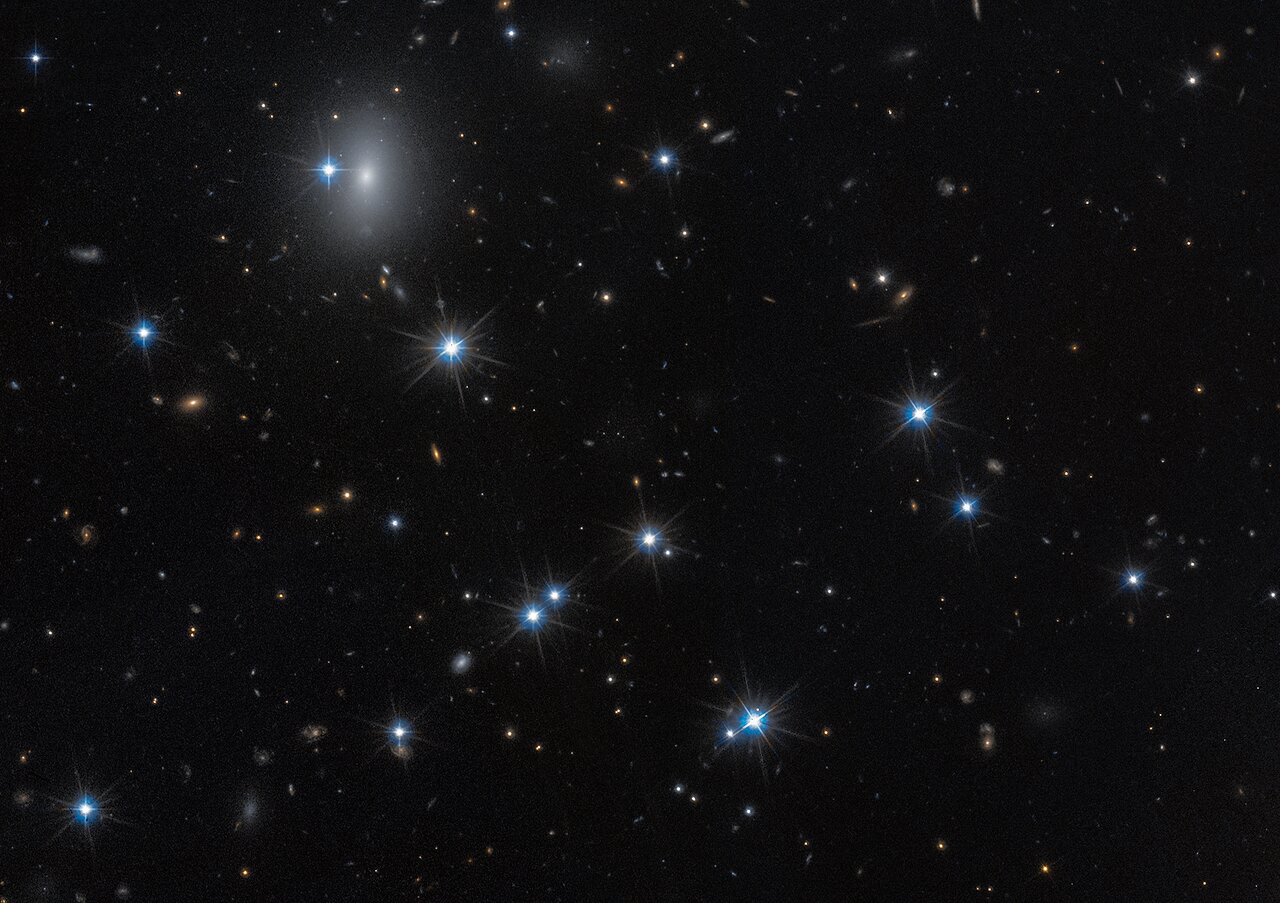
Astronomers using Hubble, Euclid, and the Subaru Telescope confirmed Candidate Dark Galaxy-2 (CDG-2), an extremely faint galaxy in the Perseus cluster whose presence was first inferred from a compact grouping of four globular clusters (compared to the Milky Way’s 150-plus). Follow‑up imaging revealed a diffuse stellar glow totaling the luminosity of roughly one million Suns, making it one of the most dark‑matter‑dominated systems known, with about 99% of its mass in dark matter. Researchers identified CDG‑2 through statistical searches for globular‑cluster groupings, a method suited to galaxies stripped of gas and stars by cluster interactions, leaving only dense clusters as durable tracers of hidden structure. (Credit: NASA, ESA, D. Li (Utoronto), Image Processing: J. DePasquale (STScI))
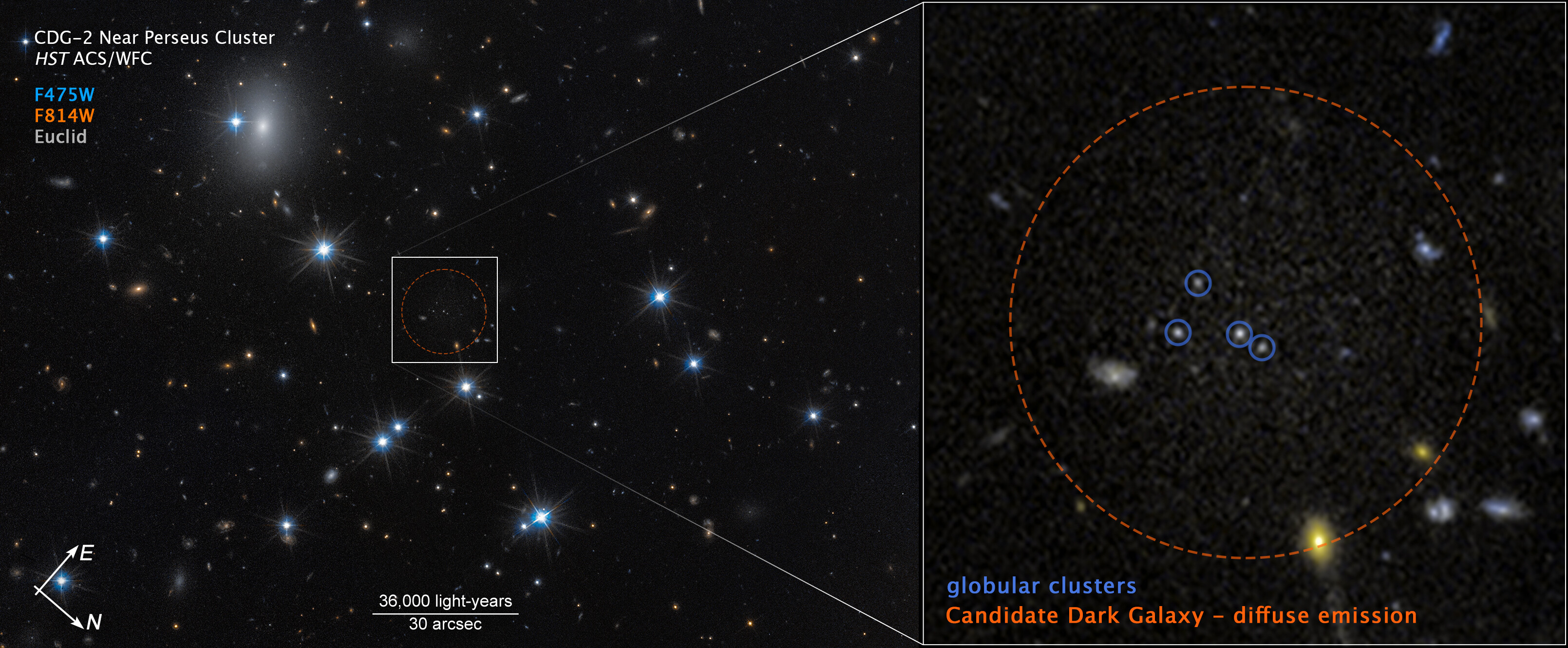
The image shows a scale bar, compass arrows, and colour key for reference. The scale bar is labeled in light-years along the top, which is the distance that light travels in one Earth-year. (It takes about 36,000 years for light to travel a distance equal to the length of the scale bar.) One light-year is equal to about 9.46 trillion kilometers. (Credit: NASA, ESA, D. Li (Utoronto), Image Processing: J. DePasquale (STScI))
NGC 5134 Spiral Galaxy : James Webb Space Telescope

Webb’s NIRCam (Near-InfraRed Camera) and MIRI (Mid-Infrared Instrument) reveal NGC 5134, a nearby spiral galaxy 65 million light‑years away in Virgo, where tightly wound arms contain dense gas clouds, embedded young stars, and complex dust rich in polycyclic aromatic hydrocarbons. Mid‑infrared emission traces warm dust structures, while near‑infrared data map stellar clusters shaping their surroundings through radiation, winds, and eventual mass loss. The observations support a program examining 55 star‑forming galaxies to track how gas cycles through clouds, stars, and supernovae, providing benchmarks for interpreting more distant systems that cannot be resolved in comparable detail.
The light that Webb collected to create this image has been journeying to us from NGC 5134 since soon after Tyrannosaurus rex went extinct. (Credit: ESA/Webb, NASA & CSA, A. Leroy)

SCIENCE
More Evidence for Early Organic Chemistry: Prebiotic Molecules Detected in Molecular Cloud Suggest Early Chemical Pathways in Star‑Forming Clouds

Infrared observations of the Taurus Molecular Cloud highlight the bright, cold pre‑stellar core L1544 at lower left. (Credit: ESA/Herschel/SPIRE)
16 February, 2026
Astronomer Yuxin Lin and colleagues at Max Planck Institute for Extraterrestrial Physics (MPE) have identified methanimine, a key precursor to amino acids, inside L1544, a cold, dense pre‑stellar core in the Taurus Molecular Cloud about 554 light‑years away. The molecule appears dispersed throughout the collapsing gas and dust, suggesting that complex organics can form before a star ignites. Because L1544 is expected to evolve into a young star with a protoplanetary disk, the finding implies that emerging planets could inherit prebiotic chemistry directly from their natal cloud rather than synthesizing it later.
The detection supports a growing body of evidence that organic molecules survive early star‑formation stages and may be widespread across star‑forming regions. It also strengthens the view that the chemical groundwork for life can originate in cold interstellar environments, long before planetary surfaces provide liquid water or energy sources. This pushes the timeline of prebiotic chemistry earlier in stellar evolution and broadens potential pathways for life’s initial ingredients.
These findings follow recent analyses of Bennu asteroid samples and updated planetary chemistry models, which together suggest that organic building blocks are widespread across the solar system while habitable conditions remain comparatively rare.
18 February, 2026
Mars lacks GPS Global Positioning System), but a new system called Mars Global Localization now lets Perseverance determine its exact position without human input.
NASA has deployed a new onboard navigation system that allows the Perseverance rover to determine its precise location on Mars without relying on daily guidance from Earth. The system compares rover‑captured panoramic images with orbital terrain maps using an algorithm running on the rover’s Helicopter Base Station (HBS) processor — hardware originally used to communicate with the Ingenuity helicopter and far more powerful than Perseverance’s main computers. The method pinpoints position within roughly 25 centimeters in about two minutes and was first used operationally in February 2025.
The upgrade addresses limitations in visual odometry (a navigation technique where a robot estimates its own movement by tracking how features in camera images shift over time), whose accumulated errors can halt long autonomous drives. Combined with Perseverance’s AutoNav and recent use of generative AI for route planning, the system enables longer, more continuous traverses with reduced operator workload. The team validated the algorithm using data from 264 prior rover stops and developed reliability checks to manage memory faults in the commercial processor.
Plan for Lunar AI‑Satellite Factory Highlights Renewed Interest in Moon‑Based Catapults to Put Satellite into Orbit

A 1985 Lunar and Planetary Institute illustration by Pat Rawlings showing a conceptual lunar catapult. (Credit: LPI)
18 February, 2026
Elon Musk is promoting a long‑term plan to build AI satellites on the Moon and launch them using a lunar mass driver, an electromagnetic catapult concept first proposed by Gerard O’Neill in the 1970s. In a recent internal meeting with xAI staff, Musk argued that space‑based manufacturing and deployment could eventually offer cheaper AI compute than Earth‑based data centers, especially if Starship enables large‑scale cargo delivery to the lunar surface. His proposal envisions using lunar resources to fabricate satellites and accelerate them into deep space, aiming to scale AI infrastructure while reducing dependence on terrestrial launch costs.
"By using an electromagnetic mass driver and lunar manufacturing, it is possible to put 500 to 1000 TW/year [terawatts per year] of AI satellites into deep space, meaningfully ascend the Kardashev scale and harness a non-trivial percentage of the sun’s power."
The idea aligns with earlier mass‑driver research at MIT and later studies suggesting that electromagnetic launch systems could leverage abundant solar power and local materials. Advocates argue such systems could support a broader lunar industrial ecosystem, though they note that early operations would still rely heavily on Earth‑supplied equipment and sustained government or commercial investment.
First Direct Observation of a Space‑Debris Pollution Plume Reveals Lithium Spike After Falcon 9 Reentry

A warehouse owner in Poland discovered what appears to be debris from a SpaceX Falcon 9 second stage on his property, after an uncontrolled reentry on February 19, 2025. (Credit: TVN24)
19 February, 2026
Scientists have, for the first time, tracked a pollution plume from a single space‑debris reentry in near real time, offering new insight into how spacecraft burn‑up affects atmospheric chemistry. Using a specialized lithium‑sensitive LIDAR, researchers at the Leibniz Institute of Atmospheric Physics in Germany detected a tenfold spike in lithium on February 20, 2025, about 20 hours after a Falcon 9 upper stage broke apart over Europe.
Back‑trajectory modeling linked the plume to the rocket’s vaporization at roughly 96 kilometers altitude, distinguishing it from natural meteorite sources. The finding comes amid rising concern over the chemical byproducts of reentries, which now occur multiple times per day as satellite numbers grow. While natural meteoritic influx is larger overall, metals from spacecraft, especially aluminum, may pose greater risks to ozone chemistry and stratospheric heating. The study demonstrates a new capability to trace reentry pollution and establishes a framework for future multi‑element monitoring as debris rates continue to climb.
For the First Time Scientists Map 3D Structure of Uranus’s Upper Atmosphere and Magnetically Driven Auroras

A new 3D mapping shows how temperature and charged particles change with altitude on Uranus, clarifying auroral structure shaped by its tilted magnetic field. The data reveal two strong auroral bands and a lower‑density region between them. (Credit: ESA/Webb, NASA, CSA, STScI, P. Tiranti, H. Melin, M. Zamani (ESA/Webb))
19 February, 2026
An international team of astronomers using the James Webb Space Telescope (JWST) have mapped the vertical structure of Uranus’s upper atmosphere and produced the first 3D map revealing how temperature, ion density and auroral activity vary with altitude across the ice giant. Using JWST’s Near Infrared Spectrograph (NIRSpec) instrument the team, led by Paola Tiranti of Northumbria University in the UK, observed Uranus for nearly a full rotation in January 2025, detecting faint infrared emissions from molecules up to 5,000 km above the cloud tops. This region is known as the ionosphere, where gases become ionized and interact intensely with the planet’s magnetic field.
The data show temperatures peaking between 3,000–4,000 km and ion densities highest near 1,000 km, with clear longitudinal variations shaped by Uranus’s tilted and offset magnetic field. Webb also identified two bright auroral bands and a depleted region between them, similar to magnetic‑field‑controlled features seen at Jupiter. The observations confirm that Uranus’s upper atmosphere continues a decades‑long cooling trend, with average temperatures around 426 K, lower than previous measurements. The results provide the most detailed view yet of how energy moves through an ice‑giant atmosphere and inform models of exoplanetary magnetospheres.
Boeing’s Starliner Crew Flight Test Labeled a Type A Mishap as NASA Cites Thruster Issues and Internal Decision‑Making

Starliner, which ferried NASA astronauts Butch Wilmore and Suni Williams to the ISS, is shown docked to Harmony’s forward port on July 3, 2024, in a view captured from SpaceX’s Dragon Endeavour. (Credit: NASA)
19 February, 2026
In a new report NASA has reclassified Boeing’s Starliner Crew Flight Test as a Type A mishap, the agency’s most serious category, following a review of the mission’s thruster failures and loss of attitude control during its June 2024 flight to the ISS. Although Starliner reached the station, the capsule temporarily lost six‑degree‑of‑freedom control and suffered multiple propulsion anomalies that later prompted NASA to return the vehicle uncrewed. NASA recognizes five categories of mishap. From most to least serious, they are Type A, Type B, Type C and Type D, as well as "close calls."
A subsequent “unexpected crew‑module propulsion failure” during reentry underscored the system’s lack of fault tolerance. Astronauts Suni Williams and Butch Wilmore, originally slated for a 10‑day mission, remained on the ISS for nine months and returned aboard a SpaceX Crew Dragon in March 2025. NASA officials acknowledged that concerns about Starliner’s reputation delayed proper classification and contributed to “programmatic advocacy” overriding risk assessment, i.e., NASA managers or teams pushing to protect or advance the Starliner program itself, rather than maintaining strict neutrality about its risks and performance. Starliner will not fly crew again until the thruster issues are resolved, though NASA still views a second commercial crew vehicle as important for future low‑Earth‑orbit operations.
Researchers Test Microbial Metal Extraction, “Biomining,” From Meteorite Samples on the ISS With Mixed but Promising Results

Michael Scott Hopkins performs a microgravity experiment on the International Space Station. (Credit: ESA / NASA)
19 February, 2026
Researchers from Cornell and the University of Edinburgh have conducted one of the first ISS experiments examining how microbes extract metals from meteorite material in microgravity, assessing their potential role in supporting resource use during deep‑space missions. The BioAsteroid project tested the bacterium Sphingomonas desiccabilis and the fungus Penicillium simplicissimum on L‑chondrite samples, comparing ISS results with ground controls.
The team found that fungal biomining was particularly effective at releasing palladium, platinum and other elements, driven by increased production of carboxylic acids and other metabolites in microgravity. Across many elements, nonbiological leaching performed worse in microgravity, while microbial extraction remained stable, suggesting microbes may help maintain consistent yields in variable gravity conditions. The experiment analyzed 44 elements, 18 of which showed biological extraction. The findings highlight both the promise and complexity of microbe‑mediated resource extraction in space, with potential applications for future off‑Earth industry and terrestrial biomining
Artemis II Faces Further Delay as Helium System Problem Emerges Following Improved Fueling Test, Ending March Launch Hopes

The Moon appears behind the SLS rocket and Orion spacecraft atop the mobile launcher at NASA’s Kennedy Space Center in Florida on Jan. 29, 2026. (Credit: NASA/Sam Lott)
17 - 21 February, 2026
NASA’s Artemis II campaign remains uncertain after mixed results from a series of fueling tests on the Space Launch System. A second wet dress rehearsal on February 19 successfully loaded cryogenic propellant without the hydrogen leaks that halted the February 2 attempt, following seal replacements at the launch pad. However, ground teams later identified insufficient helium flow to the rocket’s upper stage, a new issue that prompted NASA to prepare a rollback to the Vehicle Assembly Building and effectively removed the March launch window from consideration.
The helium system problem follows earlier hydrogen‑handling concerns that have repeatedly delayed prelaunch operations. NASA officials said the second fueling test still provided confidence in the vehicle’s performance, but additional troubleshooting is required before setting a new target date. The mission, intended to send four astronauts around the Moon, is now tracking no earlier than April 2026, pending resolution of the helium anomaly.

GOVERNANCE
SpaceX’s Stargaze Brings High‑Frequency Space‑Traffic Monitoring as Regulators Weigh Roles in SSA Governance

An illustration showing how SpaceX uses star‑tracker data from its Starlink satellites to detect other objects in orbit and calculate their trajectories. (Credit: SpaceX)
16 February, 2026
SpaceX has begun beta‑testing Stargaze, a space‑traffic management system that uses star‑tracker imagery from the 30,000 sensors across the 9,600 Starlink satellites to generate roughly 30 million observations per day and calculate orbital trajectories in near real time. The company claims that the system can observe individual objects up to 1,000 times daily, far exceeding the cadence of traditional radar‑based space situational awareness (SSA). More than a dozen operators are testing the platform, which SpaceX plans to make freely available this spring, contingent on participants sharing ephemeris and maneuver‑planning data.

Another animation details Starlink’s conjunction maneuver. (Credit: SpaceX)
Industry reactions have been broadly positive, with operators noting that high‑frequency observations could significantly improve conjunction warnings. A December 2025 case—where Stargaze detected a last‑minute maneuver that reduced a predicted miss distance from 9,000 to 60 meters—is cited as evidence of its potential. However, experts also warn that increased data volume can amplify inconsistencies across SSA providers, complicating decision‑making for operators subscribing to multiple services.
Stargaze’s emergence coincides with the U.S. Office of Space Commerce preparing the first production release of TraCSS, the government’s civil SSA system mandated by Space Policy Directive‑3. TraCSS faces funding uncertainty and questions about whether it will remain free, raising concerns about the long‑term balance between commercial services, government oversight, and the need for neutral data certification in an increasingly crowded orbit.
UK Sets Mandatory Liability Cap for Launch Operators, Introduces €60 Million Limit as RFA Prepares for 2026 and Domestic Spaceport Project Stalls

The Saxavord spaceport is located on the island of Unst, off the coast of Scotland. (Credit: RFA)
18 February, 2026
The United Kingdom has enacted the Space Industry (Indemnities) Act 2025, introducing a mandatory liability cap for launch operators and addressing a major gap in the country’s regulatory framework. Under the 1967 Outer Space Treaty, states are internationally liable for damage caused by their space objects, but most national regimes cap how much of that liability is passed on to commercial operators. The United States uses a tiered system in which operators must insure up to a government‑set “maximum probable loss” amount, while the federal government covers claims above that level up to roughly $3.1 billion. Anything beyond that reverts to the operator, but such cases have never occurred.
By contrast, the U.K.’s Space Industry Act 2018 previously imposed no statutory cap, leaving companies theoretically exposed to unlimited liability, a deterrent for insurers and investors. The new law, in force since Feb. 18, 2026, requires every license to specify a limit, currently set at €60 million / $71 million, though further reforms are expected. In the United States, for instance, the government bears liability of about $3.1 billion, with any excess falling on the operator.
The change comes as the U.K. launch sector faces mixed momentum. The German Rocket Factory Augsburg (RFA) has delivered hardware to SaxaVord Spaceport ahead of a planned 2026 attempt, while Orbex’s collapse has halted development at Spaceport Sutherland, prompting Melness Crofters Estate to seek a new partner. UK-based aerospace company, Skyrora has signaled interest but no agreement has been reached. The liability cap is intended to strengthen the U.K.’s competitiveness, yet the sector’s recent setbacks highlight the scale of investment and policy stability required to match more established launch nations.

MILITARY
US Defense is Seeking Commercial GEO Satellites Capable of Inspecting Other Spacecraft
17 February, 2026
The U.S. Defense Innovation Unit is seeking commercially built satellites capable of conducting high‑resolution, space‑to‑space imaging in geosynchronous orbit, aiming to close a long‑standing gap in the Pentagon’s ability to monitor both adversary and friendly spacecraft. The effort, called Geosynchronous High‑Resolution Optical Space‑Based Tactical Reconnaissance (GHOST‑R), calls for low‑cost satellites that can perform close‑range inspections and maintain custody of targets in GEO, where current U.S. systems are limited.
DIU wants the first spacecraft on orbit within 24 months, leveraging commercial manufacturing to accelerate deployment. The solicitation frames the capability as essential for tracking “uncooperative” satellites, a growing concern as Russian and Chinese spacecraft demonstrate proximity‑operations and intelligence‑collection behaviors in GEO.
The initiative reflects a broader DoD shift toward commercial space technologies to strengthen space‑domain awareness amid rising geopolitical competition in high‑value orbital regimes.
Google Earth AI to Run Inside Secure Government Systems Under New Vantor Partnership

A non‑AIS vessel identified by Vantor’s Maritime Sentry (maritime‑domain awareness system), with Google Earth AI models generating the embedded analysis. (Credit: Vantor)
18 February, 2026
Vantor will integrate Google Earth AI models into air‑gapped government networks, enabling automated text reports from satellite imagery without routing data through commercial cloud systems. The partnership allows Google’s large‑scale geospatial AI, which is normally accessed via Google Cloud APIs, to run inside classified U.S. and international sovereign data centers, processing Vantor’s imagery, third‑party commercial data, or customer‑owned datasets. Vantor says the system will cut report‑generation times from 24–36 hours to 10–15 minutes, addressing both latency and security concerns for defense and intelligence users.
“Air‑gapped government networks” refers to secure computer systems that are physically isolated from the public internet and commercial cloud services. Nothing can enter or leave these networks unless it is manually transferred through approved, highly controlled processes.
Google Earth AI, which already supports providers such as Planet and Airbus, has not previously been deployed in fully sovereign environments. Such environments are government‑controlled computing systems where all data, hardware, and software operate entirely under national authority, with no dependency on foreign or commercial cloud infrastructure. Vantor frames the collaboration as combining its pixel‑level analytic models with Google’s text‑generation capabilities to produce narrative intelligence summaries and support future autonomous tasking of satellite constellations. The company emphasizes a hybrid workflow in which analysts work alongside AI rather than being replaced.
SatVu Secures NATO Innovation Fund Backing to Expand Thermal‑Imaging Satellite Constellation

SatVu hyperspectral data captures activity at Bandar Abbas Port on Iran’s Strait of Hormuz. (Credit: SatVu)
19 February, 2026
SatVu has closed a £30 million ($40–41 million) funding round backed by the NATO Innovation Fund, bringing its total equity investment to £60 million as Europe increases support for defense‑oriented space startups. The UK‑based company provides high‑resolution thermal intelligence designed to monitor operational activity, infrastructure performance, and environmental change using day‑and‑night infrared data. The new capital will accelerate deployment of SatVu’s multi‑satellite thermal constellation, with two spacecraft planned for launch in 2026 and three more under contract.
The investment aligns with Europe’s broader milspace push, where SatVu and Spain’s GMV are among firms benefiting from rising defense‑tech spending. SatVu positions its thermal data as a complementary layer to traditional EO, offering insights that other commercial sensors cannot detect. The company says the funding will enhance persistent monitoring capabilities for government and commercial customers seeking intelligence on mobilization, infrastructure stress, and global operational patterns.
Boeing Expands El Segundo Satellite Production to Support Space Force Missile‑Warning Programs

Boeing’s new EO/IR production space in El Segundo, California. (Credit: Zeyad Maasarani/Boeing)
20 February, 2026
Boeing is expanding satellite production at its El Segundo facility as it ramps work on Next‑Generation Overhead Persistent Infrared (Next‑Gen OPIR) systems for the U.S. Space Force’s missile‑warning architecture. The company is adding a $10 million electro‑optical/infrared (EO/IR) production line to support higher‑volume manufacturing of sensor payloads and spacecraft components, part of a broader push to industrialize defense‑focused satellite assembly. Boeing says the upgrades will enable faster throughput for missile‑warning satellites and other national‑security programs as demand grows for resilient, proliferated constellations.
The expansion aligns with Space Force efforts to diversify suppliers and accelerate fielding of OPIR capabilities amid concerns over hypersonic threats and adversary counter‑space systems. Boeing’s El Segundo site, historically centered on large GEO satellites, is being reconfigured for more modular, repeatable builds. The company frames the investment as strengthening U.S. industrial capacity as missile‑warning programs transition from bespoke systems to scalable production.
Mynaric Becomes Target of Competing Bids as German Rheinmetall Challenges Rocket Lab’s Acquisition Plan

Mynaric's optical terminal manufacturing facility. (Credit: Mynaric)
22 February, 2026
A potential takeover of Mynaric, the Germany-based provider of laser optical communication terminals, has escalated into a geopolitical contest as Rheinmetall considers a bid that could block Rocket Lab’s planned $150 million acquisition. German media report that Rheinmetall is evaluating an offer to keep Mynaric’s laser communications terminal technology under European control, reflecting heightened scrutiny of foreign investment in sensitive defense assets. Rocket Lab announced its intent to buy Mynaric nearly a year ago, but the deal remains stalled pending German foreign direct investment approval amid Europe’s push for greater industrial sovereignty following Russia’s invasion of Ukraine.
Mynaric’s optical terminals, including the CONDOR Mk3 flying on the U.S. Space Development Agency’s PWSA satellites, are viewed as strategically important for secure, high‑rate inter‑satellite links. For Rocket Lab, the acquisition would secure a critical subsystem for its growing satellite‑manufacturing business. Mynaric, which has faced financial strain while scaling production, has become a focal point as Europe expands its milspace ambitions.

COMMERCIAL
ispace Warns of Possible Mission Delays as VoidRunner Engine Development Falls Behind
16 February, 2026
Japan’s ispace says development of its new VoidRunner engine is running behind schedule, creating uncertainty for upcoming lunar missions. The engine, jointly developed with U.S.-based propulsion company Agile Space Industries for the Apex 1.0 lander, replaced an earlier Agile design but required significant vehicle modifications, already pushing Mission 3, a NASA‑backed CLPS (Commercial Lunar Payload Services) flight led by Draper to the lunar farside, from 2026 to 2027. Executives now report slower‑than‑expected progress achieving required thrust and efficiency, and are keeping open the option of switching engines again. Announced in May 2025, VoidRunner is being developed jointly by ispace’s U.S. arm and Agile Space Industries.
Further delays would also affect Mission 4, planned for 2028, which uses ispace’s new Series 3 lander and depends on the same propulsion system. The company cut its fiscal‑year revenue forecast from 10 billion to 6 billion yen, citing the engine delay as the largest factor. Additional impacts stem from the Mission 2 lander crash in 2025 and the lack of a second CLPS task order. ispace highlighted continued work on Mission 6 and ESA‑funded MAGPIE rover development.
Aalto Looks to Australia for Zephyr Launch and Recovery as Japan Service Entry Moves to 2027

The fixed-wing Zephyr after take-off. (Credit: Aalto)
16 February, 2026
Aalto plans to establish an Australian operating base to support early commercial services for its Zephyr high‑altitude platform (HAP), now delayed to 2027 because of regulatory constraints and system‑integration work in Japan. Aalto is a UK‑based HAPS company spun out of Airbus to commercialize the long‑running Zephyr program. The Zephyr platform is a solar‑powered, fixed‑wing, ultra‑light drone designed to fly in the stratosphere at ~20 km altitude for up to ~90 days.
Operating from Australia would cut roughly 10 days from the 14–15‑day transit between the company’s Kenya site and Japan, freeing more time for communications and Earth‑observation missions across the Asia‑Pacific. Aalto, which raised $100 million in 2024 from Japanese investors led by NTT Docomo, is positioning Zephyr for disaster‑response connectivity and high‑bandwidth applications where it argues HAPS can outperform emerging direct‑to‑device satellite services.
Commercialization remains slow as Japanese authorities currently restrict Zephyr to over‑water flights, and certification work continues with the UK Civil Aviation Authority. The company is also promoting a national “Stratospace” ecosystem in Australia while U.S. competitor Sceye, backed by SoftBank, prepares its own Japan‑focused HAPS demonstrations in 2026–27.
Emerging Chinese Launch Firm Zenk Space Completes First Stage Static Fire Test

Zenk Space’s Zhihang‑1 first stage conducts its static‑fire test on Feb. 11, 2026, in Haiyang. (Credit: Zenk Space)
16 February, 2026
China’s lesser‑known launch startup Zenk Space has completed a first‑stage static‑fire test of its Zhihang‑1 (ZH‑1) rocket on February 11, using the HOS‑1 mobile sea platform off Shandong. The company released footage but did not disclose burn duration. The test, supported by commercial tank supplier R‑Space, marks the final major ground milestone before a planned debut flight, previously targeted for late February. ZH‑1 is a 50‑meter, three‑stage kerolox (kerosine-liquid oxygen) launcher with 3.35‑meter diameter stages and four CASC‑built (China Aerospace Science and Technology Corporation) YF‑102 engines, giving it a projected 4,000‑kg payload capacity to 500‑km Sun-synchronous orbit. Zenk Space, founded in 2019, highlighted guidance from the Chinese State Administration of Science, Technology and Industry for National Defense (SASTIND) and provincial defense‑industry authorities, underscoring the state’s role in shaping China’s commercial launch ecosystem.
The company is pursuing partial engine recovery, separating the engine bay after stage separation for parachute‑assisted splashdown, an approach similar to ULA’s SMART reuse concept. Zenk Space also plans larger reusable vehicles, including the 12‑ton‑class ZH‑2 and 5‑meter‑diameter ZH‑3.
ZH‑1 is one of many Chinese rockets slated for first flights in 2026, alongside CASC’s Long March 10A/10B/12B and commercial vehicles such as Pallas‑1, Nebula‑1, Gravity‑2, Kinetica‑2, YXZ‑1, and Tianlong‑3. The test comes amid intensified national efforts to expand reusable launch capacity following mixed recovery attempts by Zhuque‑3 and Long March 12A and the recent fourth flight of China’s experimental reusable spacecraft.
Spanish Firms Sateliot and PLD Space Partner on 2027 Launch of Direct‑to‑Device Tritó Satellites

Credit: PLD
17 February, 2026
Spain’s Sateliot has signed a contract with PLD Space to launch two 160‑kg Tritó direct‑to‑device satellites on a Miura 5 rocket in 2027, marking what both companies describe as the first fully private Spanish space mission, with spacecraft built and operated in Spain and launched on a Spanish‑developed vehicle . Tritó is Sateliot’s next‑generation platform, expanding from IoT connectivity to 5G D2D services for civil and defense users, and forms part of a planned 16‑satellite deployment beginning in 2027 from a new Barcelona production line .
PLD Space is preparing Miura 5 for a first flight later this year; the launcher can place >500 kg into Sun-synchronous orbit and recently secured €169.1 million through ESA’s European Launcher Challenge to support upgrades and service contracts . The mission will launch from French Guiana, where PLD Space is constructing a dedicated pad, underscoring Spain’s push for greater industrial autonomy within Europe’s commercial launch landscape .
Chinese Startup Space Epoch Secures Funding to Attempt First Reusable Rocket Orbital Launch This Year

The Yuanxingzhe‑1 verification rocket completed its first sea launch and recovery test in May 2025. (Credit: Sepoch)
17 February, 2026
China’s launch startup Space Epoch (aka Sepoch) has raised an undisclosed Series B round as it targets a first orbital launch and recovery attempt of its methane‑fueled Yuanxingzhe‑1 (YXZ‑1) rocket by the end of 2026. The company says three vehicles are already in production, with ground tests planned for the second half of the year. Founded in 2022 with technical staff drawn from China Academy of Launch Vehicle Technology (CALT), Space Epoch is building an integrated “Beijing–Shandong–Hangzhou” footprint spanning R&D, testing, manufacturing, recovery, and refurbishment.
YXZ‑1 is designed for 20‑flight reuse, with a stated capacity of 13.8 tons to 200 km and 9 tons to 1,100 km, the latter aligned with China’s planned Guowang constellation. The firm previously completed a vertical takeoff and splashdown test in 2025 using Jiuzhou Yunjian’s Longyun engines.
Space Epoch joins a crowded field of Chinese companies, Galactic Energy, Space Pioneer, CAS Space, Orienspace, Deep Blue Aerospace, iSpace, pursuing reusable launchers in 2026, following initial but incomplete recovery attempts by Landspace and CASC.

RESEARCH SPOTLIGHT
Why Are Tatooine‑Like Worlds a Rarity?

An artist’s rendering of a planet, represented by the black circle, moving around two stars in a binary system. (Credit: NASA/Goddard Space Flight Center)
Astronomers have long noted the scarcity of circumbinary planets, i.e., “Tatooine‑like” planets—worlds that orbit two stars at once—are so uncommon, even though most stars form in pairs. New work from UC Berkeley and the American University of Beirut researchers suggests the answer lies in general relativity, which subtly alters how tight binary stars move. In systems where the two stars orbit each other in less than about seven days, relativistic effects cause their orbits to slowly rotate, disturbing the surrounding protoplanetary disk where planets would normally form. Instead of settling into stable paths, young planets are pushed into unstable trajectories that either eject them from the system or send them into one of the stars.

A step‑by‑step illustration of how circumbinary planets drift into unstable orbits and are ultimately lost. (Credit: Mohammad Farhat/UC Berkeley)
This mechanism explains why only 14 circumbinary planets have been confirmed despite thousands of known exoplanets. The study reframes their rarity not as an observational gap but as a dynamical outcome of Einstein’s theory, a natural outcome of binary‑star dynamics, indicating that stable circumbinary planets are far more likely around wider, slower‑orbiting stellar pairs.
New Analysis Narrows the Possible Origins of the Ultra‑High‑Energy Amaterasu Particle

An artist's impression of a telescope array detecting a cosmic ray. (Credit: Osaka Metropolitan University/L-Insight, Kyoto University/Ryuunosuke Takeshige)
Scientists are narrowing in on the origins of the Amaterasu particle, an ultra‑high‑energy cosmic ray detected in 2021 whose energy rivals the most extreme particles ever observed. Named after the Japanese sun goddess, the particle carried 40 million times more energy than particles accelerated by the Large Hadron Collider (LHC), racing at near light speed. Its energy is exceeded only by the famous 1991 “Oh‑My‑God” particle, making it the second most powerful cosmic ray ever observed.
Intriguingly, new analysis from the Max Planck Institute for Physics shows that its arrival direction points toward the Local Void, a region of the sky largely empty of powerful astrophysical accelerators, deepening the puzzle of how such particles reach energies far beyond what supernovae or active galactic nuclei typically produce.
Researchers are now combining sky maps, magnetic‑field models, and particle‑propagation simulations to test whether the particle’s path was significantly bent by intergalactic magnetic fields or whether an unidentified source, such as a dormant black hole or a transient event, could be responsible. Chances are that the Amaterasu particle likely did not originate from a single empty region of space but instead from a broader set of nearby cosmic environments, with star‑forming galaxies such as M82 emerging as the most probable sources. Using data‑driven simulations and statistical modeling, they produced probability maps that strengthen future searches for ultra‑high‑energy cosmic‑ray accelerators and help clarify where such extreme particles can form. The findings were published in The Astrophysical Journal.
Despatch Out. 👽🛸
