

{{First_Name|Explorer}}, welcome back!🚀
Thanks for joining again! Plenty of exciting new findings in science and research this week, while space commerce saw a lot of funding rounds.
Click here for the full newsletter experience! ↓
Also, I wanted to take a moment and thank my readers for their encouraging messages and the “fan mails.” I appreciate that you appreciate the Lagrangian Despatch.
See you next week.

IMAGES
Crab Nebula : Hubble Space Telescope

Hubble’s new observation of the Crab Nebula provides a detailed view of the supernova remnant’s expansion 6,500 light‑years away. The image captures fine filamentary structures and reveals measurable outward motion over 25 years at roughly 5.5 million kilometers per hour. The nebula, the aftermath of SN 1054, is powered by a central pulsar whose magnetic field drives synchrotron radiation throughout the structure. The updated data offer improved insight into the remnant’s three‑dimensional geometry and ongoing evolution, enabled by Hubble’s long operational lifetime and high spatial resolution.
SN 1054 is the supernova recorded by Chinese, Japanese, and Middle Eastern astronomers in July 1054, whose explosion created the Crab Nebula and left behind the rapidly spinning Crab pulsar. (Credit: NASA, ESA, STScI, W. Blair (JHU). Image Processing: J. DePasquale (STScI))

Credit: NASA, ESA, STScI, W. Blair (JHU). Image Processing: J. DePasquale (STScI)

Hubble’s 1999 view of the Crab Nebula, newly reprocessed for comparison with the 2026 observation (based on data collected in 2024), highlights the same filamentary network shaped by temperature, density, and chemical variations in the expanding gas. The archival data, captured before the installation of Wide Field Camera 3, document the nebula’s earlier state and provide a baseline for tracking 25 years of outward motion. The reprocessed image shows that peripheral filaments have shifted farther than those near the center, reflecting the pulsar‑driven nature of the expansion rather than shock‑wave erosion seen in other supernova remnants. (Credit: NASA, ESA, STScI, W. Blair (JHU). Image Processing: J. DePasquale (STScI))
The Triangulum Galaxy : Very Large Telescope, ESO

A detailed observation from ESO’s Very Large Telescope, using the Multi Unit Spectroscopic Explorer (MUSE) instrument, shows a close‑up of the Triangulum Galaxy, about 3 million light‑years away, highlighting the complex network of gas and dust shaped by nearby stars. The colour mapping traces oxygen in blue, hydrogen in green, and sulphur in red, revealing how radiation and stellar feedback (the collection of physical processes through which stars inject energy, momentum, and chemically enriched material back into the gas around them) sculpt the interstellar medium. The dataset, part of a study led by Anna Feltre, captures the chemical composition and motion of the gas across the field, offering new insight into how star‑forming regions evolve within this Local Group galaxy.
MUSE’s superpower is its ability to break up the light into the different rainbow colours, allowing the team to examine the chemical composition of the interstellar matter at every location across its whole field of view. (Credit: ESO/A. Feltre, F. Belfiore, G. Cresci et al.)
A New Look at a 2,000-Year-Old Supernova : IXPE, Chandra X-Ray Observatory, ESA XMM Newton

NASA’s Imaging X‑ray Polarimetry Explorer (IXPE) has mapped the outer rim of RCW 86, a supernova remnant about 8,000 light‑years away in the constellation Circinus and possibly linked to the “guest star” recorded by Chinese astronomers in 185 AD in this area of the night sky that remained visible for 8 months. IXPE’s polarized X‑ray emission appears in purple in the inset in the lower‑right edge, tracing shock‑accelerated particles. The full composite combines IXPE data with low‑energy X‑rays in yellow and high‑energy X‑rays in blue from Chandra and ESA XMM‑Newton, overlaid on an optical starfield from NOIRLab.
Chandra observations revealed that RCW 86 expanded unusually quickly because the explosion occurred inside a low‑density cavity, shaping the remnant’s large size and asymmetric structure. IXPE’s polarization measurements add new constraints on how magnetic fields and shock fronts evolve in this historically significant supernova remnant.(Credit: X-ray: Chandra: NASA/CXC/SAO, XMM: ESA/XMM-NEWTON, IXPE:NASA/MSFC; Optical: NSF/NOIRLab; Image Processing: NASA/CXC/SAO/J. Schmidt)
A Solar System in the Making : Very Large Telescope, ESO

Astronomers have observed two planets forming in the disc around a young star named WISPIT 2.
A Very Large Telescope/SPHERE (Spectro-Polarimetric High-contrast Exoplanet REsearch instrument) image shows the young star WISPIT 2 surrounded by a disc of gas and dust in which two giant planets are forming. The outer planet, WISPIT 2b, was first identified in 2025 as it carved a gap in the disc. New observations by the same team confirm a second planet, WISPIT 2c, orbiting closer to the star. Both are gas giants: WISPIT 2b is nearly five times Jupiter’s mass and orbits at roughly 60 AU, while WISPIT 2c is about twice as massive and circles the star four times nearer. SPHERE’s adaptive optics and coronagraphy reveal the faint disc and planets, with additional GRAVITY+ instrument on the the VLT Interferometer measurements confirming their planetary nature. (Credit: ESO/C. Lawlor, R. F. van Capelleveen et al.)

This annotated image from ESO’s Very Large Telescope shows the young planetary system forming around the star WISPIT 2. The now confirmed second planet, WISPIT 2c is orbiting closer to the star, as indicated in the inset. The observations were obtained with the SPHERE instrument on the VLT, which corrects atmospheric distortion and suppresses starlight to reveal the faint disc and embedded planets. (Credit: ESO/C. Lawlor, R. F. van Capelleveen et al.)
Saturn in Infrared : James Webb and Hubble Space Telescopes
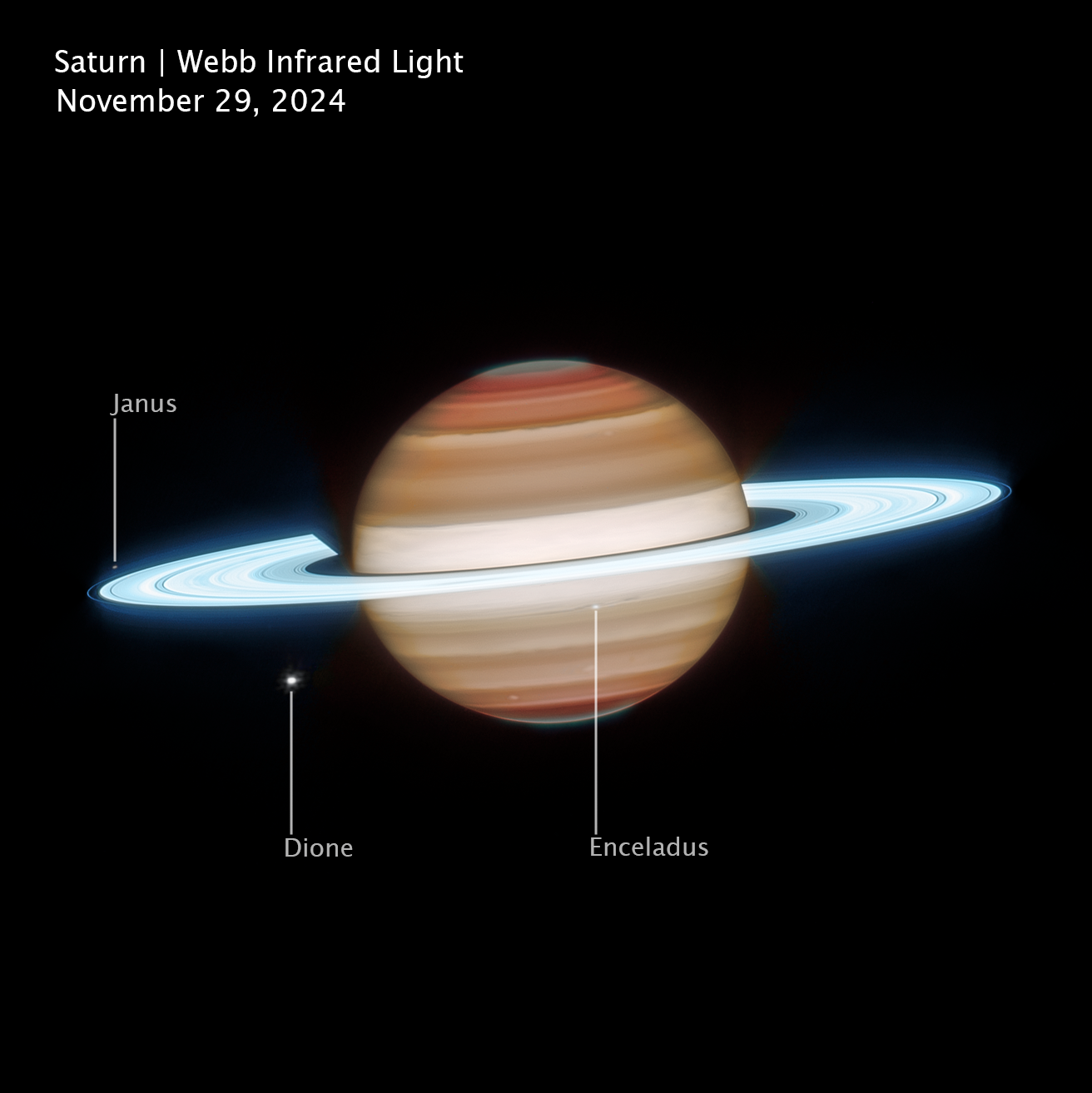
NASA’s James Webb Space Telescope captured Saturn in infrared light, revealing a dimly lit disk contrasted by bright, reflective rings and several small moons. Webb’s NIRCam data highlight high‑altitude methane clouds and temperature‑driven variations across the planet’s atmosphere, along with faint structures in the rings produced by embedded moonlets.
The rings are extremely bright because they are made of highly reflective water ice. These 2024 observations, released now and taken 14 weeks apart, show the planet moving from northern summer toward the 2025 equinox. As Saturn transitions into southern spring, and later southern summer in the 2030’s, Hubble and Webb will have progressively better views of that hemisphere. (Credit: NASA, ESA, CSA, STScI; Image Processing: Joseph DePasquale (STScI))

A complementary Hubble observation shows Saturn in visible light, capturing the planet’s banded atmosphere, ring system, and several moons with high spatial clarity. The image, taken as part of the Outer Planet Atmospheres Legacy program, documents cloud patterns, storms, and color variations shaped by seasonal shifts in solar illumination. Hubble’s long time‑baseline enables comparison with earlier cycles of atmospheric activity, offering context for changes detected in Webb’s infrared data.
In both images, we’re seeing the sunlit face of the rings, a little less so in the Hubble image, hence the shadows visible underneath on the planet. There are also subtle ring features such as spokes and structure in the B ring (the thick central region of the rings) that appear differently between the two observatories. The F ring, the outermost ring, looks thin and crisp in the Webb image, while it only slightly glows in the Hubble image. (Credit: NASA, ESA, STScI, Amy Simon (NASA-GSFC), Michael Wong (UC Berkeley); Image Processing: Joseph DePasquale (STScI))
Western Australia’s Kimberley Region : Copernicus Sentinel-2

A natural‑colour Sentinel‑2 view shows the western coastline of the Kimberley region in Western Australia, including King Sound, a 120‑km‑long inlet with some of the world’s highest tides. Sediment‑laden water from rivers such as the Fitzroy flows into the sound, giving the shallow coastal waters a brownish appearance. Mangrove estuaries fringe the coast but are partly obscured by extensive tidal mudflats. Inland, sparse vegetation and the deep ochre tones of pindan soil mark the transition from grasslands to the arid interior, with burn scars sometimes blending into the surrounding red terrain. (Credit: Copernicus Sentinel data, ESA)

A false‑colour Sentinel‑2 view of the Kimberley coastline highlights features concealed in natural light. Mangrove forests appear in bright neon green, revealing their density across the estuaries surrounding King Sound. Water surfaces shift to black and blue tones, distinguishing deeper areas and zones of high sediment concentration. Burn scars stand out as dark patches across the pindan landscape, offering a clear record of recent wildfires in a region prone to seasonal burns. The spectral combination provides a sharper view of vegetation health, sediment transport, and environmental change across this remote coastal system. (Credit: Copernicus Sentinel data, ESA)

SCIENCE
Artemis Pivot: NASA Pauses Lunar Gateway to Build A Lunar Base And Canada Cancels First Lunar Rover

Illustration of NASA astronauts on the lunar South Pole. (Credit: NASA)
24 March, 2026
NASA has decided to move away from the Lunar Gateway program and redirect Artemis toward a surface‑first architecture. The agency announced it will pause Gateway “in its current form” and repurpose existing hardware while shifting resources to a multi‑phase plan for building a lunar base, beginning with expanded Commercial Lunar Payload Services deliveries and progressing to semi‑habitable modules, logistics support, and heavier infrastructure for a sustained human foothold. The pivot also reshapes the mission sequence: Artemis III, now planned for 2027, will no longer attempt a lunar landing, with the first surface attempt moved to Artemis 4 in 2028. After a series of delays, Artemis 2 is scheduled for launch on April 1.

A Canadian lunar‑rover prototype, in 2024, during testing on the Canadian Space Agency’s simulated lunar terrain in this undated handout image. The controlled environment was designed to mimic surface conditions the rover would have encountered on the Moon. (Credit: Canadian Space Agency / The Canadian Press)
Meanwhile, Canada, a Gateway partner, separately confirmed it will cancel its first lunar rover mission as part of its 2026–27 spending plan. The south‑polar rover, intended to search for water ice and fly on a Firefly CLPS 2029 mission, was terminated amid domestic budget reprioritization. The Firefly lander was slated to deliver six instruments to the lunar surface, including five Canadian payloads and a NASA‑supplied radiometer under a joint agency agreement. The 35‑kilogram rover was also intended to showcase two decades of Canadian expertise in planetary‑rover development.
The Canadian Space Agency emphasized that the decision was not directly tied to NASA’s Artemis changes, though the cancellation follows the broader program shift. Researchers involved in the rover project said the scientific expertise developed will continue to support future lunar efforts.
Projecting toward the planned 2029 launch, the Canadian Space Agency said that canceling the rover and reducing 45 full‑time‑equivalent positions through attrition and revised staffing will save an additional 26 million Canadian dollars between fiscal years 2027–28 and 2028–29.
NASA Will Develop Nuclear‑Powered Interplanetary Spacecraft to Deliver Skyfall Helicopters to Mars

Early concept of Skyfall illustrates six helicopters attached to the much larger spacecraft just before mid-air deployment. (Credit: AeroVironment)
24 March, 2026
NASA has set a December 2028 launch date for Space Reactor‑1 Freedom (SR-1), the agency’s first fission‑powered interplanetary spacecraft and the platform for the Skyfall mission. The spacecraft will use nuclear electric propulsion (NEP), a system in which a compact fission reactor generates electricity to power high‑efficiency electric thrusters, enabling sustained deep‑space travel independent of sunlight. NASA described the technology as a departure from radioisotope generators used on probes such as Voyager, which supply power but do not contribute to propulsion. The mission will carry three Ingenuity‑class Skyfall helicopters to Mars to survey potential human landing sites, search for subsurface water, and relay navigation data.
SR‑1 Freedom spacecraft differs from earlier nuclear‑propulsion concepts such as the 1950s Project Orion, which envisioned using repeated nuclear explosions for thrust, and the 1970s Project Daedalus study, which proposed fusion‑powered engines. Instead, SR‑1 Freedom will rely on a compact nuclear‑fission reactor, similar in principle to terrestrial power plants, to generate electricity for an ion engine, providing continuous, efficient propulsion for deep‑space travel.
The Skyfall concept, developed by NASA’s Jet Propulsion Laboratory and AeroVironment, advances the aerial‑exploration work begun by the Ingenuity helicopter, which completed 72 flights on Mars between 2021 and 2024. NASA officials said the mission will demonstrate advanced nuclear electric propulsion in deep space and establish flight heritage for future fission‑powered systems. The agency views the technology as critical for long‑duration operations on the Moon and for missions to the outer solar system, where solar power is limited.
Hera Completes Major Maneuvers To Stay On Course For November Asteroid Rendezvous

ESA’s Hera is a survey mission designed to study the aftermath of NASA's DART mission, which intentionally crashed into the smaller moonlet, Dimorphos, of the Didymos binary asteroid system, in 2022. (Credit: ESA)
25 March, 2026
The European Space Agency’s Hera spacecraft completed its largest deep‑space maneuver to date, advancing preparations for a planned November 2026 rendezvous with the Didymos binary asteroid system. The sequence of three major engine burns and a smaller correction, carried out over four weeks in February and March, consumed 123 kilograms of hydrazine and changed the spacecraft’s velocity by 367 meters per second, a shift ESA compared to accelerating from rest to supersonic flight. The maneuver aligned Hera’s solar orbit with that of Didymos and tested systems needed for braking and close‑proximity operations later this year. The binary system consists of the primary ~780m-wide Didymos and the ~151m moonlet Dimorphos.
Hera, launched in October 2024, previously conducted a Mars flyby in March 2025 that validated autonomous navigation and captured images of Deimos, a Martian moon. The mission will survey Dimorphos, which is also the asteroid struck by NASA’s DART impactor in 2022, and deploy two CubeSats, Milani and Juventas, for additional measurements. ESA teams are now preparing software updates ahead of the approach phase.
Separately, ESA announced plans for a dedicated SpaceX Crew Dragon mission in early 2028 to expand astronaut access to the International Space Station before its retirement. The ESA Provided Institutional Crew (EPIC) project will send four professional astronauts for a month‑long stay focused on research, maintenance, and operational tasks, with ESA leading the mission in coordination with NASA and international partners.
In Space, Sperms Have a Hard Time Finding the Egg

A University of Adelaide study finds that sperm lose their ability to navigate in low gravity. (Credit: Sperm and Embryo Biology Laboratory, University of Adelaide)
26 March, 2026
Australian researchers report that human sperm may struggle to navigate in microgravity, raising new questions about reproductive viability during long‑duration spaceflight. In laboratory experiments at the University of Adelaide, scientists exposed donated sperm samples as well as mouse and pig sperms to simulated microgravity and found that the cells’ directional movement became disordered, with many failing to swim toward chemical signals that normally guide them to an egg. About 30% fewer sperm reached the egg compared with samples kept in normal gravity.
"We know that sperm responds to chemical cues, but we also know that they like to swim near surfaces. Obviously, to know where surfaces are, you need to understand your position in time and for that you need gravity."
Scientists say sperm rely on a complex set of cues to reach an egg, including chemical signals such as the female hormone progesterone, but gravity also appears to play an important role, McPherson said. The study observed changes in calcium signaling, a key driver of motility. Researchers said the findings highlight a potential barrier to conception in space and emphasized the need for further testing in real microgravity environments. The research adds to the increasing body of work in understanding how human reproduction may be affected beyond Earth. The findings were published in the journal Communications Biology.

GOVERNANCE
U.S. Office of Space Commerce Proposes Single-Window Certification to Cut Red Tape for Novel Space Missions
24 March, 2026
The U.S. Office of Space Commerce (OSC) released a 13-page proposal March 24 for a consolidated "Space Commerce Certification" process covering commercial activities that fall outside existing regulatory frameworks, including:
satellite servicing,
in-space assembly,
active debris removal,
nuclear space activities,
lunar missions, and
commercial space stations.
Under the framework, OSC would serve as the single point of contact for regulatory approval, conducting interagency review on behalf of the FAA (Federal Aviation Administration FCC), FCC (Federal Communications Commission), and CRSRA (Commercial Remote Sensing Regulatory Affairs), which retain their statutory authority but could rely on the certification to waive portions of their own reviews. Applications currently require separate filings to each agency. A 120-day decision timeline applies, with approval presumed unless one of four explicit grounds for denial is met:
inability to comply with certification commitments;
risk to national security that cannot be mitigated;
likelihood of violating U.S. international obligations or
harming foreign relations; or unacceptable danger to space operations or public safety.
The program is voluntary and was developed under Executive Order 14335, “Enabling Competition in the Commercial Space Industry,”. Notably, OSC is not using notice-and-comment rulemaking, which the agency said will allow it to develop and revise procedures more rapidly. Mission-type-specific requirements will be developed through implementation rather than upfront rulemaking, drawing instead on emerging industry standards. Industry feedback on the proposal is being accepted on a voluntary basis.
OSC Director Taylor Jordan, while announcing the proposal also flagged concern over the European Union Space Act, which would require non-EU firms to register with the European Commission before providing services to member states. OSC has communicated objections to the proposal through interagency channels, and FCC Chairman Brendan Carr has indicated the U.S. could mirror European restrictions reciprocally if the act moves forward.
The proposal marks a significant shift in how the U.S. approaches authorization of commercial space activities, closing a long-standing regulatory gap while attempting to preserve agency flexibility as the industry evolves.

MILITARY
Space Force Deploys Cyber Units at Launch Sites as Intelligence Officials Detail Growing Threat From China, Russia
23 March, 2026
U.S. Space Force Space Systems Command announced March 23 the deployment of two Defensive Cyber Operations Squadrons at its primary launch sites, as senior military intelligence officials detailed an expanding range of threats to U.S. space systems from China and Russia.
The squadrons, which include the 630th at Vandenberg Space Force Base and the 645th at Cape Canaveral Space Force Station, will monitor network traffic across launch ranges in real time during countdown and liftoff, watching for anomalies in command links, telemetry streams and ground communications. "Launch sites were mainly concerned with physical security," said Lt. Col. John Quinn, commander of the 645th. "We've had to increase our security protection against a host of potential cyber attacks."
The announcement came alongside an unclassified threat briefing at Satellite 2026 conference by Space Force Chief Master Sergeant Ron Lerch, who identified electronic warfare as a growing priority threat. Lerch cited a Chinese research paper describing a ground-based high-power microwave capable of targeting satellites repeatedly across a large constellation, a cost-effective alternative to direct-ascent weapons.
A separate 2025 Chinese paper described deploying drones to jam satellite communications across localized areas. China operated approximately 1,300 active spacecraft at the close of 2025, including more than 500 ISR and remote-sensing satellites. Lerch also confirmed intelligence suggesting Russia has pursued a nuclear weapon capable of orbital detonation, which he said could immediately affect at least one third of all active satellites.
Space Force’s posture is increasingly oriented toward active defense of space infrastructure, from launch ranges to on-orbit assets, as U.S. military dependence on space-based systems for communications, missile warning, and intelligence continues to deepen.
US Spy Satellites Conduct Coordinated Inspection Of China’s Shijian‑29 Pair

Ground‑based imagery of the Shijian‑29A and 29B satellites in geostationary orbit. (Credit: s2a Systems)
26 March, 2026
Commercial tracking data shows two U.S. GSSAP (Geosynchronous Space Situational Awareness Program) satellites conducting a coordinated proximity‑operations campaign, executing a “handoff” operation, around China’s Shijian‑29A and 29B spacecraft in geostationary orbit. U.S.-based space situational and domain awareness provider Commercial Space Operations Center (COMSPOC), observed USA 324 and USA 325 bracketing the Chinese pair from March 14–18 before USA 325 departed the area on March 18 handing continued monitoring to USA 324. USA 324 closed to roughly 63 kilometers of Shijian‑29A by March 19.
The Chinese satellites, launched in December for technology‑verification missions, have shown differing brightness in ground‑based observations, amid rising GEO maneuver activity among major space powers.

COMMERCIAL
Japanese Space Compass Orders SWISSto12 GEO Optical Relay For LEO Data Links

The HummingSats are just over one-and-a-half cubic metre in volume, which is one-tenth the size of conventional satellites placed in geostationary orbit some 36 000 kilometres above Earth. (Credit: Swissto12)
23 March, 2026
Japanese space-based infrastructure provider, Space Compass and SWISSto12, the Swiss GEO satellite manufacturer, have signed a procurement contract for the world’s first commercial geostationary optical data‑relay satellite, marking a major step toward Space Compass’s planned high‑speed, high‑capacity LEO‑to‑GEO relay network. The spacecraft will use SWISSto12’s compact HummingSat platform, which integrates bespoke optical communications payloads and is slated for delivery by March 2029.
A geostationary optical data‑relay satellite sits in a fixed position over the equator and uses laser links to collect data from passing LEO satellites and route it to the ground in near‑real time. Its purpose is relay, not direct imaging or broadband service.
Unlike LEO satellites, which move quickly across the sky and require large constellations, a GEO relay spacecraft provides continuous coverage from a single orbital slot. And unlike typical GEO communications satellites, which use radio‑frequency payloads to serve end users, an optical relay satellite is built specifically to move large volumes of data between spacecraft and Earth using high‑capacity laser terminals.
The system is intended to support real‑time Earth‑observation data delivery and form part of Space Compass’s multi‑orbit communications infrastructure, a joint venture between Japanese telecom firms NTT and SKY Perfect JSAT. SWISSto12 said the contract further validates its small‑GEO platform for diverse mission types, while Space Compass emphasized the satellite’s role in enabling faster operational decision‑making and future disaster‑response and public‑safety applications.
Moog, Redwire Partner To Add ELSA Solar Arrays To The Meteor Spacecraft Line

Redwire unveiled ELSA, a high‑volume solar array that provides 50% more power while reducing stowed mass and volume. (Credit: Redwire)
24 March, 2026
Space infrastructure provider Redwire and Moog, a motion and flow control solutions provider, signed a new agreement to integrate Redwire’s ELSA (Extensible Low-Profile Solar Array) high‑performance, low‑mass solar array wings with Moog’s Meteor satellite bus, expanding their collaboration on small‑GEO and LEO spacecraft platforms. The deal follows Redwire’s recent contract to deliver ELSA arrays for an undisclosed customer, with the company citing demand for higher‑power systems that fit within constrained launch volumes.
Moog said the combined Meteor–ELSA configuration will support missions requiring compact, scalable power systems, building on earlier joint work highlighted by both companies. Redwire noted that ELSA provides up to 50% more power per unit volume than its previous arrays and is designed for volume production. The companies said the integration effort positions them to serve commercial, civil and national security customers seeking higher‑performance small‑satellite architectures.
NASA Overhauls Exploration and Commercial Station Strategy, Drawing Industry Backlash

A rendering from NASA’s RFI issued March 25 describing its concept for a core module for the ISS to support commercial space station development. (Credit: NASA)
24 March, 2026
NASA announced a sweeping overhaul of its exploration and commercial strategy at March 24 “Ignition” event, reorienting its lunar Gateway program toward a surface base, targeting a nuclear propulsion demonstration mission to Mars as early as 2028, and proposing a significant restructuring of its commercial space station program.
The most contentious element involves NASA's Commercial Low Earth Orbit Destinations program. Agency officials said the commercial market for successor stations to the International Space Station has not materialized at the pace originally projected, with independent market surveys consistently placing a mature market roughly a decade away. Under an alternative approach NASA is now considering, the agency would procure a core module, that would provide power, propulsion, life support, and docking ports, to be installed on the ISS, with commercial modules attaching to it over time. That assembly would eventually detach as a standalone commercial station, potentially incorporating existing ISS modules. NASA issued a request for information March 25 seeking industry input, with responses due April 8, a draft RFP for the core module potentially ready within months, and a final RFP expected in June.
The proposal drew immediate criticism. Dave Cavossa, president of the Commercial Space Federation, testified before the House Science Committee the following day that the announcement had created confusion among station developers and that NASA's market analysis was flawed, pointing to recent investment activity and a report that Starlab Space had fully booked its commercial payload racks. Rep. George Whitesides cautioned that companies had raised in excess of $2 billion in private capital under existing program expectations and that repeated strategy shifts risked undermining NASA's credibility as a commercial partner.
On the lunar side, NASA's Moon Base plan spans three phases through the mid-2030s, targeting 21 robotic landings delivering 4,000 kilograms of payload through 2028, scaling to monthly landing cadences in later phases. NASA awarded Intuitive Machines a $180.4 million CLPS contract for a 2030 south polar mission using the new Nova-D lander. The agency also issued a draft RFP for CLPS 2.0 covering more capable landers. Details on Human Landing System acceleration plans for Blue Origin and SpaceX remain undisclosed.
The announcements represent NASA's most significant strategic realignment in years, compressing its lunar ambitions into a phased base-building program while simultaneously retreating from a hands-off commercial station model it has championed for nearly a decade. Whether the revised CLD approach stabilizes or further unsettles private investment will likely depend on the speed and clarity of NASA's follow-through, a credibility test the agency's own partners have already begun to flag publicly.
Space Tech Investment Surges Across Navigation, Propulsion, AI, Mobility, and Spectrum
Astronstone (China, reusable launch), Bellatrix Aerospace (India, in‑space propulsion), Xona Space Systems (California, LEO PNT), Sift (California, AI and data infrastructure), Pave Space (Switzerland, orbital transfer vehicles), and Airbase (U.S., spectrum‑management software) all announced new funding rounds this week.
24 March, 2026
In the United States, spectrum‑automation startup Airbase emerged from stealth with a $5 million round led by Andreessen Horowitz to automate radio‑frequency spectrum allocation as orbital activity increases. Squadra Ventures and Founders You Should Know also participated. The company aims to replace the FCC’s manual, PDF‑based licensing workflows with real‑time monitoring, automated deconfliction, and database management tools. Airbase said it has already secured its first federal prototype contract, enabling field testing of its coordination system. The startup is led by CEO Ari Rosner, formerly of True Anomaly and JPL, and CTO Millen Anand, previously an engineer at Planet Labs and Boeing’s GEO satellite programs.
Chinese commercial space startup AstronStone also known as Beijing Uishi Space Technology, raised 200 million yuan ($28 million) in a new Pre‑A+ funding round led by GL Ventures and Xingxiang Capital as it advances toward the first flight of its reusable AS‑1 rocket. The round will support final assembly and testing, validation of the company’s “chopstick” recovery system, and expansion of production capacity and staffing. Astronstone has raised nearly 500 million yuan / $72.5 million since 2024 and grown to 170 employees.
The firm completed a second‑stage static‑fire campaign in late 2025 and a full‑scale capture‑arm ground test, and is building out facilities in Beijing, Hebei and Hunan. The two‑stage, stainless‑steel methalox AS‑1 is targeting a 2027 debut with up to 15,700 kilograms to LEO expendable and 10,000 kilograms recovered.

A rendering of Pave Space’s planned orbital transfer vehicle designed to move satellites from low Earth orbit to higher‑energy destinations. (Credit: Pave Space)
25 March, 2026
Switzerland‑based Pave Space raised $40 million in seed funding led by Visionaries Club and Creandum to develop its orbital transfer vehicle, designed to move up to 5 metric tons from LEO to higher‑energy orbits or lunar trajectories in under a day as opposed to months. Founded in 2024 as a spin‑off from the Gruyère Space Program, the startup has eight reservation agreements and a 40‑person team. Pave plans to launch its Graze avionics pathfinder in October and conduct a first main‑thruster ignition in the Swiss Alps later this year.
Industrial‑AI company Sift raised a $42 million Series B to deploy its Sift Stack software. The round was led by StepStone, with participation from GV, Riot Ventures, Fika Ventures, and CIV, bringing total funding to $67 million. Founded by former SpaceX engineers Karthik Gollapudi and Austin Spiegel, the company is developing data‑infrastructure software which provides an intelligence layer that structures high‑volume sensor data from mission‑critical machines across space, defense, manufacturing, and autonomy.
The platform unifies audio, video, logs, and high‑frequency telemetry to provide real‑time monitoring, anomaly detection, and automated quality‑control workflows as well as AI‑driven operations for factories producing mission‑critical hardware, including aerospace systems. Customers include ULA, Astranis, K2 Space, and defense programs.

Credit: Xona Space Systems
26 March, 2026
Navigation‑satellite startup Xona Space Systems closed a $170 million Series C round led by Mohari Ventures Natural Capital, with Craft Ventures, ICONIQ, Woven Capital, NGP Capital, Samsung Next, Hexagon, and other investors participating. The funding will also accelerate manufacturing at Xona’s new Burlingame, Calif., facility and support deployment of its 258‑satellite Pulsar low‑Earth‑orbit positioning, navigation, and timing (PNT) constellation, which provides higher‑power, encrypted signals compatible with existing GPS devices. More than a dozen commercial receiver partners are already tracking Pulsar signals, with early coverage expected as soon as 2027.
27 March, 2026
India’s Bellatrix Aerospace secured $20 million in a pre‑Series B round led by Cactus Partners to scale production of its electric and green in‑space propulsion systems. New investors including Hero Investment Office, 35 North Ventures, Indusbridge Ventures, and Monarch Holdings joined existing backers. The company, which has flight‑qualified its core technologies and expanded internationally with a U.S. subsidiary, plans to increase manufacturing capacity, shorten lead times, and support customer programs as demand from satellite‑constellation operators grows. Bellatrix’s systems have been used in missions with Astroscale Japan and NewSpace India Limited.
Ispace Overhauls Lander Design And Delays U.S. Mission As Lander Providers Prepare For Increased NASA Cadence

ispace’s Ultra lander unifies separate lander designs by the company’s American and Japanese divisions. (Credit: ispace)
27 March, 2026
Japanese lunar exploration company, ispace has announced that it will replace the VoidRunner engine, that it was jointly developing with American propulsion company Agile Space Industries, meant to be used on its U.S. and Japanese lunar landers. The company said March 27 it will adopt a flight‑proven engine from an undisclosed supplier and also merge the Apex 1.0 and Series 3 designs into a unified Ultra lander. The shift pushes its first American mission, the Draper‑led NASA Commercial Lunar Payload Services (CLPS), now renamed Mission 5, three years later than planned, to 2030. VoidRunner was to be used on Apex 1.0 landers built by ispace U.S. and the Series 3 landers built by ispace in Japan.
Japan‑based missions supported by a Japanese government SBIR award, will launch in 2028 and another Japanese lander, supported by a Space Strategy Fund award in 2029, as Missions 3 and 4, both using Ultra. ispace will also restructure its global engineering teams and expects modest layoffs as it calculates redesign costs.
The company separately announced Lunar Connect Service, a five‑satellite lunar communications and navigation network targeted for 2030. The first spacecraft will launch in 2027 on an Argo Space (U.S.-based OTV developer) orbital transfer vehicle as Mission 2.5, carrying one of ispace U.S.’s previously planned relay satellites. ispace U.S. was developing two relay satellites, Alpine and Lupine, to launch with the original Mission 3 for communications services on the moon's far side. ispace said it is coordinating with NASA on schedule changes and expects its landers and communications system to support future lunar infrastructure efforts
Meanwhile, Firefly Aerospace and Intuitive Machines separately said they support NASA Administrator, Jared Isaacman’s proposal to increase robotic lunar lander missions to a monthly cadence starting next year, but offered few details on how they would scale to meet that demand, SpaceNews reports. The companies, which have flown three of NASA’s four CLPS missions to date and hold five more under contract, noted ongoing challenges with landing reliability and mission frequency. Firefly’s Blue Ghost 1 in 2025 remains the only CLPS lander to complete its full mission, while Intuitive Machines’ IM‑1 and IM‑2 both tipped over on landing.
Firefly said Blue Ghost 2 is planned for late this year or early 2026 and highlighted facility expansions funded in part by the Texas Space Commission to increase production capacity. The company also reported a successful March 11 return‑to‑flight of its Alpha rocket and expects three additional Alpha launches this year as it transitions to the Block 2 variant. Development of the medium‑class Eclipse rocket with Northrop Grumman continues, with the first Firefly‑built vehicle targeted for no earlier than 2027.
Intuitive Machines, which closed its $800 million acquisition of Lanteris Space Systems in January, said the combined company could generate up to $1 billion in 2026 revenue. Lanteris will support IM’s lunar data‑relay network and expand its GEO and LEO satellite manufacturing work, including for Space Development Agency constellations.

RESEARCH SPOTLIGHT
Can Fiber‑Optic Cables Sense Moonquakes?

Fiber‑optic cables rest on and beneath crushed basalt inside a Los Alamos National Laboratory test facility. (Credit: Los Alamos National Laboratory)
Researchers at Los Alamos National Laboratory (U.S.) reported new findings on how lightweight fiber‑optic cables could be used to detect moonquakes, offering a lower‑cost alternative to traditional seismometers. Two recent studies showed that cables laid directly on the lunar surface can register seismic signals despite extreme temperature swings and the Moon’s thin exosphere. Tests in simulated lunar regolith found that burial depth had little effect on signal clarity, and that stiffer, thicker cables with continuous ground contact improved performance. The work also suggests fiber optics could measure debris hazards from rocket landings.
A single fiber‑optic line could act as thousands of seismic sensors, offering far broader coverage than the limited Apollo seismometer network, which recorded thousands of moonquakes between 1969 and 1977 but relied on heavy, costly instruments. Moonquakes differ sharply from earthquakes: without tectonic plates, lunar tremors are driven by Earth’s tidal pull, meteorite strikes, and extreme temperature swings, and the shaking can persist much longer because seismic energy dissipates slowly in the Moon’s fractured interior.
Researchers said improved moonquake mapping could clarify the Moon’s internal structure, including its core and any fault systems. The data also carry operational importance for NASA’s Artemis program, as long‑duration vibrations may affect habitats, landing pads, and surface equipment. Understanding where and how moonquakes occur will help engineers select safer base sites and design infrastructure capable of withstanding repeated stress.
NASA’s Heat Shields Behave Differently In Nitrogen And Oxygen, Study Shows

High‑speed footage captures sudden bursts of particles blowing off the material in supersonic nitrogen tests, including rare cases (not shown here) where debris is pushed upstream by pressure inside the sample. The white conical shapes in the images are wedge‑shaped test samples of the heat‑shield material, specifically pieces of Phenolic Impregnated Carbon Ablator (PICA). (Credit: Francesco Panerai/University of Illinois)
A research team from the Grainger College of Engineering at the University of Illinois Urbana-Champaign reported that spacecraft heat shields behave far more violently in nitrogen‑rich atmospheres, such as on Venus and Titan, than in oxygen‑bearing air. The findings were based on experiments that used the Plasmatron X wind tunnel of the Center for Hypersonics and Entry System Studies which mimics the atmospheric conditions encountered in hypersonic flight.
Tests on NASA’s Phenolic Impregnated Carbon Ablator, (NASA’s prime heat shield technologies) used on Mars missions and selected for the Dragonfly probe to Titan, showed steady particle erosion in oxygen but intermittent, forceful bursts in nitrogen, driven by carbon deposition and pressure buildup inside the material. High‑speed imaging, particle tracking, and microscopy confirmed the unsteady spallation or breakup mechanism. Researchers noted parallels to the Artemis I heat‑shield char‑loss investigation and said the findings carry implications for material permeability and for interpreting particulate effects during Titan entry.
118 New Alien Planets Identified From Existing Data And Scientists Flag 45 Earth-Like Worlds To Look For Alien Life

Artist’s impression of an ultra‑short‑period planet orbiting its star in 10.5 hours at a distance of about 750,000 miles. (Credit: NASA, ESA, A. Schaller (STScI))
Astronomers at the University of Warwick have validated 118 previously unknown exoplanets using a new artificial intelligence pipeline applied to data from NASA’s Transiting Exoplanet Survey Satellite (TESS). The system, called RAVEN, analyzed observations of more than 2.2 million stars collected during TESS’s first four years and identified over 2,000 additional high‑quality planet candidates, nearly 1,000 of them newly flagged.
The study focused on short‑period planets orbiting their stars in under 16 days, producing one of the most comprehensive samples of close‑in worlds to date. The newly confirmed planets include ultra‑short‑period objects, orbiting their stars in less than 24 hours, rare “Neptunian desert” planets, a rare class found in a region where theory predicts planets should be scarce and compact multi‑planet systems. Researchers said the AI model’s training on simulated astrophysical signals significantly reduced false positives and streamlined validation. The research was published across three papers in the journal Monthly Notices of the Royal Astronomical Society.

Artist’s impression of a planet orbiting a red star, where surface life could reflect colors unlike Earth’s. (Credit: Gillis Lowry)
Meanwhile, astronomers have identified 45 rocky exoplanets as the most promising places to search for extraterrestrial life, narrowing a field of more than 6,000 known worlds. The catalog, compiled by researchers led by Lisa Kaltenegger at the Carl Sagan Institute in Cornell University, uses data from ESA’s Gaia mission and the NASA Exoplanet Archive to pinpoint planets receiving stellar energy levels comparable to Earth, placing them within their stars’ habitable zones. The study also incorporates a more restrictive 3D habitable‑zone model based on atmospheric and cloud behavior, finding 24 planets that meet those criteria.

A diagram showing how habitable‑zone boundaries vary by stellar type, with rocky exoplanets from Bohl et al. (2026) overlaid. The zone shifts with star color because different wavelengths heat planetary atmospheres differently. (Credit: Gillis Lowry / Pablo Carlos Budassi (CC BY 4.0))
The list includes well‑studied systems such as TRAPPIST‑1 and Proxima Centauri b, along with planets chosen to test the limits of habitability, including those on the inner and outer edges of the zone and those with eccentric orbits. Researchers say the catalog is intended to guide observations by facilities such as JWST, the Extremely Large Telescope, and the upcoming Habitable Worlds Observatory as they assess atmospheric composition and search for potential biosignatures. The findings were published in Monthly Notices of the Royal Astronomical Society
Sun’s Magnetic Engine Traced To A Depth Of 200,000 Km Below Surface

This diagram of the Sun’s interior and outer atmosphere, shows the core, radiative and convection zones, which are separated by the tachocline, and surface features such as sunspots, flares, the chromosphere and corona. (Credit: NASA)
New Jersey Institute of Technology researchers have pinpointed the likely location of the Sun’s magnetic engine nearly 200,000 kilometers (about the length of stacking 16 Earths end to end) beneath the surface after analyzing almost 30 years of solar oscillation data. The team combined observations from SOHO’s Michelson Doppler Imager, SDO’s Helioseismic and Magnetic Imager, and the ground‑based GONG network, producing one of the longest continuous records of the Sun’s internal vibrations.
The study, published in Nature Scientific Reports, offers one of the clearest observational views of the solar dynamo, the mechanism that drives the Sun’s 11‑year magnetic cycle. Sunspots, cooler, magnetically active regions that migrate toward the equator in a butterfly‑shaped pattern, are visible surface signatures of this deeper process. The findings indicate that the “engine room” generating these magnetic fields lies far below the convection zone, helping clarify the origins of solar activity that shapes space weather.
Despatch Out. 👽🛸
