

Hello there, {{First_Name|Explorer}}.🚀
A busy week in defense and a lot of funding movement in the commercial sector. Don’t forget the breathtaking images.
Click the link below to read the unclipped publication. ↓
Dive in.

IMAGES
Portrait of a Dying Star, Cat’s Eye Nebula : Euclid & Hubble Space Telescope

NASA and ESA released a new composite view of the Cat’s Eye Nebula also known as NGC 6543, combining high‑resolution imaging from the Hubble Space Telescope with wide‑field data from ESA’s Euclid mission. The joint observation captures the nebula’s multilayered shells of gas and dust with greater clarity than previous images, revealing complex structures produced as a Sun‑like star shed its outer layers during its final evolutionary stages. (Credit:

In Euclid’s wide near‑infrared and visible‑light view, the arcs and filaments of the nebula’s bright core sit within a halo of gas fragments moving outward from the central star. This outer ring was expelled earlier, before the formation of the main nebula. Hubble’s high‑resolution visible‑light imaging captures the innermost structures in sharper detail. The nebula appears against a background filled with distant galaxies, illustrating the range of scales captured in modern surveys. (Credit: ESA/Hubble & NASA, ESA Euclid/Euclid Consortium/NASA/Q1-2025, J.-C. Cuillandre & E. Bertin (CEA Paris-Saclay), Z. Tsvetanov)

Located roughly 4,300 to 4,400 light‑years away in the constellation Draco, the Cat’s Eye is one of the most studied planetary nebulae, historically significant for helping establish that such objects are expanding gas clouds rather than planetary bodies. The new dataset offers updated detail for ongoing studies of stellar death and nebular morphology. (Credit: ESA/Hubble & NASA, ESA Euclid/Euclid Consortium/NASA/Q1-2025, J.-C. Cuillandre & E. Bertin (CEA Paris-Saclay), Z. Tsvetanov)

In this new image, Hubble captures the nebula’s core using the High Resolution Channel of the Advanced Camera for Surveys, an instrument designed to record fine structure in a small field of view. The data reveal concentric shells, fast‑moving jets and dense knots shaped by shock interactions, features that trace episodic mass loss from the dying central star. Some of these observations were included in a 2004 release, but previously unused ACS data combined with modern processing techniques produce the sharpest view of the Cat’s Eye Nebula to date. (Credit: ESA/Hubble & NASA, Z. Tsvetanov)
The Center of the Milky Way : Very Large Telescope, ESO

ESO released a new image of the planetary nebula NGC 2818, captured with the FORS2 instrument on the Very Large Telescope. The observation highlights the nebula’s filamentary gas structures and asymmetric shape, produced as a Sun‑like star shed its outer layers near the end of its life. Located more than 10,000 light‑years away in Pyxis, NGC 2818 is notable for lying within the open cluster NGC 2818A, a rare pairing given the differing lifetimes of planetary‑nebula progenitors and open clusters. The image resolves knots, arcs and shock‑shaped features that help researchers study nebular dynamics and late‑stage stellar evolution. (Credit: ESO/D. Ribeiro for the MPE GC team)
Unnamed Lunar Crater : Lunar Reconnaissance Orbiter, NASA
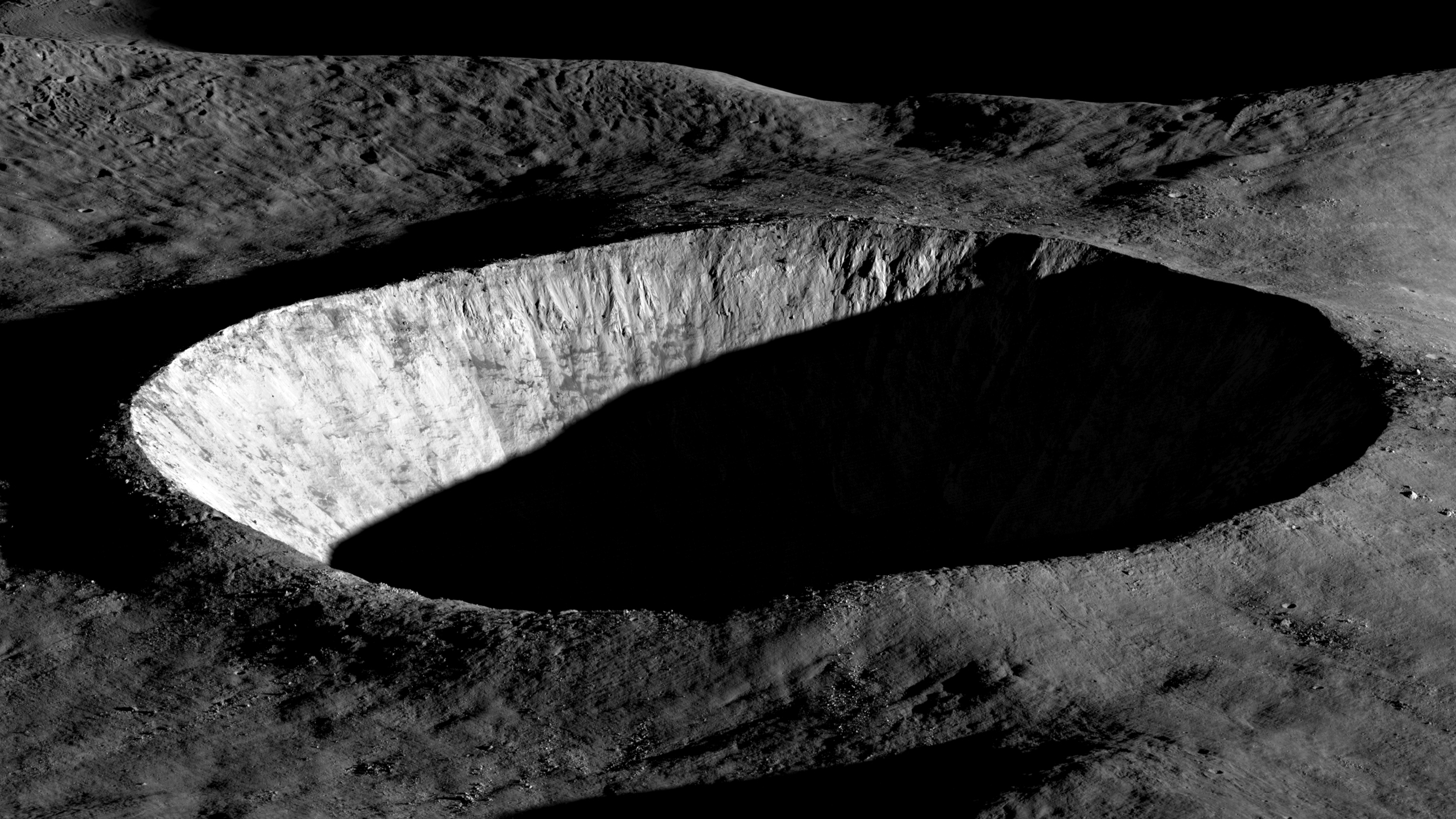
NASA released a new Lunar Reconnaissance Orbiter image showing early morning sunlight illuminating the western wall of an unnamed lunar crater. The photograph, taken on August 30, 2023, by the Lunar Reconnaissance Orbiter Camera, highlights deep interior shadows and surface textures captured as the Sun rose over the crater rim. LRO has been in lunar orbit since 2009, using its suite of instruments to make a 3D map of the lunar surface in support of future robotic and crewed missions, characterize the radiation environment, and identify potential resources. The new image contributes to ongoing efforts to document surface conditions relevant to landing‑site assessment and lunar exploration planning. (Credit: NASA’s Goddard Space Flight Center / Intuitive Machines)
Shades of a Lunar Eclipse : NASA Earth Observatory

NASA released a series of nighttime satellite images showing how moonlight reaching Earth changed during the total lunar eclipse of March 3, 2026. The NOAA‑21 satellite’s VIIRS (Visible Infrared Imaging Radiometer Suite) instrument recorded variations in surface illumination as Earth moved between the Sun and Moon, an event visible across the Americas, East Asia, Australia and the Pacific. The imagery captured shifts in reflected light over cities, coastlines and atmospheric features as the Moon dimmed and briefly turned orange‑red, “Blood Moon,” during totality. These images of the Arctic were taken about every 100 minutes, with earlier swaths toward the right and later swaths to the left.
Researchers used the dataset to track how the eclipse altered Earth’s nighttime brightness in real time, providing a detailed record of the event’s progression. (Credit: NASA Earth Observatory / Michala Garrison)
Mayon, an Erupting Volcano in Phillipines : Landsat 8, NASA

The Philippines’ Mayon Volcano, its most active volcano having erupted 65 times in the past 5,000 years, continued an active eruptive phase that began in January 2026, with satellite and ground observations documenting sustained lava effusion, rockfalls and frequent pyroclastic flows. The Philippine Institute of Volcanology and Seismology (PHIVOLCS) raised the alert level to three on a five-level scale on, January 6 after lava emerged from the summit crater and pyroclastic density currents advanced down the southeast flank.
A natural‑color Landsat scene captured on February 26, 2026, shows lava, ash and volcanic gases moving downslope from the summit crater on Luzon Island. (Credit: NASA Earth Observatory)

A Landsat 8 image from February 26 shows active lava and heat signatures as PHIVOLCS reported volcanic earthquakes and flows reaching 4 kilometers through the Mi‑isi Gully. Sulfur dioxide emissions peaked at 7,633 metric tons on March 6, the highest daily value in 15 years. Evacuations within a 6‑kilometer radius displaced hundreds of families as monitoring agencies tracked drifting SO₂ plumes and continued seismic activity. (Credit: NASA Earth Observatory)
Lake Coatepeque, El Salvador : Astronaut Photography, ISS

An astronaut aboard the International Space Station captured a natural‑color photograph of Lake Coatepeque in western El Salvador on February 10, 2026, documenting the volcanic landscape surrounding the crater lake. Coatepeque occupies a caldera formed by explosive eruptions between 72,000 and 51,000 years ago, with later activity producing lava domes along its western rim, including Isla del Cerro. No Holocene‑age eruptions have been reported. (Credit: NASA Earth Observatory)

The shoreline is now lined with homes and tourist infrastructure, extending toward the steep caldera wall that rises to Santa Ana, the country’s tallest and still‑active volcano. The image also highlights the broader Central American Volcanic Arc, a chain of volcanoes stretching more than 1,000 kilometers along the Pacific coast. (Credit: NASA Earth Observatory)
The Unusual Lake Unter-See, Antarctica : Landsat 9, NASA

Scientists released new satellite and field observations of Lake Unter‑See, a perennially frozen lake in Queen Maud Land, Antarctica, known for its unusual chemistry and microbial structures. A Landsat 9 image from February 16, 2026, shows the ice‑covered lake fed primarily by meltwater from the Anuchin Glacier. (Credit: NASA Earth Observatory)

Unter‑See contains exceptionally oxygen‑rich, alkaline waters and hosts large conical stromatolites—microbial reef structures that grow beneath several meters of ice. Researchers also confirmed that a 2019 glacial lake outburst flood from nearby Lake Ober‑See raised water levels by about 2 meters and delivered 17.5 million cubic meters of meltwater, altering the lake’s pH and carbon‑dioxide content. The event provided new insight into how periodic flooding influences Antarctic microbial ecosystems. (Credit: NASA Earth Observatory)

SCIENCE
Self‑Repairing Carbon‑Fiber Material Shows Damage Detection and Healing Capability

A 40‑cm Project Cassandra test panel, built with fiber‑optic sensors and embedded heating grids that enable ESA’s self‑healing composite to detect damage and restore structural integrity during trials. (Credit: CompPair)
The European Space Agency and industry partners advanced work on self‑repairing spacecraft structures, demonstrating composite materials designed to detect and heal early‑stage damage. Under ESA’s Project Cassandra (short for "Composite Autonomous Sensing And Repair"), teams from the Swiss companies CompPair and CSEM, and the Belgian company Com&Sens tested a carbon‑fiber composite embedded with optical sensors and a heating element. The “self-healing” composite material, ‘HealTech,’ developed by CompPair, can detect microcracks and activate a heat‑triggered healing agent to seal cracks. Tests show the composite restoring integrity when warmed to roughly 100–140°C, with infrared imaging confirming the repair process.
The self‑healing materials can flow into microfractures when warmed, restoring structural integrity after impacts or stress events. The technology is being evaluated for applications ranging from reusable vehicles to long‑duration missions, where early detection and repair of damage could limit degradation over time. ESA says the technology could support reusable launch systems and future cryogenic tanks by reducing maintenance and extending component lifetimes. Demonstrator panels have undergone controlled damage trials to validate sensing accuracy, heating performance, and repeatability of the healing cycle. Cassandra is part of ESA’s Future Innovation Research in Space Transportation (FIRST!)
Jupiter Imaging Detects Infrared Signatures From Its Moons In its Auroras

Webb captured a wide‑field infrared view of Jupiter showing the planet, its faint rings, and the small moons Amalthea and Adrastea. The composite NIRCam image, taken on 27 July 2022, also includes background galaxies visible as blurred points. (Credit: NASA, ESA, Jupiter ERS Team; image processing by Ricardo Hueso (UPV/EHU) and Judy Schmidt)

Credit: NASA, ESA, Jupiter ERS Team; image processing by Ricardo Hueso (UPV/EHU) and Judy Schmidt
New infrared observations from the James Webb Space Telescope have revealed previously unseen structure within Jupiter’s northern lights, including abrupt temperature shifts and density changes in the planet’s upper atmosphere. An international team led by Northumbria University reported the first spectral measurements of the auroral “footprints” produced by Io and Europa, showing that electrons funneled along Jupiter’s magnetic field generate sharp physical variations within Io’s footprint. While Earth’s auroras stem primarily from the solar wind, Jupiter’s displays are also shaped by its four Galilean moons, Io, Europa, Ganymede and Callisto, where each generates its own localized auroral signature on the planet.

The James Webb Space Telescope captured the auroral footprints of Io and Europa, providing the first spectral measurements of these features and revealing sharp physical changes within Io’s footprint likely caused by electrons striking Jupiter’s upper atmosphere. (Credit: NASA, ESA, CSA, Jupiter ERS Team; image processing by Judy Schmidt; Webb/NIRSpec: Katie L. Knowles (Northumbria University))
Additional Webb observations also revealed cold regions and distinct infrared signatures linked to several of Jupiter’s moons, with Io, Europa, Ganymede and Amalthea each producing detectable auroral “footprints” inside the planet’s polar oval. These features arise because Jupiter’s magnetic field rotates with the planet in roughly 10 hours, sweeping charged particles around the system, while the moons orbit far more slowly—Io in about 42.5 hours. As the moons interact with the surrounding magnetic field and plasma, they generate energetic particles that travel along magnetic field lines and strike Jupiter’s atmosphere, creating localized auroral spots that map to their orbital positions. JWST captured five images of Jupiter’s auroras, and four appeared typical. In one, however, a pronounced cold patch showed up beneath the aurora linked to Io’s footprint. While the surrounding emission held steady at about 919°F / 493°C, the cold region measured only 509°F / 265°C.
The findings, published in the journal Geophysical Research Letters indicate that Jupiter’s atmosphere responds rapidly to moon‑driven electromagnetic interactions, offering new constraints on magnetospheric processes at the solar system’s largest planet.
DART Impact Alters Binary Asteroid System’s Orbit Around The Sun

NASA’s DART mission captured this view of the larger, Didymos (left) and Dimorphos moments before colliding with the smaller asteroid on Sept. 26, 2022, an impact that measurably altered the orbit of its larger companion. (Credit: NASA/Johns Hopkins APL)
NASA confirmed that its Double Asteroid Redirection Test (DART) not only altered the orbit of Dimorphos around Didymos, but also produced a 0.15 seconds change in the binary system’s trajectory around the Sun. The smaller asteroid’s 12-hour orbital period around the nearly half-mile-wide (805-meter-wide) Didymos shortened by 33 minutes. The agency reported that ejecta from the 2022 impact reduced the system’s heliocentric orbital period by several minutes, a shift detected through continued ground‑ and space‑based observations.
“The change in the binary system’s orbital speed was about 11.7 microns per second, or 1.7 inches per hour. Over time, such a small change in an asteroid’s motion can make the difference between a hazardous object hitting or missing our planet.”
The collision also reshaped Dimorphos, dispersing debris and modifying the moonlet’s surface structure. The findings provide the most detailed assessment to date of how a kinetic impact affects a binary asteroid’s motion and physical state. NASA said the results will inform future planetary‑defense planning as researchers refine models of momentum transfer, ejecta behavior and long‑term orbital evolution following a deliberate impact.
NASA is developing the Near‑Earth Object Surveyor, a next‑generation space telescope managed by the Jet Propulsion Laboratory and designed specifically for planetary defense. The mission will search for hard‑to‑detect near‑Earth asteroids and comets, including dark objects that reflect little visible light.
China Selects Rimae Bode as the Leading Candidate Zone for First Crewed Moon Landing

Chinese astronauts Zhai Zhigang (left) and Wang Yaping (right) pose with the lunar spacesuit revealed in 2024. (Credit: CMSA)
9 March, 2026
China has identified Rimae Bode, a volcanic and topographically varied region located near the Sinus Aestuum volcanic plains, on the moon’s near side, north of the lunar equator, as a leading candidate for its first crewed lunar landing. A new analysis highlights the area’s mix of basalt plains, sinuous channels, and ancient highlands, offering access to diverse geological samples within a compact traverse zone. One of 14 finalist sites chosen from an initial list of 106, the location had to satisfy engineering requirements for a safe landing, including near‑side visibility for communications, relatively flat terrain, and a low‑latitude position to ensure adequate solar power.
A research team at the China University of Geosciences in Wuhan, has completed a detailed evaluation of a priority landing zone, offering new data that informs planning for the mission and its expected scientific return. Jun Huang and colleagues analyzed the moon’s Rimae Bode region using multiple orbital imaging sets and datasets from several spacecraft. Their assessment finds that the site combines strong scientific potential with favorable landing conditions for a future crewed mission.
The site selection follows a year of hardware testing for China’s planned pre‑2030 mission, including landing simulations, crew‑vehicle abort trials, and rocket evaluations. Researchers say Rimae Bode’s terrain could support both operational needs and scientific return, positioning it as a high‑priority target in China’s broader lunar program. The paper was published in the journal Nature Astronomy.
Comet 3I/ATLAS Shows Extreme Methanol Levels In New ALMA Data Hinting at Extra-Solar System Origins

An artist’s impression depicts 3I/ATLAS as it nears the Sun, with blue indicating methanol released on the illuminated side and orange marking hydrogen cyanide on the shaded side. (Credit: NSF/AUI/NSF NRAO/M.Weiss)
9 March, 2026
Astronomers using the Atacama Large Millimeter/submillimeter Array (ALMA) reported that interstellar comet 3I/ATLAS contains unusually high levels of methanol, placing it among the most methanol‑rich comets ever measured. Observations with ALMA’s Atacama Compact Array on multiple dates in late 2025 tracked the comet as it released gas and dust while approaching the sun, allowing researchers to analyze the chemical composition of its coma. The team measured methanol‑to‑hydrogen‑cyanide ratios of roughly 70 and 120, far exceeding values typical of solar system comets.
Data show hydrogen cyanide originating primarily from the nucleus, while methanol is released both from the nucleus and from icy grains in the coma (the cloud of gas and dust that surrounds its nucleus as sunlight warms and vaporizes its ices), marking the first detailed tracing of such outgassing behavior in an interstellar object. Previous James Webb Space Telescope observations found a carbon‑dioxide‑dominated coma. Along with the unusually high methanol‑to‑HCN ratios show that 3I/ATLAS formed in chemical conditions very different from those that shaped most comets in our solar system.
After 14 Years in Orbit, NASA Van Allen Probe A Crashes Back to Earth Early Due To Increased Solar Activity

Illustration of the identical Van Allen Probes. (Credit: JHU/APL, NASA)
11 March, 2026
NASA’s Van Allen Probe A re‑entered Earth’s atmosphere at 6:37 a.m. EDT on March 11, ending nearly 14 years in orbit and concluding a mission that produced unprecedented data on Earth’s radiation belts. The 1,323‑pound / 600-kilogram spacecraft, launched with its twin spacecraft in August 2012 for a two‑year mission, operated until 2019, studying how charged particles are gained and lost within the Van Allen belts, which shield Earth from cosmic radiation and solar storms. It was deactivated in 2019 after running out of fuel. The U.S. Space Force confirmed the probe came down over the eastern Pacific Ocean near 2 degrees south latitude and 255.3 degrees east longitude, with most components expected to burn up during reentry.
The probes were the first to operate for extended periods inside the belts, identifying phenomena such as a temporary third radiation belt during periods of intense solar activity. The mission also helped improve forecasts of space weather impacts on satellites, astronauts, and terrestrial systems. Probe A’s re‑entry occurred earlier than the original 2034 estimate due to heightened atmospheric drag from the current solar maximum. Probe B is not expected to re‑enter before 2030.
Russia Revives Venus Exploration With Venera‑D Mission Targeting 2036 Launch

The Venera‑D mission concept from the Russian Academy of Sciences’ Space Research Institute (IKI) features a three‑year Venus orbiter and a lander engineered to endure the planet’s harsh surface environment for several hours. (Credit: NASA/JPL‑Caltech)
13 March, 2026
Russia is advancing the Venera‑D mission, a long‑delayed Venus project now targeted for launch no earlier than 2036 as part of an effort to reestablish its presence in planetary exploration. The mission concept includes an orbiter designed to operate for up to three years, a lander built to withstand Venus’ extreme surface conditions for several hours, and a balloon platform to study the atmosphere. The spacecraft would launch on an Angara A5 rocket from Vostochny, and operate in a highly elliptical orbit to support remote sensing and communications.
The lander would carry instruments for imaging, atmospheric sampling, and surface analysis, continuing the legacy of the Soviet Venera program, which achieved the first successful Venus landings. Design studies remain ongoing, with Russian industry teams refining payloads, thermal protection, and descent systems. The mission follows earlier proposals for international collaboration, including with the U.S., that did not advance. Officials describe Venera‑D as a strategic step toward restoring deep‑space capabilities after years of limited planetary activity.

GOVERNANCE
US Congress Moves To Extend ISS Operations to 2032, Seeks To Maintain Lead Over China

9 March, 2026
United States Congress is increasing pressure on NASA to accelerate work on commercial space station replacements while simultaneously moving to extend International Space Station operations through 2032. A NASA Authorization bill approved by the Senate Commerce Committee directs the agency to issue the long‑delayed request for proposals for the second phase of its Commercial Low‑Earth‑Orbit Development (CLDP) program, after months of inaction cited by committee staff.
The legislation also formalizes a two‑year extension of ISS operations beyond the current 2030 retirement date, citing the need to avoid a gap in U.S. human‑spaceflight infrastructure as private stations are built. Lawmakers point to aging ISS hardware, including structural cracks and equipment failures, but argue continued operations are necessary until commercial platforms are ready.
NASA’s Commercial LEO Destinations (CLD) program, which funds early design work for private space stations, has awarded more than $500 million since 2021 primarily to Blue Origin and Voyager Technologies for development of the Orbital Reef and Starlab stations. The Senate Commerce Committee is pressuring NASA to release the long‑delayed RFP for Phase 2 CLDP, which will cover full station development and future service procurement. Meanwhile, additional private projects are advancing as well. Vast recently raised $500 million for its Haven‑2 outpost, and Axiom Space plans to operate a commercial station built from modules first launched to, and attached to, the ISS.
The NASA Authorization bill, first introduced in March 2025 and recently revised by the Senate Commerce Committee, also rejected President Trump’s proposed 24% cut to the agency and instead allocated $24.7 billion for FY 2026 and $25.3 billion for FY 2027. The bill also directs NASA to begin building a crewed lunar base, reinforcing an existing objective of the Artemis program.
The Committee believes that extending ISS operations to 2032 is necessary to maintain continuous U.S. human presence in low Earth orbit and avoid ceding leadership to China before commercial stations are ready. Staying ahead of China in human spaceflight remains a central priority for the committee and its chairman, Senator Ted Cruz, who last year held a hearing emphasizing the need for the Artemis program to return astronauts to the lunar surface before China’s planned 2030 landing. The bill’s summary frames the extension as part of that broader strategic competition.
NASA previously contracted SpaceX to develop a deorbit tug for the station, originally planned for 2030, but the extension would shift that timeline while preserving microgravity research continuity.
Lawmakers Press NASA To Build A Permanent U.S. Base On The Moon

A rendering of NASA astronauts on the lunar South Pole. (Credit: NASA)
9 March, 2026
Alongside efforts to prolong ISS operations, Congress is now pressing NASA to commit to a permanent base on the moon.
U.S. lawmakers are renewing calls for NASA to establish a permanent lunar base, framing the effort as part of a broader competition with China for leadership in deep‑space exploration. During a Senate Commerce Committee hearing, members emphasized that a sustained American presence on the lunar surface is necessary to maintain strategic and scientific advantages, noting China’s goal of landing astronauts by 2030.
"The United States is in an intensifying strategic space race with the People's Republic of China, spanning Earth's orbit, the moon, and the broader expanse of deep space," Cruz stated. "Beijing is rapidly advancing its lunar ambitions, expanding its on-orbit capabilities, constructing supporting infrastructure beyond Earth, and promoting alternative governance frameworks such as the International Lunar Research Station (ILRS) - all with a clear objective."
U.S. Senators questioned NASA officials on timelines, funding needs, and the agency’s ability to meet Artemis program milestones, while also referencing past directives—including a 2025 executive order—calling for a permanent U.S. foothold on the moon by the end of the decade. The discussion highlighted concerns that delays in Artemis missions could allow China to reach key milestones first, shaping future norms for lunar activity. Lawmakers said a long‑term base would support science, resource utilization, and extended human operations, but acknowledged the scale of the technical and budgetary challenges involved.
SpaceX Plan For One Million AI Satellites Raises Major Astronomy Concerns

A composite image from 14 cameras shows satellite activity over Eureka, in the Canadian territory of Nunavut, on February 22, 2025. Each streak represents a single satellite crossing the sky. (Credit: U. Western and Defence R&D Canada)
13 March, 2026
SpaceX’s proposal to deploy up to 1 million solar‑powered satellites as orbital AI data centers is drawing strong criticism from astronomers, who warn the constellation could severely disrupt ground‑based observations. The plan, filed with the FCC in January 2026, would place the satellites in higher orbits than Starlink, leaving many illuminated throughout the night and potentially making tens of thousands visible at once, increasing sky brightness and contaminating telescope images with streaks.
Estimates suggest each orbital data‑center satellite could span about 100 meters / 330 feet and operate in sunlit, pole‑to‑pole orbits between 500 to 2000 kilometers / 310 and 1,243 miles. According to astronomer John Barentine, most existing constellations fly lower and spend much of the night in Earth’s shadow, but these higher‑inclination satellites would remain illuminated by the Sun even at midnight, making them far more visible from the ground.
Scientists say the scale of the network, far exceeding the roughly 10,000 Starlink satellites already in orbit, poses unprecedented challenges for optical and radio astronomy. The proposal has also triggered regulatory and industry pushback. Amazon urged the FCC to reject the application, calling it a speculative plan lacking technical detail, while FCC Chair Brendan Carr criticized Amazon for opposing the project despite falling behind on its own satellite deployment milestones.

MILITARY
BAE Systems Passes US Space Force Preliminary Design Review For Missile Warning/Tracking Constellation

The MEO‑based Epoch 2 architecture will supply missile warning and tracking from space, covering ballistic missiles and advanced threats like hypersonic glide vehicles. (Credit: BAE Systems)
9 March, 2026
The U.S. Space Force has completed its government-led preliminary design review (PDR) of BAE Systems’ proposed architecture for the Resilient Missile Warning and Tracking (RWMT) Epoch 2 constellation, advancing development of a 10‑satellite medium Earth orbit (MEO) system intended to track ballistic and advanced missile threats. Space Systems Command (SSC) said the milestone was achieved nine months after awarding BAE Systems a $1.2 billion firm‑fixed‑price contract in May 2025. The review covered spacecraft designs and associated ground command‑and‑control infrastructure, establishing the technical baseline for the program. A critical design review is scheduled for this summer.
BAE Systems, serving as prime contractor, will design and build the satellites and associated systems under a four‑year delivery timeline followed by five years of operations and support. The Epoch 2 constellation is intended to expand the capabilities of the earlier Epoch 1 architecture and provide global, resilient coverage against emerging threats, including hypersonic glide vehicles. Completion of the design review allows BAE Systems to proceed toward finalizing the spacecraft configuration and preparing for subsequent production phases.
Anduril Acquires ExoAnalytic To Expand Space Domain Awareness Capabilities

Credit: Anduril
11 March, 2026
Anduril has reached an agreement to acquire ExoAnalytic Solutions, a move that will expand its space domain awareness and missile defense portfolio and significantly increase the size of its space division. The company said the acquisition will integrate ExoAnalytic’s global network of optical sensors, real‑time tracking software, and data analytics capabilities with Anduril’s autonomous defense systems. ExoAnalytic operates one of the world’s largest commercial space‑tracking sensor networks, supporting government and commercial customers with monitoring of satellites, debris, and missile threats.
ExoAnalytic, a California‑based company with about 130 employees, will more than double the size of Anduril’s 120‑person space division once integrated. Anduril said the combined capabilities will enhance its work on integrated air and missile defense, space command‑and‑control, and autonomous sensing architectures. The acquisition follows Anduril’s recent expansion of its space unit, which has doubled in size over the past year. Terms of the transaction were not disclosed. ExoAnalytic will continue supporting existing programs as integration proceeds, including U.S. government contracts focused on space domain awareness and missile defense mission areas.
Anduril is already active in space domain awareness through a $100 million award from November 2024 to deploy its Lattice operating system for a ground‑sensor mesh network used to track space objects.
SES Teleport In Israel Is Hit By Missile Amid Regional Tensions

Israel’s SES Ha’Ela Valley Teleport Was Damaged In A Missile Strike. (Credit: via X)
11 March, 2026
Luxembourg-based satellite operator SES has reported that a missile struck its Emek Ha’ela teleport in Israel on March 9, damaging part of the geostationary antenna field but causing no injuries and leaving the main facility operational. The company reported that power, connectivity, and all services not reliant on the affected antennas continued normally, and that its business continuity plan was activated with restoration paths in place. The site is one of 45 SES teleports supporting GEO broadband and TV broadcast services, in addition to nine teleports dedicated to its medium Earth orbit constellation.
Hezbollah claimed responsibility for the strike through an affiliated media outlet, describing the site as linked to the Israeli military’s cyber and communications division. Israeli reports said the facility was privatized in 2008 after being established in the early 1970s. SES cited significant redundancy but declined to detail backup arrangements, noting the teleport also supports government customers.
Leonardo Sets 2026 Field Test With Ukraine For Michelangelo Security Dome
12 March, 2026
Italian defense and aerospace company, Leonardo will conduct the first field test of its Michelangelo multi‑domain “security dome” architecture in Ukraine by the end of 2026, CEO Roberto Cingolani said March 12. Announced in November 2025, Michelangelo is designed as an interoperable air, land, maritime, and space system integrating platforms and sensors for threat detection and tracking. The roadmap includes launching Leonardo’s 20‑satellite Space Guardian Earth‑observation constellation in two tranches between late 2027 and 2028, reaching full operations in 2029 and beginning integration with other early‑warning constellations in 2030.
Leonardo said Michelangelo could generate €21 billion in business opportunities through 2035 and is under evaluation by more than 20 countries. The initiative emerges alongside other European air and missile defense efforts, including the European Commission’s planned space shield and Thales Alenia Space’s newly announced SkyDefender system. Cingolani said there has been no coordination with Thales and described Michelangelo as an open architecture compatible with other systems.

COMMERCIAL
SSTL To Build Spacecraft Platform For Schmidt Sciences’ Privately Funded Lazuli Deep‑Space Observatory

A rendering of Lazuli, a space telescope with a mirror three meters across being developed privately. (Credit: Schmidt Sciences)
9 March, 2026
Surrey Satellite Technology Ltd (SSTL), the British small satellite developer, was selected by Schmidt Sciences to supply the spacecraft platform for Lazuli, a privately funded space telescope featuring a three‑meter primary mirror, larger than Hubble’s. Announced March 9, the contract tasks the British firm with providing attitude control, propulsion, and communications for the mission, part of the Eric and Wendy Schmidt Observatory System that also includes three ground‑based facilities. Eric Schmidt was Google's CEO from 2001 to 2011.
Lazuli is slated to launch as early as mid‑2028, with final assembly planned near its Florida launch site using off‑the‑shelf components. Schmidt Sciences estimates mission costs in the hundreds of millions of dollars, about one‑tenth that of a NASA flagship. SSTL, which has built more than 70 spacecraft over four decades, said its small‑satellite development approach can scale to larger observatories. A chart shown at the January announcement indicated a launch from a Cape Canaveral pad used by Relativity Space, whose chief executive is Eric Schmidt. SSTL did not disclose the value of the Lazuli contract.
Funding and Acquisition Momentum Builds Across Lunar, Orbital, And Earth‑Observation Sectors
New Funding And Deals Across Voyager, Max Space, Lux Aeterna, China's BlueStar, Mantis, iMetalX, York, Orbion and, Austria’s Enpulsion and Another Earth.
Capital continues to flow into space infrastructure, with new funding rounds and acquisitions spanning lunar habitats, reusable satellites, optical communications, in‑space energy, propulsion, and AI‑driven Earth observation.
9 March, 2026

Credit: Max Space/Voyager Technologies
Commercial and defense space infrastructure company Voyager Technologies announced a multi‑million‑dollar, low‑eight‑figure strategic investment in space-habitat startup Max Space to accelerate development of next‑generation expandable space habitats aimed at sustained lunar operations and future deep‑space missions. The funding will support internal research and development, manufacturing scale‑up, and mission integration for soft‑goods habitat modules that can expand to as much as 20 times their stowed volume, offering higher usable space per launch mass than traditional rigid structures.
Voyager is also developing Starlab with Airbus, a commercial space station selected by NASA as one of several private LEO destinations intended to succeed the ISS after its planned retirement in the 2030s. Voyager and Max Space as among the companies “betting millions” that expandable habitats could be used for future Artemis lunar bases, though NASA has not yet selected specific surface habitat architectures.

An illustration of Lux Aeterna’s Delphi‑1 reusable satellite after reentry. (Credit: Lux Aeterna)
10 March, 2026
In orbital infrastructure, Lux Aeterna closed a $10 million seed round to develop Delphi, a fully reusable satellite platform designed to be refurbished and relaunched rather than deorbited at end of life. The company aims to reduce spacecraft replacement costs and on‑orbit debris by enabling satellites to be recovered, serviced, and flown again, positioning Delphi as a reusable bus for multiple missions over time. The seed funding will support engineering, testing, and early customer engagements for the reusable system.
11 March, 2026
China’s optical communications sector saw a major capital infusion as Bluestar Optical Domain raised 500 million yuan / $72 million in a Series C round to expand manufacturing of laser communication terminals for China’s planned Guowang and Thousand Sails (Qianfan) megaconstellations. The funding will help production and deployment of laser links for high‑throughput, low‑latency data transfer between satellites and between space and ground, supporting domestic broadband, remote sensing, and government applications.
The Shanghai‑based firm plans to upgrade production capacity to 1,000 units annually by mid‑2026 and increase localization of core components, including high‑end chips and high‑power lasers. The investment comes as China finalizes its 15th Five‑Year Plan, which prioritizes satellite internet and integrated space‑air‑ground networks. BlueStar, founded in 2021, completed its first in‑orbit tests in 2022 and expects rising demand as launches resume March 12.

Credit: Mantis Space
11 March, 2026
In the emerging in‑space energy segment, Mantis Space exited stealth with a $10 million seed round to develop a constellation that beams power to satellites from low medium‑Earth orbit. Described as an “orbital energy firm,” the company is working on systems to generate and distribute power in space, with concepts that include beamed energy or in‑orbit power services for satellites and future platforms. The seed funding will be used to mature core technologies, build initial hardware, and engage prospective government and commercial customers interested in outsourced power solutions in orbit. The funding, led by Rule 1 Ventures and Montauk Capital, will support workforce expansion and a new 2,000‑square‑meter headquarters in Albuquerque, backed by $24 million in state and city incentives.
The company was co‑founded by CEO Eric Truitt, who previously helped lead defense tech provider BlueHalo’s $4.5 billion sale to AeroVironment and earlier co‑founded PredaSAR and Terran Orbital. Chief engineer John Sandusky joined after more than two decades overseeing space, solar, and laser programs at Sandia National Laboratories. Director of optical engineering Greg Brady previously designed Apple’s Face ID and multiple camera systems before serving on the team responsible for the James Webb Space Telescope’s Optical Telescope Element.

Credit: iMetalX
11 March, 2026
iMetalX emerged from stealth to announce a partnership with autonomous navigation provider for GPS-denied environments Psionic. The partnership would pair Psionic’s Space Navigation Doppler Lidar with iMetalX’s Asgard data and simulation platform to generate high‑fidelity 3D models of resident space objects within minutes. The companies say the combined system is designed to support autonomous navigation and integrate with U.S. Space Force and Space Development Agency architectures. iMetalX, which pivoted from metallurgy and autonomous systems after the 2019 Hyperspace Challenge, has secured $6.2 million in military contracts and plans ground and in‑orbit testing of its Asgard and Thor platforms across more than seven missions beginning in 2027.

Credit: Enpulsion
11 March, 2026
Austria-based Enpulsion raised €22.5 million / $26 million in its first major external round to scale production of its field‑emission electric propulsion systems and expand into integrated mobility solutions. The funding, led by Germany’s Nordwind Growth, will support U.S. expansion, new assembly and testing capabilities, and potential acquisitions of complementary technologies.
The electric thruster manufacturer for small satellites, which has more than 320 thrusters operating in orbit with 500 combined flight‑years, plans to use the funds to offer bundled mobility packages (combining thrusters with components, such as attitude determination and control systems) as customers seek more powerful and reliable systems. CEO Alexander Reissner said rising institutional spending and stricter supply‑chain requirements are likely to accelerate consolidation across Europe’s propulsion sector.

Final testing of an Orbion Aurora integrated propulsion system prior to delivery. (Credit: Orbion Space)
12 March, 2026
On the M&A front, York Space Systems acquired Orbion Space Technology in a move to strengthen its spacecraft supply chain with flight‑proven electric propulsion capabilities. Orbion, known for its Hall‑effect thrusters for small and medium satellites, will bring in‑house propulsion manufacturing and expertise to York’s standardized satellite bus line.
The acquisition is expected to streamline integration, reduce schedule risk, and offer customers vertically integrated platforms with propulsion, avionics, and structures under a single provider. Orbion will continue operations under the York umbrella, supporting both existing and future government and commercial programs.
12 March, 2026
In Europe, Vienna‑based startup Another Earth raised €3.5 million / about $4.1 million to advance its AI‑driven Earth observation platform. The company is building tools that apply machine learning to satellite imagery for applications such as environmental monitoring, infrastructure analysis, and risk assessment.
The funding will support product development, expansion of its engineering and data science teams, and new partnerships with satellite operators and data providers. Access to high‑quality training data remains limited in earth observation, as satellite imagery is expensive, especially in remote areas, and requires extensive manual labeling. The company aims to make complex EO analytics more accessible to non‑specialist users through automated insights and user‑friendly interfaces.
Across these deals, investors are concentrating capital in enabling infrastructure rather than single‑mission payloads: expandable habitats for future lunar bases, reusable satellite buses, high‑capacity optical links, orbital power services, integrated propulsion, and AI‑enhanced Earth observation analytics. Both established primes and startups are positioning for long‑duration human activity beyond low Earth orbit, higher‑throughput data networks, and more flexible, service‑oriented models for operating hardware in space.
Heavy‑Lift Efforts Advance As China’s Landspace Tests 220‑Ton Methalox Engine And SpaceX Readies Starship V3
China’s Landspace and the U.S.-based SpaceX reported new progress on their respective heavy‑lift launch systems, with Landspace advancing methane‑engine testing and SpaceX announcing preparations for its next Starship test flight in South Texas amid ongoing development challenges.

China’s homegrown “Lanyan” full‑flow staged‑combustion methane engine, rated at 220 tons of thrust, recently completed a long‑duration full‑system test, China Media Group reported. (Credit: Echinanews)
10 March, 2026
Landspace reported that its ‘Lanyan’ or BF‑20 (Blue Flame) methane‑oxygen engine reached 220 tons of thrust in a recent long-duration full-system hot-fire test, a performance level the company says meets requirements for its planned Zhuque‑3 heavy‑lift reusable rocket. The engine is designed for reusability and higher thrust to support larger payloads. The milestone, although lower than SpaceX’s ‘Raptor 2,’ marks one of the highest thrust levels publicly reported by a Chinese commercial methane engine program.

Starship V3 completes test operations ahead of launch. (Credit: SpaceX)
Meanwhile, SpaceX is approximately four weeks from launching what CEO Elon Musk described as the most powerful Starship to date, ‘Version 3’. The upcoming flight will incorporate upgraded Raptor engines, structural modifications to both stages, and expanded test objectives following earlier integrated flight tests.
Starship V2 flew its final mission during Flight 11 last October, following a recovery from early‑2025 failures that saw the Ship upper stage explode on three flights in January, March and May 2025. SpaceX ended the year with two successful missions, but hit fresh challenges while preparing its V3 hardware. The V3 upgrade introduces major changes to Starship’s Super Heavy booster and Ship upper stage (Ship 39), with both stages slightly taller and powered by higher‑thrust, more efficient Raptor 3 engines. Earlier Starship versions were already the largest and most powerful rockets to fly, and V3 increases performance further.
Designed for full reusability, Starship remains central to NASA’s Artemis lunar lander architecture and SpaceX’s long‑term plans for high‑capacity orbital and deep‑space missions.
Starlab Space Station Commercial Payload Slots Fully Booked While Awaiting NASA’s Next CLD Phase

A rendering of the Starlab commercial space station being developed by Starlab Space. (Credit: Starlab Space)
10 March, 2026
Starlab Space has announced that all commercial payload capacity for its planned commercial space station has been reserved as the joint venture awaits the next phase of NASA’s Commercial Low Earth Orbit Destinations (CLD) program. Voyager Technologies chief executive Dylan Taylor said on a March 10 earnings call that the reservations provide early visibility into future utilization, noting the station is not scheduled to reach orbit for 36 months. The announcement coincided with Starlab Space confirming that German biotech firm Yuri has secured dedicated payload capacity for the station’s entire first year of operations.
Voyager chief financial officer Filipe de Sousa said the company has booked $6 million in Starlab‑related backlog, ahead of expectations. Starlab is developed and operated by Starlab Space, a US-led global joint venture where Voyager holds a 61.9% stake and includes Airbus, with strategic partnership and equity from Mitsubishi Corporation, MDA Space, and Palantir Technologies. NASA has disbursed $183 million of a $218 million Space Act Agreement supporting Phase 1 of the CLD program.
NASA has yet to release the revised Phase 2 solicitation, prompting Senate legislation extending the International Space Station to 2032 and directing the agency to accelerate the program. Taylor said he expects the request for proposals within 60 days. Starlab Space continues to raise private investment and holds a $90 million launch contract to send the station to orbit on SpaceX’s Starship.
Eutelsat Ends Russian Satellite Leases After Failure And Sanctions Impact
13 March, 2026
Eutelsat has ended its leases on two Russian satellites after one suffered an in‑orbit failure and the other prepared to shift orbital position, closing out agreements affected by Western sanctions and the broader decline of geostationary television markets. The operator had expected to lease capacity on Express‑AT1 and Express‑AT2 for at least three more years. RSCC, Russia’s state-owned operator, said Express‑AT1 ceased operating March 4 for unknown reasons and was declared lost after manufacturer ISS Reshetnev was unable to restore service. A competitive process is underway to procure a replacement, Express‑AT3, for launch in 2030.
Eutelsat had leased 19 of Express‑AT1’s 32 Ku‑band transponders and eight of Express‑AT2’s 16. The company said March 12 it expects a “low single‑digit million” revenue impact from ending the contracts, with virtually no effect on EBITDA because it will no longer pay for the capacity. Eutelsat now counts 31 GEO satellites, including Express‑AMU1, marketed as Eutelsat 36C. Video revenues fell 12.3% in the six months ending December 31, while OneWeb LEO broadband sales rose nearly 60% to €111 million, accounting for about 20% of total revenue.
Despatch Out. 👽🛸
