

{{First_Name|Explorer}}, welcome back!🚀
Beautiful images and interesting updates from space science and governance this week. US Space Force and the Department of War find a lot of funding-related mentions.
Having trouble with links? Click the link below to read the unclipped publication. ↓
Dive in.

IMAGES
Sombrero Galaxy / Messier 104 : DECam

A new DECam (Department of Energy-fabricated Dark Energy Camera) image from the US NSF’s Víctor M. Blanco 4‑meter Telescope at Cerro Tololo Inter-American Observatory in Chile, shows the Sombrero Galaxy (Messier 104) with its bright central bulge, extended stellar halo and sharply defined dust‑laden disk. The observation highlights the galaxy’s tilted orientation, which accentuates the dark lane encircling its midsection and the diffuse halo stretching far beyond the disk. (Credit: CTIO/NOIRLab/DOE/NSF/AURA; Image Processing: T.A. Rector (University of Alaska Anchorage/NSF NOIRLab), D. de Martin & M. Zamani (NSF NOIRLab))

Credit: CTIO/NOIRLab/DOE/NSF/AURA; Image Processing: T.A. Rector (University of Alaska Anchorage/NSF NOIRLab), D. de Martin & M. Zamani (NSF NOIRLab)
Buckyballs In A Planetary Nebula : James Webb Space Telescope

James Webb Space Telescope has been used to get the first detailed mid‑infrared view of the planetary nebula Tc 1, the source where astronomers first confirmed cosmic buckyballs in 2010.
The JWST MIRI data, combining nine filters spanning wavelengths from 5.6 to 25.5 microns (well beyond what the human eye can detect), reveals blue‑hued hotter gas at shorter mid-infrared wavelengths, red‑toned cooler material, and intricate shells, rays and filaments surrounding the nebula’s central white dwarf. The JWST looked 10,000 light-years away into space to trace the origin of buckyballs, large and hollow molecules where atoms are arranged in manner similar to the tiling on a soccer ball.
The Western University, Canada team reports that C60 molecules form a thin spherical shell around the star, while an unusual curved structure resembling an inverted question mark appears near the center. The observations, part of JWST program GO‑4706, include integral‑field spectroscopy that maps the nebula’s chemistry and will support multiple forthcoming studies. (Credit: Processed by Katelyn Beecroft using PixInsight; NASA / ESA / CSA / Western University, J. Cami)

Buckyballs or Buckminsterfullerenes (C60) are a form of polycyclic aromatic hydrocarbons (PAHs), a family of organic molecules considered fundamental building blocks of life. Each PAH produces its own distinct spectral signature, even though members of the group share common chemical traits. This artist's concept of buckyball molecules is seen against the backdrop of the Small Magellanic Cloud, which was imaged by NASA's Spitzer Space Telescope. In 2010 Spitzer discovered huge quantities of buckyballs in space, and the new study further suggests that these molecules are common across the universe. (Credits: NASA/JPL-Caltech)
Shifting Ancient Ashes On Mars : Mars Express

ESA’s Mars Express High Resolution Stereo Camera captured a new view of Utopia Planitia showing dark volcanic ash advancing across the landscape over recent decades, a change first noted by comparing the scene with NASA Viking images from 1976. The frame shows bright tan dust abutting darker mafic material composed of olivine- and pyroxene‑rich ash likely redistributed by winds or exposed as overlying dust eroded away.
A 15‑kilometer impact crater sits within the ash layer, surrounded by a lighter ejecta blanket and marked by internal ice‑related flow features. To the east, scalloped depressions indicate periglacial terrain shaped by subsurface ice loss, while the western portion displays long graben‑like fractures formed by crustal weakening or tectonic activity. The region lies within the 3,300‑kilometer‑wide Utopia Planitia basin, once thought to host standing water and still containing buried ice. The image continues Mars Express’s two decades of high‑resolution mapping of the planet’s surface. (Credit: ESA/DLR/FU Berlin)

A patch of Mars imaged by NASA's Viking orbiters in 1976. The white box outlines the region captured in detail by the High Resolution Stereo Camera on ESA's Mars Express mission in 2024, which is also shown above. (Credit: NASA)

The same patch of Mars imaged by ESA's Mars Express orbiter in 2024. The white box outlines the region captured in detail by the High Resolution Stereo Camera on ESA's Mars Express mission in 2024, which is also shown above. (Credit: NASA)
Sun Released Two Colossal Solar Flares : NOAA, NASA SDO
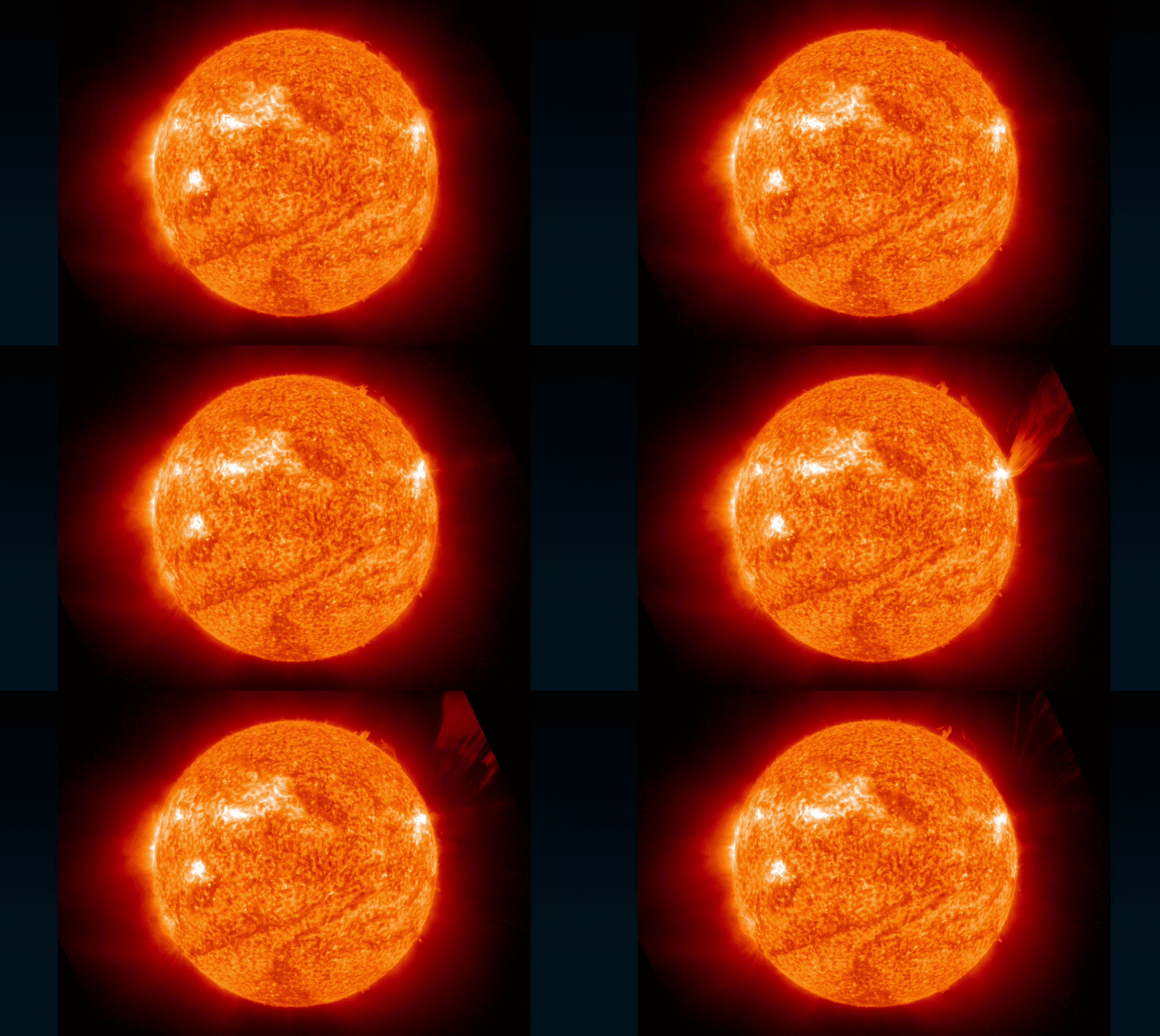
A NASA Solar Dynamics Observatory captured two X‑class eruptions that peaked at 9:07 p.m. EDT on April 23 and 4:14 a.m. EDT on April 24, classified as X2.4 and X2.5 events. Seen here is the first of the two eruptions. The bursts released intense X‑ray and ultraviolet radiation that rapidly ionized the ionosphere, disrupting shortwave radio communications over the Pacific Ocean and Australia during the first flare and East Asia during the second. (Credit: NOAA GOES-19)
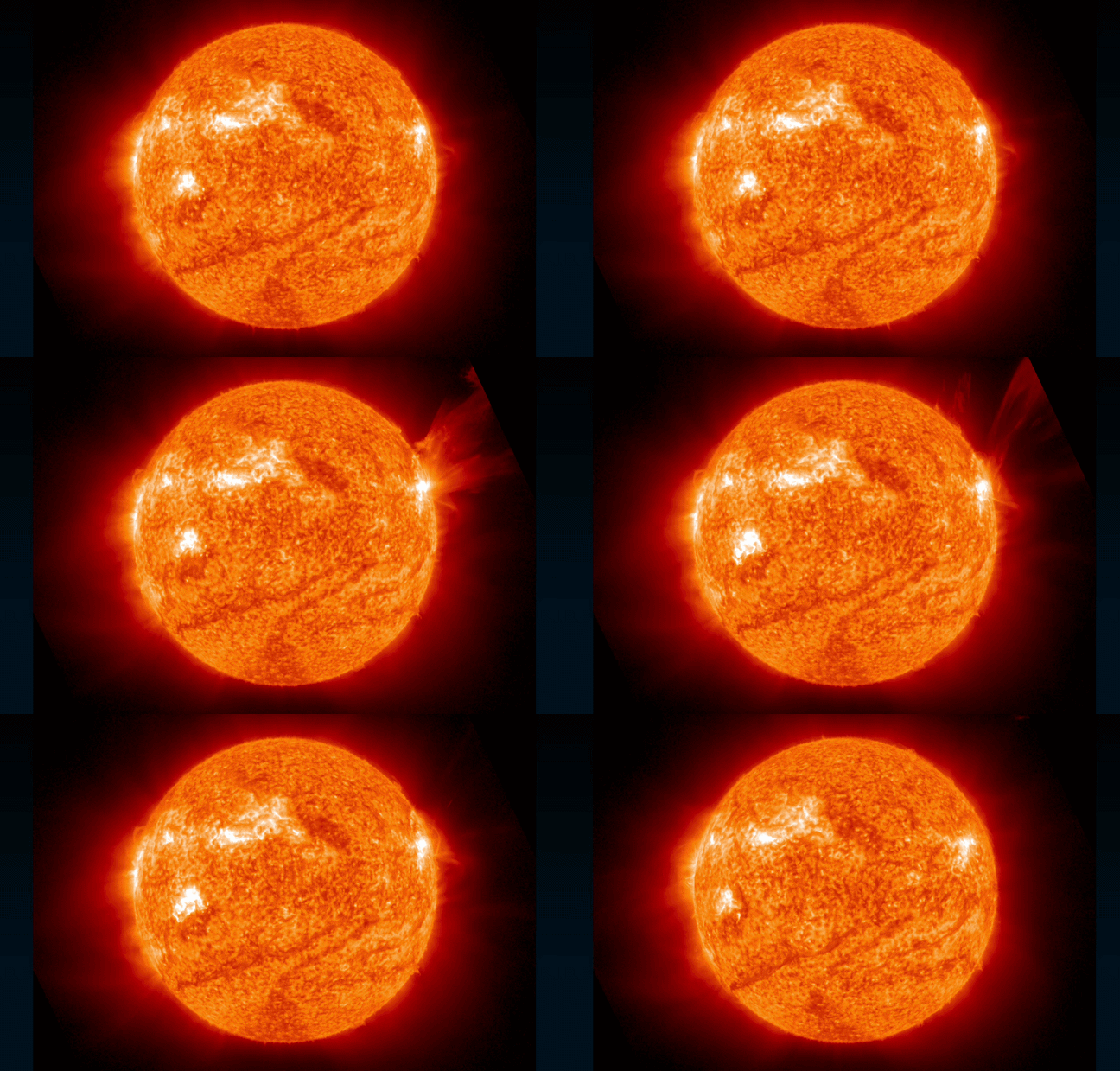
Seen here is the second eruption. Both flares originated near the Sun’s western limb, from a sunspot region AR4419, making any associated coronal mass ejections unlikely to strike Earth directly, though forecasters noted a glancing impact remained possible. These were the strongest solar flares in 78 days, following multiple M‑class eruptions and a rare sympathetic flare earlier on April 23. (Credit: NOAA GOES-19)

NASA’s Solar Dynamics Observatory captured these images of solar flares, seen as the bright flashes in the top right, on April 23 and 24, 2026. The images show a subset of extreme ultraviolet light that highlights the extremely hot material in flares and which is colorized in in gold and blue on the left and teal on the right. (Credit: NASA/SDO)
The Lunar Terminator : Artemis II

A photo taken on April 6, 2026 shows the Moon’s far side along the terminator, the boundary between lunar day and night, where low‑angle sunlight casts long shadows across cratered terrain. A portion of the Orientale Basin appears along the upper right of the disk, its multi‑ring structure highlighted by grazing illumination. The contrast between illuminated and shadowed regions reveals subtle variations in surface topography. (Credit: NASA)
Lyrid Meteor Spotted : Astronaut Jessica Meir, ISS

NASA astronaut Jessica Meir photographed a Lyrid meteor streaking through Earth’s atmosphere from the International Space Station on April 20, ahead of the shower’s April 21–22 peak. A 3‑second exposure taken from the station’s cupola shows a bright Lyrid meteor cutting across the limb of Earth, with city‑light trails and red airglow visible beneath the horizon. The annual Lyrid shower, produced by debris from long‑period comet C/1861 G1 Thatcher, typically generates 15–20 meteors per hour as Earth passes through the comet’s dust stream. The image captures the event from above the atmosphere, offering a perspective distinct from ground‑based views recorded the same morning in Canada and Maryland. (Credit: NASA/Jessica Meir)

SCIENCE
NASA Shuts Down Long‑Running Voyager 1 Instrument To Conserve Power

Because Voyager 1 is over 15 billion miles / 25 billion kilometers from Earth, the shutdown commands take about 23 hours to arrive, and the process lasts roughly three hours. A low‑power motor that rotates the LECP sensor will remain active to preserve the option of reactivating the instrument if future power margins allow. (Credit: NASA/JPL - Caltech)
20 April, 2026
NASA engineers at the Jet Propulsion Laboratory (JPL) shut down Voyager 1’s Low‑energy Charged Particles experiment (LECP) on April 17 to conserve power and keep the 49‑year‑old spacecraft operating as its radioisotope thermoelectric generator (a device that converts heat from decaying plutonium into electricity) continues to lose about 4 watts annually. The instrument, which has measured ions, electrons and cosmic rays since 1977 and helped map pressure fronts and particle density beyond the heliosphere, was next on a long‑planned shutdown sequence agreed upon by the mission’s science and engineering teams.
The move follows an unexpected power drop during a February 27 roll maneuver that risked triggering the probe’s undervoltage protection system in case of any additional drop. Voyager 1 continues to operate two remaining instruments that monitor plasma waves and magnetic fields. Engineers expect the shutdown to provide roughly a year of margin as they prepare a broader power‑saving reconfiguration known as “the Big Bang,” to be tested on Voyager 2 in May and June before attempting the same changes on Voyager 1 no earlier than July.
Seven of the ten instrument suites on each Voyager spacecraft have already been deactivated, and Voyager 1’s LECP was next on that list, following Voyager 2’s shutdown of the same instrument in March 2025.
Astronauts Misjudge Grip Strength In Microgravity And After Earth Return

ESA astronaut Samantha Christoforetti works out on the Advanced Resistive Exercise Device on the ISS. (Credit: NASA)
20 April, 2026
A new study of 11 European Space Agency astronauts finds that crews living for months in microgravity consistently misjudge how much force is needed to grasp objects, both in orbit and after returning to Earth. Researchers from the Université catholique de Louvain and Ikerbasque tracked grip force and movement before flight, aboard the International Space Station, and post‑landing, concluding that astronauts’ brains continue to rely on Earth‑trained expectations of gravity even when none is present.
In space, participants routinely applied more force than required, while after landing they struggled to recalibrate and often under or over‑gripped objects for months. The team attributes the effect to the brain’s slow adjustment to changes in gravitational context and warns that grip miscalibration could affect tasks ranging from equipment handling to robotic‑arm operations and spacewalk safety. The findings were published April 20 in the Journal of Neuroscience.
Vast Interstellar Ice Reservoirs Mapped In The Milky Way’s Active Star‑Forming Regions

The chemical signatures of water ice (shown in bright blue) and polycyclic aromatic hydrocarbons (orange) in Cygnus X, one of the most active and turbulent regions of star birth in our Milky Way galaxy. (Credit: Credits: NASA/JPL-Caltech/IPAC/Hora et al.)

The same region shown in the previous image is presented here at three wavelengths, mapped to green, blue, and red. (Credit: NASA/JPL‑Caltech/IPAC/Hora et al.)
20 April, 2026
NASA’s SPHEREx mission has produced the first large‑scale maps of interstellar ice across the Milky Way, revealing extensive reservoirs of water, carbon dioxide, and carbon monoxide frozen onto dust grains inside giant molecular clouds. New observations of the Cygnus X star‑forming complex, one of the Milky Way’s most active stellar nurseries, show dense ice structures precisely aligned with dark dust lanes, confirming that dust shields these molecules from ultraviolet radiation emitted by young stars. The findings, published in The Astrophysical Journal, reveal diffuse background light passing through entire dust clouds rather than only along sightlines to bright stars, allowing researchers to trace ice concentrations across the galactic plane. They also demonstrate that SPHEREx (Spectro-Photometer for the History of the Universe, Epoch of Reionization, and Ices Explorer) can trace the spatial distribution of ices across regions more than 600 light‑years wide, offering a “big picture” view unattainable with targeted observations from telescopes such as JWST or Spitzer.
The data show that water ice is unevenly distributed, accumulating in dense dust lanes that shield molecules from ultraviolet radiation generated by newborn stars. Scientists say these “interstellar glaciers” represent a major reservoir of the galaxy’s water and likely supply material to emerging planetary systems. SPHEREx, now conducting a two‑year all‑sky survey, will continue mapping how ices respond to varying radiation environments to build a broader picture of chemical evolution in the Milky Way.
Launched in March 2025, SPHEREx has completed its first all‑sky infrared map, using 102 spectral channels to characterize galaxies, star‑forming regions, and chemical environments. The mission is managed by JPL with data processing at Caltech’s IPAC and contributions from U.S., South Korean, and Taiwanese institutions.
Mars Presents Basin Scale Ancient Ocean Signature And Newly Identified Building Blocks of Life

A cropped view from NASA’s Curiosity rover shows terrain within the Kimberley formation as the rover continued its southward drive toward the center of Gale Crater. Recent spectroscopy measurements indicate that subsurface soils in this area contain water‑equivalent hydrogen amounting to roughly 1.5% to 2.5% of their total weight. (Credit: NASA/JPL‑Caltech/MSSS)
20 - 21 April, 2026
Caltech researchers have identified a broad topographic “bathtub ring” in Mars’ northern hemisphere that is the strongest evidence yet for a long‑lived ancient ocean.
A new analysis of global elevation data from orbiters shows a wide, low‑gradient band of land encircling the northern lowlands, analogous to Earth’s continental shelf, which forms only through prolonged interaction between land and ocean, ‘like a ring that remains around a drained bathtub.’ The feature aligns with previously mapped river deltas, suggesting sustained water levels and an ocean that may have covered up to a third of the planet’s surface. The work addresses long‑standing inconsistencies in proposed Martian shorelines, which appear at varying elevations and have complicated interpretations for decades. Researchers used computer simulations that “drained” Earth’s oceans to identify persistent landforms, then applied the same approach to Mars to isolate the shelf‑like ring. The findings, published in Nature, strengthen the case that Mars once hosted a stable, long‑duration ocean rather than isolated lakes or transient seas.

This is an annotated close-up of three holes NASA’s Curiosity drilled into Martian rock at a location nicknamed “Mary Anning” in October 2020. The sample where the rover found a diverse number of organic molecules came from “Mary Anning 3.” (A nearby spot nicknamed “Mary Anning 2” went unused.) (Credit: NASA/JPL-Caltech/MSSS)
Meanwhile, NASA’s Curiosity rover has identified more than 20 organic molecules, some of which considered building blocks for the origin of life and never seen before on Mars, in 3.5‑billion‑year‑old clay‑bearing sandstones in Gale Crater.
The Sample Analysis at Mars (SAM) instrument detected nitrogen and sulfur‑bearing compounds and several organics not previously confirmed on Mars, including benzothiophene, a carbon- and sulfur-bearing molecule that’s been found in many meteorites. Researchers interpret the results as breakdown products of ancient macromolecular carbon preserved despite radiation and diagenesis. The findings align with Perseverance rover detections and expand evidence that diverse organic matter persists in multiple Martian environments, informing future life‑detection instruments. This was also the first use of a tetramethylammonium hydroxide (TMAH) wet‑chemistry experiment on another planet, a method used to detect organic molecules in Mar's clay-rich sandstone.
Nancy Grace Roman Space Telescope Reaches Completion, To Be Launched In Early September 2026

NASA’s Nancy Grace Roman Space Telescope is photographed in the largest clean room at the agency’s Goddard Space Flight Center. (Credit: NASA/Scott Wiessinger)
21 April, 2026
NASA’s Nancy Grace Roman Space Telescope is fully assembled, has completed environmental testing, and is now targeting an early September 2026 launch, eight months ahead of its contractual May 2027 deadline.
NASA has completed construction of the Nancy Grace Roman Space Telescope following successful integration and environmental testing at Goddard Space Flight Center. Administrator Jared Isaacman announced the schedule shift during an April 21 media event, crediting the acceleration to coordinated work across NASA centers, industry partners, and international contributors. cerebral-overload The fully assembled observatory will ship to Kennedy Space Center for final preparations before launching on a SpaceX Falcon Heavy.
Roman carries a 2.4‑meter mirror and a Wide Field Instrument offering a field of view at least 100 times larger than Hubble’s, enabling rapid infrared surveys of dark energy, dark matter, galaxy evolution, and exoplanets. The mission is expected to collect roughly 20,000 terabytes of data over its five‑year primary phase, identifying up to 100,000 exoplanets and imaging hundreds of millions of galaxies. International partners include ESA, JAXA, CNES, and the Max Planck Institute for Astronomy.
NASA’s Next Generation Spacesuits At Risk Of Missing Deadlines

The Artemis III spacesuit prototype, the AxEMU, debuted in 2023. Though this prototype uses a dark gray cover material, the final version will likely be all-white when worn by NASA astronauts on the Moon’s surface. (Credit: Axiom)
Axiom Space
21 April, 2026
NASA’s inspector general warns that next‑generation spacesuits for Artemis and the ISS face significant delays, with demonstrations potentially slipping to 2031 despite NASA and Axiom expressing confidence in meeting a 2028 lunar‑landing schedule.
A new report from NASA’s Office of Inspector General concludes that the agency’s commercial services approach to developing next‑generation spacesuits under the xEVAS program has produced major schedule and management risks. The audit finds that NASA’s firm‑fixed‑price, service‑based contracting model was poorly suited to the technical complexity of spacesuit development, noting limited industry experience and the absence of a viable non‑NASA market. Collins Aerospace, selected alongside Axiom Space in 2022, failed to meet milestones and exited the program in 2024, leaving Axiom as the sole provider.
The OIG states that NASA’s original plans to demonstrate lunar and microgravity suits in 2025 and 2026 have already slipped by at least 18 months, and historical development timelines suggest demonstrations may not occur until 2031. NASA and Axiom maintain that progress remains aligned with supporting a 2028 lunar landing, citing ongoing testing, increased NASA technical support, and plans for an in‑space evaluation as early as next year.
China Sends Pakistan’s Remote Sensing Satellite And Multiple Test Satellites Into Orbit
26 April, 2026
China conducted three orbital launches between April 17 and 25, bringing its 2026 total to 26 missions as the country accelerates remote‑sensing, communications‑technology, and environmental‑monitoring programs. The most recent flight, a Long March 6 from Taiyuan on April 25, placed Pakistan’s PRSC‑EO3 high‑resolution Earth‑observation satellite into orbit under a multi‑launch agreement with China Great Wall Industry Corporation. The mission follows earlier launches of PRSC‑EO1 and EO2 and comes as Pakistan deepens cooperation with China, including participation in the International Lunar Research Station and the training of two astronaut candidates in Beijing.
A day earlier, a Long March 2D from Xichang deployed four satellite‑internet technology test spacecraft for GalaxySpace, Changguang Satellite Technology, and the Harbin Institute of Technology, supporting China’s planned low‑Earth‑orbit communications constellations.
On April 17, a Long March 4C from Jiuquan launched the Daqi‑2 atmospheric monitoring satellite into a 700‑kilometer polar orbit. China has conducted 26 launches this year, including three failures, and is targeting up to 140 missions in 2026.

GOVERNANCE
NASA And OPM Launch NASA Force To Recruit High Impact Technical Talent

NASA and the U.S. Office of Personnel Management opened a new NASA Force website on Friday, April 17, 2026. (Credit: NASA)
20 April, 2026
NASA and the U.S. Office of Personnel Management have launched NASA Force, a new hiring initiative designed to bring early‑ and mid‑career technical specialists into mission‑critical roles across the agency. The program opened its first applications on April 17 for two‑year aerospace engineering positions, with additional technical roles to follow. NASA Force is part of OPM’s broader U.S. Tech Force effort to place high‑impact technologists across federal agencies to modernize systems and strengthen mission delivery.
Administrator Jared Isaacman said the initiative is intended to rebuild core engineering capacity and sustain momentum following the Artemis II mission. OPM Director Scott Kupor said the program aims to ensure NASA has access to next‑generation innovation and stronger private‑sector partnerships.
The launch comes amid workforce reductions reported across NASA in fiscal year 2026 and follows the administration’s proposed 2027 budget, which in a repeat of the 2026 proposal, includes significant cuts to NASA’s overall and science funding.
China is Expanding Satellite Manufacturing Capacity Toward 7,000 Spacecraft Per Year, Report

Visitors tour iSpace’s Phase I assembly, testing, and reuse facility at Wenchang International Aerospace City. The site is China’s first dedicated factory for reusable launch vehicles. (Credit: Xinhua)
20 April, 2026
China is accelerating construction of a nationwide satellite‑manufacturing ecosystem capable of producing several thousand spacecraft annually, according to new industry assessments, even as launch capacity and uncertain commercial demand constrain actual deployment. An analysis by Chinese outlet Hello Space identifies 55 satellite factories across the country, including 36 operational, 16 under construction, and three planned, representing a combined theoretical output of 7,360 satellites per year. Existing facilities account for 4,050 satellites annually, with future sites adding 3,310.
The buildout is driven in part by requirements for China’s planned Guowang and Qianfan broadband constellations, totaling 28,000 satellites, but projected capacity exceeds those needs. Additional demand is expected from remote sensing, IoT, meteorology, direct‑to‑device communications, navigation augmentation, and emerging concepts such as on‑orbit computing. China has also filed two new ITU constellations totaling 200,000 satellites, signaling longer‑term ambitions.
Regional clusters are expanding, with Shanghai leading at 970 satellites per year, followed by Zhejiang (870) and Jilin (400). Beijing and Hainan each plan to add 1,000‑satellite‑per‑year capacity.
Despite this infrastructure, China launched 371 satellites in 2025, less than 10% of current capacity, compared with 3,157 Starlink satellites launched by SpaceX. Bottlenecks include limited launch cadence and still‑developing commercial markets. China is preparing new reusable Long March and commercial rockets, alongside expanded spaceport infrastructure, to close the gap.
FAA Begins Charging Payload Based, User Fees For Commercial Launches And Reentries

Kennedy Space Center launch pads A (foreground) and B (background), with the Atlantic Ocean to the right. (Credit: NASA)
22 April, 2026
The U.S. Federal Aviation Administration will start assessing user fees on all licensed commercial launches and reentries, implementing a requirement established by the 2025 budget reconciliation law. The April 22 Federal Register notice sets the 2026 rate at $0.25 per pound of payload, capped at $30,000 per mission, with annual increases rising to $1.50 per pound and a $200,000 cap by 2033. Operators must submit payload‑mass data at least 60 days before flight; the FAA will issue a fee notification, due within 30 days. Existing licenses are also subject to the fees, including missions flown earlier this year.
The FAA licensed 199 launches and seven reentries in 2025, activity dominated by SpaceX’s Starlink missions, which would generate roughly $8,000–$9,200 per launch under the new structure. The fees coincide with the agency’s request to raise the Office of Commercial Space Transportation budget from $39.6 million to $56.8 million in FY 2027 to hire additional engineers and expand automation as launch demand continues to surge.

MILITARY
US Space Force Establishes Office To Coordinate Cislunar Programs

An illustration of the Air Force Research Laboratory Oracle spacecraft, meant to observe the region near the Moon and potentially beyond. (Credit: AFRL)
20 April, 2026
The U.S. Space Force is establishing a Cislunar Coordination Office to organize acquisition planning for missions operating between Earth and the moon, formalizing a shift toward deep‑space requirements following the Trump administration’s December 2025 executive order on American space superiority. Maj. Gen. Stephen Purdy said the office will consolidate engineering and program‑management expertise to map government and industry activity, develop technology roadmaps, and identify funding priorities. Jaime Stearns, a former Air Force Research Laboratory (AFRL) and Space Rapid Capabilities Office program manager, will lead the effort. Prior to this, she spearheaded an AFRL initiative known as Oracle, which is designed to deploy several cislunar domain awareness satellites in the forthcoming years.
Officials said the office will work closely with NASA, the Air Force Research Laboratory, the Defense Innovation Unit, and intelligence agencies as the Pentagon evaluates transportation, communications, and navigation architectures beyond Earth orbit. Senior leaders, including Chief of Space Operations Gen. Chance Saltzman, said the service’s role will center on enabling access and sustaining operations as U.S. civil and commercial activity expands toward the lunar surface. The initiative also responds to limited U.S. tracking capabilities in cislunar space, where orbital dynamics complicate space‑domain awareness.
Pentagon Seeks $1.45 Trillion Budget With Major Boost For US Space Force

22 April, 2026
The Pentagon’s fiscal 2027 budget request seeks $1.45 trillion in defense spending, a 44% increase over the 2026 enacted level, with space programs receiving some of the largest proposed gains. Budget documents released April 21 show the U.S. Space Force would see its funding rise to $71.2 billion, more than double its roughly $32 billion appropriation for 2026. Nearly $50 billion of that total is allocated to research, development, test and evaluation and procurement, reflecting an accelerated push to field new space systems.
The request supports 31 national security space launches, adds approximately 2,800 personnel, and includes $2.2 billion to modernize U.S. launch ranges. The documents cite “intensifying strategic competition in the space domain” and adversary counter‑space developments as key drivers of the expansion.
A significant portion of the request, about $350 billion of the overall defense budget and more than $12 billion of the Space Force total, would be financed through the congressional budget reconciliation process (a special congressional procedure normally used for tax and mandatory‑spending legislation; it bypasses the 60‑vote Senate threshold, allowing passage with a simple majority) rather than standard appropriations. The administration used a similar mechanism last year to secure $150 billion in additional defense funding outside discretionary caps. Officials acknowledged the approach is unusual for military programs and may require alternative funding strategies if reconciliation fails.
The Pentagon’s reliance on reconciliation is most visible in the Golden Dome missile‑defense initiative, projected to cost $185 billion through 2035, with $18 billion requested for 2027. Most of that funding would come through reconciliation. Golden Dome would establish a layered architecture incorporating space‑based sensors, expanded constellations, data links and command systems to track advanced threats, including hypersonic weapons.
NordSpace Secures Canadian Defence Funding To Advance VLEO Satellite Development

An illustration of the VLEO "Kestrel" Satellite Concept. (Credit: NordSpace)
20 April, 2026
Canadian aerospace company, NordSpace, has secured a one‑year, roughly $183,000 contract from Canada’s Department of National Defence to mature technologies for its proposed Kestrel very low Earth orbit (VLEO) constellation, which aims to deliver 10‑centimeter‑resolution imaging beginning in 2028. The company said lower orbital altitudes would enable low‑latency, high‑resolution data not currently available commercially, though VLEO operations require solutions for atmospheric drag and rapid satellite replenishment. Initial Kestrel designs have a three‑year lifespan, with future versions expected to operate longer through improved propulsion and station‑keeping.
The funding builds on more than C$10 million / $7.3 million in prior grants, largely from Canada’s Launch the North initiative supporting sovereign launch capabilities. NordSpace plans to leverage its developing Tundra orbital rocket, slated for a 2028 debut, and its Taiga suborbital rocket, expected to fly in the coming months. The company will also launch its Terra Nova LEO pathfinder this fall on a SpaceX rideshare to test imaging, edge‑AI processing, and in‑space propulsion systems for future constellations.
US Space Force Issues New Awards To Spacex, Leidos, Maplarge And Twelve Golden Dome Industry Partners
The latest contracting round spans a $57 million satellite‑link demo with SpaceX, prototype battle‑management software from Leidos and MapLarge, and space‑based interceptor prototypes for Golden Dome under agreements worth up to $3.2 billion.
22 April, 2026
The U.S. Space Force, through its acquisition arm Space Systems Command, has awarded Leidos $1.4 million and MapLarge $500,000 to develop prototype software for Kronos, a new Space Force program intended to unify battle management and command‑and‑control tools. Announced April 22, the awards are the first under Kronos, which aims to replace the patchwork of legacy systems used to process satellite, debris, and threat data.
The initial prototypes will integrate intelligence data into operational workflows to help operators maintain continuous awareness of adversary activity, improve tasking of ISR assets, and support target development. Commercial technologies are funneled through the Space Domain Awareness Tools, Applications and Processing Lab or TAP Lab, which runs rapid development cycles in Colorado Springs and Maui.
Kronos solicitations are issued through the Pentagon’s Commercial Solutions Opening process, with additional awards expected this year. The software will support users including the National Space Defense Center, Combined Space Operations Center, and regional combatant commands.
23 April, 2026
Separately, Space Systems Command awarded SpaceX a $57 million contract to demonstrate Link‑182 satellite‑to‑satellite communications for the Space Force’s planned MILNET relay network, a Starshield‑based constellation in low Earth orbit. The award, announced April 22, requires completion by April 2027.
While the announcement frames the effort as supporting U.S. warfighting capability, a September 2025 broad agency announcement identified Link‑182 as the required space‑to‑space protocol for the Pentagon’s Golden Dome missile‑defense architecture. Under that design, space‑based interceptors would use Link‑182 radios operating in L‑ and S‑band to pass data across satellites rather than through ground stations.
Space Systems Command emphasized it does not plan to rely on a single supplier. The 2025 solicitation signaled intent to procure large quantities of Link‑182 radios for a future operational network.
24 April, 2026
Meanwhile, the U.S. Space Force awarded up to $3.2 billion in agreements to 12 companies to develop prototypes for space‑based interceptors, advancing one of the most technically demanding elements of the proposed Golden Dome missile‑defense architecture. Announced April 24, the awards span 20 Other Transaction Authority agreements issued in late 2025 and early 2026 to:
Anduril Industries,
Booz Allen Hamilton,
General Dynamics Mission Systems,
GITAI USA,
Lockheed Martin,
Northrop Grumman,
Quindar,
Raytheon,
Sci‑Tec,
SpaceX,
True Anomaly
Turion Space.
Golden Dome envisions a layered defense network linking ground, air and space sensors with interceptors capable of destroying missiles in the boost phase, though officials emphasized that affordability will determine whether orbital interceptors proceed to production. Program leaders cited the cost imbalance between interceptors and the threats they target as a central challenge.
Col. Bryon McClain said the Space Force aims to demonstrate an initial capability in 2028, while vendors must show their designs can be produced and deployed at scale. Gen. Michael Guetlein told lawmakers that if boost‑phase intercept from space cannot be delivered affordably, the Pentagon will rely on other missile‑defense layers.
US Department of War Seeks $2.3 Billion To Expand Palantir’s Maven Battle-Management AI Platform
22 April, 2026
The Pentagon is seeking a major funding increase to expand Palantir’s Maven Smart System, elevating it from an intelligence tool to a core operational platform across the U.S. military.
The Pentagon’s fiscal 2027 budget request asks Congress for $2.3 billion over five years to expand the Maven Smart System, an AI‑enabled platform developed by Palantir that integrates data from satellites, radar, drones, and other sensors to identify objects and threats in near real time. The request, released April 21, also funds a related joint fires network intended to link AI‑generated intelligence directly to weapons systems across the services. Last year, Maven‑related work totaled nearly $1.3 billion through 2029, marking a significant increase.
Originally launched in 2017 as Project Maven, the system has expanded beyond imagery analysis and now supports battlefield command‑and‑control, targeting, and situational awareness. Control of geospatial functions shifted to the National Geospatial‑Intelligence Agency in 2022, and Palantir holds contracts across the Army, Navy, Air Force, and Space Force. Analysts at William Blair said Maven is now used as the Pentagon’s primary operational C2 and targeting platform and noted that the FY27 request marks its first appearance as a core budget priority.
The broader FY27 proposal includes $58.5 billion for artificial intelligence, reflecting a shift from isolated projects to a unified national‑security approach.
At a Palantir event earlier this month, Pentagon AI official Cameron Stanley demonstrated how the Maven platform can support weapons targeting in the Middle East, showing heat‑map outputs and other screenshots from the system. “When we started this, it literally took hours to do what you just saw,” he said, according to a company video posted on YouTube.
United Nations expert panels have warned that AI‑enabled targeting without human oversight carries ethical, legal and security risks because algorithms can inherit biases from training data. Palantir says its software does not make lethal decisions and that human operators remain responsible for selecting and approving targets.

COMMERCIAL
Beijing-Based Orbital Chenguang Secured Funding To Build Space Data Center Constellation
20 April, 2026
Beijing‑based Orbital Chenguang completed an early stage, Pre‑A1 funding round as China advances plans for gigawatt‑scale space‑based computing infrastructure. The financing is backed by investors such as Haisong Capital, CITIC Construction Investment Capital, Cathay Capital, InnoAngel Fund, Anhui Xinhua Group, Zhike Industrial Investment, Kunlun Capital and Lizhe Fund. The company also secured 57.7 billion yuan / $8.4 billion in strategic credit lines from 12 major financial institutions such as the Bank of China, Agricultural Bank of China, Bank of Communications, Shanghai Pudong Development Bank and CITIC Bank.
Orbital Chenguang is incubated by the Beijing Astro‑future Institute of Space Technology, which leads a consortium of 24 organizations and is pursuing a dawn‑dusk Sun‑synchronous constellation targeting gigawatt‑scale orbital data‑center capacity by 2035. The phased plan includes core technology development and initial launches through 2027, followed by Earth‑space integration from 2028–2030.
China’s broader strategy includes ITU filings for two constellations totaling 193,428 satellites, signaling long‑term ambitions for large‑scale orbital infrastructure
Jaxa Deploys Origamisat 2 And Seven Tech Satellites On Rocket Lab Mission

The OrigamiSat‑2’s folding 2-layer membrane being prepared for stowage before the launch. (Credit: JAXA)
22 April, 2026
Rocket Lab successfully launched eight Japanese satellites on the “Kakushin Rising” mission, its second dedicated flight for the Japan Aerospace Exploration Agency (JAXA). The Electron rocket lifted off from Launch Complex 1 in New Zealand on April 22–23 local time, placing the payloads into a 540‑kilometer sun‑synchronous orbit.

Credit: Rocket Lab
The spacecraft were part of JAXA’s Innovative Satellite Technology Demonstration Program and included educational smallsats, an ocean‑monitoring satellite, platforms testing ultra‑small multispectral cameras, and OrigamiSat‑2, which carries a deployable antenna that expands to 25 times its stowed size using origami‑inspired folding.
The launch followed a similar JAXA‑contracted Electron mission in December 2025 that deployed the RAISE‑4 technology demonstrator. Rocket Lab CEO Peter Beck said the back‑to‑back missions underscore Electron’s role as a preferred launcher for national space agencies. The flight was Rocket Lab’s eighth of 2026 and its 87th overall, with additional commercial, technology‑demonstration, and national‑security missions planned later this year.
European Startups ATMOS Space Cargo, Univity Secure New Funding For Orbital Return And VLEO 5G Systems

An animation showing ATMOS’s Phoenix reentry capsule. (Credit: ATMOS Space Cargo)
22 April, 2026
German space logistics startup, ATMOS Space Cargo raised €25.7 million / $30 million in Series A financing to transition from demonstration flights to routine orbital return operations, the company announced April 22. The round, co‑led by Balnord and Expansion Ventures with participation from the European Innovation Council, will fund construction of three PHOENIX‑2 orbital transfer and return vehicles, each capable of carrying 100‑kilogram payloads on missions lasting from hours to several months.
The funding also launches ATMOS WORKS, a new unit serving European governmental and defense customers, and supports development of PHOENIX‑3, a next‑generation capsule with roughly ten times the payload capacity of PHOENIX‑2.
Initial recovery operations are being prepared near Santa Maria in the Azores under Portugal’s first commercial re‑entry license, enabling Europe to establish a repeatable, sovereign return‑from‑orbit capability.
23 April, 2026
French startup Univity closed a €27 million Series A round to advance its plan to build Europe’s largest very low Earth orbit (VLEO) 5G connectivity constellation, the company and investors said April 23. The round, backed by Blast, Expansion, and France’s Deeptech 2030 fund, brings total secured funding to €68 million, including a prior €31 million CNES contract.
Founded in 2022, Univity aims to deploy up to 3,400 VLEO satellites operating around 375 kilometers, offering low‑latency 5G broadband and direct‑to‑smartphone connectivity using telecom operators’ own spectrum rather than selling directly to consumers. The Series A will fund two VLEO demonstration satellites under the uniShape program to validate 5G NTN and direct‑to‑cell capability ahead of commercial service in 2028.
Univity has signed 16 agreements with telecom operators across four continents, positioning its wholesale model as a European alternative to U.S. systems.

RESEARCH SPOTLIGHT
Stellar Magnetism Links Red Giants To White Dwarfs And Illuminates The Sun’s Fate

An illustration of a whitedwarf, Janus, about 1,300 light-years away in the constellation Cygnus. (Credit: Caltech)
Researchers at the Institute of Science and Technology Austria (ISTA) have developed new theoretical models showing how magnetic fields inside stars can be traced across their entire lifetimes, from early evolution through the red‑giant phase and into their final state as white dwarfs. The work combines asteroseismic observations of starquakes, i.e., vibrations that ripple through stars, which reveal internal magnetic structures in Sun‑like and evolved stars, with evolutionary modeling that links these signatures to the strong magnetic fields detected on the surfaces of older white dwarfs.
Using oscillation patterns measured by space‑based photometry from missions such as Kepler and TESS, the team demonstrates that magnetic fields imprint themselves on stellar oscillations in ways that can persist for billions of years. These seismic signatures provide evidence of magnetism in the cores of red giants, the dying progenitors of white dwarfs. The new models show that these internal fields can survive the red‑giant phase, remain embedded as the star sheds its outer layers, and later emerge at the surface of the white dwarf as long‑lived “fossil fields.”
The results connect, for the first time, independent observations of magnetism at two widely separated evolutionary stages, red‑giant cores and white‑dwarf surfaces, revealing that both probe the same stellar region at different times. The models indicate that a substantial fraction of the progenitor’s core must be magnetized and that evolving fields may form shell‑like structures, rather than simple central concentrations.
By linking seismic measurements, internal magnetism, and remnant magnetic fields, the ISTA team provides a unified framework for understanding why stars with similar masses and ages can display different magnetic behaviors and activity cycles. The findings revive the fossil‑field scenario as a viable explanation for white‑dwarf magnetism and offer a new basis for comparing the Sun’s magnetic evolution with that of other stars, improving long‑term models of stellar activity and its influence on planetary environments. The model was published in Astronomy & Astrophysics by an international team led by Lukas Einramhof and Lisa Bugnet.
Despatch Out. 👽🛸
