

{{First_Name|Explorer}}, welcome back!🚀
Interesting new updates in science, space research and commerce. Plus some stunning new images. Having trouble with links? Click the link below to read the unclipped publication. ↓
Hope you enjoy this Space!

IMAGES
Saharan Dust Storm Over Canary Islands : Copernicus Sentinel‑3

A large Saharan dust storm moved westward over southern and central Morocco earlier this week, carrying sand and dust across the Atlantic Ocean and over the Canary Islands, according to new imagery from the Copernicus Sentinel‑3 mission. The event is part of La Calima, a recurring regional weather pattern that transports airborne dust from Western Africa into the archipelago. ESA reports that the wall of dust extended roughly 1,300 kilometers, reducing visibility and prompting officials to advise residents to keep windows and doors closed and limit outdoor exposure. The satellite image, captured by Sentinel‑3’s Ocean and Land Colour Instrument, shows the dust plume spanning the Atlantic with Fuerteventura, Lanzarote, Gran Canaria, Tenerife and La Gomera visible beneath the haze. (Credit: ESA)
Cerulean Blue Meltwater In Antarctica : Landsat 9

New Landsat 9 imagery captured on January 6, 2026, shows extensive seasonal melt across the Nivlisen Ice Shelf and the nearby Schirmacher Oasis in East Antarctica, revealing one of the strongest melt events observed in the region in recent decades. The images document bright blue meltwater ponds and drainage channels that formed as summer temperatures rose just above freezing, enabling widespread surface melting under continuous sunlight. (Credit: Landsat 9 / NASA Earth Observatory)
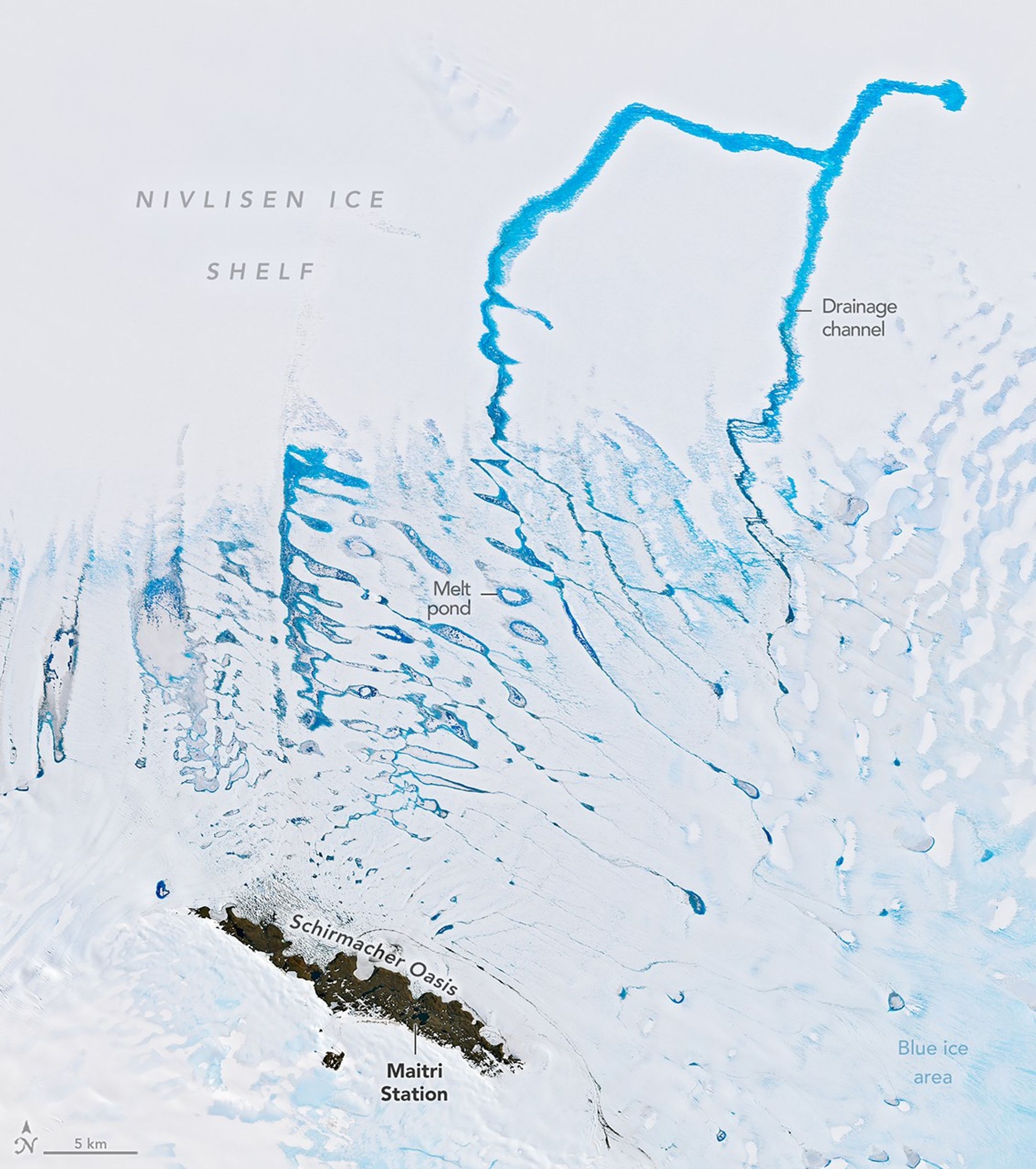
Freshwater lakes dot the rocky, ice‑free Schirmacher Oasis during the 2026 austral summer, a season when constant sunlight supports microbial life and seabirds while temperatures rise just enough to trigger widespread surface melting. Blue‑ice patches surrounding the oasis expose dense, old glacial ice scoured clean by katabatic winds and sublimation; these low‑albedo surfaces absorb more sunlight, warm faster, and help drive seasonal melt across the Nivlisen Ice Shelf. (Credit: Landsat 9 / NASA Earth Observatory)

Credit: Landsat 9 / NASA Earth Observatory

Researchers report that these drainage networks trace preexisting structural weaknesses, including crevasses, that can concentrate meltwater near the grounding line and potentially weaken the ice shelf. The data also highlight the region’s distinctive blue‑ice areas, where old, dense glacial ice is exposed by katabatic winds and sublimation. Long‑term satellite and field studies show that since 2000, melt features on Nivlisen have increased in depth, area and volume, with the 2026 season consistent with elevated melt conditions. (Credit: Landsat 9 / NASA Earth Observatory)
The Extremely Large Telescope, From Space : Astronaut Sophie Adenot, ISS

A new image taken from the International Space Station shows the construction site of the European Southern Observatory’s Extremely Large Telescope (ELT) on Cerro Armazones in Chile’s Atacama Desert. The photograph, captured by ESA astronaut Sophie Adenot during her long‑duration mission Epsilon, highlights the telescope’s spiral access road and the small dark structure at the center of the image marking the partially built facility, visible even from more than 400 kilometers above Earth. (Credit: ESA – S. Adenot)

The surrounding landscape’s natural geological lines contrast with the engineered spiral leading to the summit. Once completed, the ELT will become the world’s largest visible and infrared telescope, featuring a 39‑meter primary mirror designed to collect unprecedented amounts of light. Adenot’s accompanying log entry emphasizes the region’s exceptionally clear skies, which also host ESO’s La Silla and Paranal observatories. (Credit: ESA – S. Adenot)
Moonrise : Copernicus Sentinel-2

The Copernicus Sentinel‑2 mission captured a calibrated image of the Moon after one of its satellites was rolled sideways to view Earth’s natural satellite instead of the planet. The maneuver is part of Sentinel‑2’s routine calibration process, which relies on the Moon’s stable reflectance to detect and correct subtle changes in instrument performance.
The image, taken at roughly 5‑kilometer resolution, shows prominent lunar features including the Tycho, Copernicus and Kepler craters, as well as the Seas of Rain, Serenity and Tranquillity. The release coincides with NASA’s Artemis II mission, launched the previous day. (Credit: ESA)
Young Stars In The W51 Region : James Webb Space Telescope

Mid‑Infrared Three‑Color Image (MIRI): This three‑color mid‑infrared image shows glowing gas illuminated by ultraviolet light from massive young stars, with hotter gas appearing red and cooler gas in blue. (Credit: NASA, ESA, CSA, Yoo & Ginsburg (UF); processing by A. Pagan (STScI))
University of Florida researchers used the James Webb Space Telescope to capture the most detailed infrared images to date of the W51 star‑forming region, revealing thousands of young, massive stars still embedded in dense dust. JWST’s long‑wavelength infrared capability allowed the team to observe atoms, molecules and protostellar objects invisible to optical and ground‑based infrared telescopes. The data show that many stars in W51 formed within the past million years and continue to grow, producing radiation, hot winds, shocks and cavities that reshape the surrounding gas. The images also reveal ionized bubbles, dark filaments and outflow structures not seen in earlier surveys. Comparisons with ALMA observations indicate that only a small fraction of stars appear in both datasets, underscoring how much early star formation remains hidden even with JWST’s sensitivity.

Near‑Infrared Image (NIRCam): Near‑infrared view highlighting stars, dark clouds and scattered light from the ionized H II region within W51. (Credit: NASA, ESA, CSA, Yoo & Ginsburg (UF); processing by A. Pagan (STScI))

MIRI Gas‑Structure Image: MIRI image revealing swirls of gas illuminated by massive stars, including shocks, bubbles and filamentary structures previously unresolved. (Credit: NASA, ESA, CSA, Yoo & Ginsburg (UF); processing by A. Pagan (STScI))

NIRCam Wispy‑Gas Image: NIRCam image showing wispy gas features, cavities carved by massive stars and dark lanes of cold gas, along with newly identified young stars. (Credit: NASA, ESA, CSA, Yoo & Ginsburg (UF); processing by A. Pagan (STScI))

SCIENCE
Blue Ghost Lander Challenges Long‑Held Model Of Lunar Thermal Asymmetry

Radioactive, heat‑producing elements such as thorium are heavily concentrated on one part of the Moon’s nearside, as shown in this false‑color map. Blue Ghost touched down in a basin outside that enriched region to determine how temperatures compare elsewhere. White indicates the highest thorium levels and purple the lowest. (Credit: NASA)
Firefly Aerospace’s Blue Ghost lunar lander returned the first heat‑flow measurements from outside the Procellarum KREEP Terrane region, challenging the long‑standing model that the Moon’s nearside is significantly hotter than its far side. Data presented at the Lunar and Planetary Science Conference show that subsurface temperatures at the Mare Crisium landing site are comparable to those recorded by Apollo 15 and 17, despite expectations that the region would be cooler. Blue Ghost targeted Mare Crisium, a volcanic plain well outside the Moon’s heat‑rich Procellarum KREEP Terrane, where cooler subsurface temperatures were expected. Earlier heat‑flow measurements, taken by Apollo 15 and 17 more than 50 years ago, came from the edges of the Imbrium and Serenitatis basins, both geologically complex regions.
Scientists used a drill-based heat probe instrument called LISTER, mounted on the underside of the spacecraft, to measure, at incremental depths, the amount of heat escaping from the moon's interior at the landing site. The LISTER drill encountered dense, rocky soil that limited penetration depth, but still provided enough readings to suggest a more uniform distribution of heat‑producing radioactive elements such as thorium. Instead of reaching of the intended depth of over 1 meter into the subsurface, the drill was able to reach 36 inches / 98 centimeters.
Additional measurements from the lander’s magnetotelluric instrument support the finding, indicating that the Moon’s internal heat structure may be less divided than previously believed. The results reopen questions about why volcanic maria are concentrated on the nearside and whether the Procellarum KREEP Terrane alone drove ancient eruptions.
Interstellar Comet 3I ATLAS Appears To Be Nearly 12 Billion Years Old And May Have Outlived Its Star System

3I/ATLAS, imaged by the Hubble Space Telescope. (Credit: NASA, ESA, STScI, D. Jewitt (UCLA). Image Processing: J. DePasquale (STScI))
30 March, 2026
Interstellar comet 3I/ATLAS may be among the oldest objects ever observed in the solar system, with new isotopic analyses suggesting it formed 10–12 billion years ago, shortly after the Milky Way’s birth. Science says that the older an interstellar object, the faster it travels. A fast interstellar object will have likely experienced multiple encounters and gravitational slingshots with stars, accelerating it to high velocity. The comet, discovered in 2025 and the fastest ever recorded, traveling at 58 km/s, is only the third confirmed interstellar visitor after 1I/ʻOumuamua and 2I/Borisov.
An earlier research had determined 3I/ATLAS’s "kinematic" age somewhere between 3 billion and 11 billion years old. However, now a new study led by NASA Goddard's Martin Cordiner has shortened that range, based on the comet's isotopic composition. The assessment, based on James Webb Space Telescope Near-Infrared spectrography, found unusually low carbon‑13 to carbon‑12 ratios and water enriched in deuterium (one of two stable isotopes of hydrogen), indicating formation in extremely cold, metal‑poor early galactic environments.
Isotopes are versions of an element with the same number of protons but different numbers of neutrons. Carbon‑12 has six protons and six neutrons, while carbon‑13 has six protons and seven neutrons. Deuterium is a form of hydrogen with one proton and one neutron, unlike ordinary hydrogen, which has no neutrons.
Additional observations from ESA’s JUICE mission show strong water‑vapor outgassing, dual tails, and a gas‑and‑dust trail extending more than 5 million kilometers, behavior consistent with active comets despite its unusual chemistry.
Artemis II Launch Initiates Mission With Minor Issues, Major Science Targets And Historic Return To Deep Space

A view of Earth captured by NASA astronaut and Artemis II Commander Reid Wiseman through one of Orion’s four windows after the spacecraft completed its translunar injection burn on April 2, 2026. (Credit: NASA)
1 - 4 April, 2026
NASA launched four astronauts on the Artemis II mission from Launch Complex 39B here at NASA's Kennedy Space Center, sending Orion on a 10‑day lunar flyby that marks the first crewed voyage beyond low Earth orbit in more than 50 years. The mission, commanded by Reid Wiseman with Victor Glover, Christina Koch and CSA (Canadian Space Agency) astronaut Jeremy Hansen, will test Orion’s life‑support, navigation and deep‑space communications systems ahead of Artemis III. The Space Launch System’s twin solid rocket boosters and four RS‑25 engines produced the most powerful crewed launch in U.S. history, with the vehicle entering a high‑Earth orbit before performing a translunar injection burn.
NASA scientists plan to use the lunar flyby to study how the Moon’s environment interacts with the solar wind and how water and other volatiles migrate across the surface. The mission will collect data on the lunar exosphere, hydrogen distribution and radiation conditions beyond Earth’s magnetosphere, helping refine models for future crewed landings. Researchers also aim to validate Orion’s sensor performance for tracking hydration signatures and surface composition during the closest approach. The findings are expected to support planning for Artemis III and later missions that will rely on improved understanding of lunar resources and deep‑space environmental hazards.
Earlier, NASA confirmed that a strong solar flare detected hours before liftoff posed no radiation risk to the crew. Orion’s trajectory will set a new human distance record as it arcs more than 430,000 miles from Earth. NASA also highlighted upgrades to crew systems, including a redesigned waste‑management assembly that drew attention after minor issues during early flight operations. The agency said the toilet remains fully functional and is undergoing routine troubleshooting. Artemis II is intended to validate spacecraft performance, crew operations and recovery procedures before NASA attempts a crewed lunar landing later in the decade. To track Orion’s journey to the Moon and back, visit this link.
Meanwhile, NASA has halted work on Mobile Launcher 2, the tower and platform system NASA uses to assemble, transport, and launch the Space Launch System (SLS) rocket, after ending development of the Space Launch System Block 1B, issuing a stop‑work order and directing teams to remove hardware for reuse on the existing Block 1 launch platform. Exploration Ground Systems manager Shawn Quinn said components such as the core‑stage and Orion umbilical arms, including long‑lead cryogenic flex lines, will be preserved as critical spares for future Artemis missions.
ML‑2 had been designed for the larger Exploration Upper Stage, but NASA announced Feb. 27 it would standardize on a “near Block 1” configuration and later confirmed it will replace the Interim Cryogenic Propulsion Stage (ICPS) with a Centaur‑derived upper stage. The ML‑2 program had faced significant overruns, with costs projected to reach $2.5 billion and readiness slipping to 2029. Following the April 1 Artemis II launch, NASA reported that Mobile Launcher 1 sustained mostly cosmetic damage, an improvement over Artemis I.
SLS Block 1B was the planned upgraded configuration of NASA’s Space Launch System, designed to carry heavier payloads and larger crewed missions than the current Block 1. The canceled Block 1B was to have a much larger, more powerful Exploration Upper Stage (EUS) than the ICPS used on Artemis I and II, with four RL10 engines instead of one. It was planned to lift heavier payloads to the Moon, including large cargo modules or combined crew‑and‑cargo missions. The EUS would have changed the rocket’s height and umbilical locations, which is why NASA was building Mobile Launcher 2.

GOVERNANCE
Another Starlink Satellite Breaks Apart As LEO Debris And Traffic Pressures Increase

Starlink satellite 34343 broke apart on March 29, 2026. The image above was taken by HEO on Feb. 14, and the company is now acquiring additional observations to assess the spacecraft’s current state. LeoLabs first detected and characterized the event. (Credit: HEO)
30 March, 2026
SpaceX confirmed that Starlink satellite 34343 broke apart in orbit after an on‑orbit anomaly on March 29, resulting in loss of communications at an altitude of about 560 kilometers. The company said initial analysis shows no risk to the International Space Station, its crew, the Artemis II launch trajectory, or the Transporter‑16 mission, which was planned to deploy payloads above or below the constellation. HEO Robotics released imagery of the spacecraft captured on February 14, weeks before the fragmentation, and said it is working to image the satellite’s current condition.
SpaceX reported that the event produced “tens of objects,” with debris expected to persist longer due to the higher orbit. The U.S. Space Force’s Space Surveillance Network is tracking the pieces. Starlink stated it is investigating the root cause and will implement corrective actions.
This is SpaceX’s second fragmentation incident in recent months, when on December 17, 2025, satellite 35956 broke apart. Early analysis by LeoLabs and independent experts has suggested that both events were caused by an internal "energetic source." The debris is expected to burn up in the atmosphere in the next few weeks. Starlink satellites ave high operational load, conducting approximately 145,000 evasive maneuvers in the first half of 2025 to avoid potential collisions, and throughout 2025, 1 to 2 Starlink satellites were falling back to Earth daily as part of their end-of-life deorbiting process. With over 10,000 Starlink satellites active in 2026 there is an increased debris management and collision risk in low Earth orbit.
Although, Spacex filing for a million datacenter satellites with the FCC, followed by Blue Origin and Starcloud filing for tens of thousands more in LEO, can be seen as a “first mover” strategy to claim orbital slots early, the trend is still concerning.
While the FCC (in the U.S.) and International Telecommunication Union (ITU) manage spectrum, there is currently no hard, legally binding cap on the total number of LEO satellites, leading to significant feasibility concerns regarding collisions and environmental impact.
European Union Overtakes ESA, National Programs As Financial Driver Of Space Sector, Report Outlines Shift
31 March, 2026
A new analysis argues that the European Union is emerging as a central political and financial driver of Europe’s space sector as Brussels increases funding for defense‑ and security‑oriented programs. The report, written by analyst Michael Gleason published by The Aerospace Corporation’s Center for Space Policy and Strategy, states that rising EU budgets, potentially doubling or tripling in the coming years, could shift authority over major satellite initiatives away from national governments and intergovernmental bodies such as the European Space Agency and EUMETSAT. The European Commission has proposed a 2028–2034 framework that would raise combined defense and space spending to roughly $150 billion, while the EU already funds about a quarter of ESA’s budget, a share that could exceed 50% if planned increases are approved.
“With the benefit of the European Space Agency’s technical expertise and with the EU’s and ESA’s combined ability to pool resources from across their member states, the EU could soon position itself as the foremost space actor in Europe and a leading global actor in space security and defense.”
The report, titled, “A Geopolitical Awakening: The European Union and Space,” notes that the EU oversees Galileo, Copernicus, EGNOS, GOVSATCOM, IRIS², and a growing surveillance and intelligence architecture, with additional spending expected to protect these systems from electronic interference and anti‑satellite threats. At the same time, national governments are expanding their own military space programs, including Germany’s proposed $12 billion, 100‑satellite communications constellation, raising concerns about duplication and fragmentation. The result, the report concludes, is a shifting balance in which Brussels gains influence over Europe’s space priorities while member states retain control of sovereign defense capabilities.
NASA Targeted Again As White House Proposes Major Budget Reductions For 2027 But Isaacman Defends Funding Plan

Credit: NASA
3 April, 2026
For the second straight year, the White House has issued a budget proposal that would significantly scale back NASA’s science activities and support for the International Space Station.
The White House released a fiscal year 2027 budget proposal that would cut NASA’s funding to $18.8 billion, a 23% reduction from 2026’s $24.4 billion and the second consecutive request seeking major reductions to the agency’s science programs and ISS operations. The proposal includes a $3.4 billion, or 47%, cut to science, terminating more than 40 missions ranging from Mars Sample Return to SERVIR (a joint initiative with USAID to distribute Earth science data and help developing nations use satellite data and geospatial technologies to address environmental challenges), while omitting previously targeted programs such as Chandra, Astrophysics Probe and OSIRIS‑APEX.
NASA said only one of the two recently selected Earth System Explorer missions, STRIVE and EDGE, would proceed within the five‑year window. The budget would also reduce ISS spending by $1.1 billion and cut space technology by nearly one‑third, while eliminating STEM Engagement. Exploration funding would rise nearly 10% to $8.5 billion, including $175 million for new lunar robotic missions and a request to repurpose $2.6 billion in Gateway funds. Congressional Democrats and industry groups criticized the proposal and urged appropriators to reject it.
3 April, 2026
However, billionaire turned NASA Administrator Jared Isaacman publicly defended the administration’s fiscal year 2027 budget request. The cut in science funding marks one of the steepest proposed reductions to U.S. federal research programs across government. In appearances on CBS and CNN on April 5, Isaacman said the agency could still meet its exploration objectives, citing the 2026 appropriations bill and $10 billion in supplemental funding from last year’s budget reconciliation act as resources enabling accelerated lunar hardware production, an added Artemis mission in 2027, and development of a lunar base.
“I strongly support the President’s fiscal policies and mandate to drive efficiency.
“I encourage the workforce to leave the politics for the politicians and remain focused on the mission.”
He argued that assessments of the proposal overlook the reconciliation funding, which is concentrated in exploration and does not support science or space technology, both facing major reductions. Isaacman pointed to continued support for missions such as the Roman Space Telescope and the Dragonfly Titan lander, although dozens of early‑stage and extended‑operation science missions face cancellation under the request. He said NASA should be evaluated on outcomes rather than annual spending levels and noted that NASA’s science budget remains larger than that of all other space agencies combined.
The administration released the budget on April 3 without the customary NASA briefing, instead posting the congressional justification online. In an internal memo the same day, Isaacman told employees the proposal reflects a mandate to increase efficiency and said the requested levels are sufficient to meet national mission priorities, urging the workforce to remain focused on execution rather than politics.

MILITARY
Varda's Reentry Mission Flies US Hypersonic Payloads Including Rhea Space Activity's GPS‑Denied Navigator

A render of Varda's W-4. (Credit: Varda Space Industries)
30 March, 2026
Orbital pharmaceutical processing and hypersonic reentry testbed provider, Varda Space Industries launched its sixth reentry capsule March 30 on SpaceX’s Transporter‑16 mission, carrying U.S. government‑funded experiments intended to operate during hypersonic flight. The W‑6 capsule, part of Varda’s line of orbital manufacturing and reentry vehicles, will expose onboard hardware to conditions exceeding Mach 25 before returning to Earth.
Among the payloads is a GPS‑denied autonomous navigation system from Rhea Space Activity, funded by the Space Force and Air Force Research Laboratory, designed to determine position during the plasma‑induced communications blackout of reentry. The unit includes two cameras and a flight computer to test RSA’s AutoNav algorithm, which matches observed orbital objects to those in the Space Force Unified Data Library. The mission also carries thermal protection materials from Sandia National Laboratories and NASA. AFRL has a multiyear contract with Varda to fly and recover high‑speed test articles, and the company plans to increase cadence of its W‑Series flights.
Aspect Aerospace Raises $2.4 Million To Build Single‑Board Satellites For VLEO Sensor Swarms

Concept art depicts a host spacecraft releasing several single‑board satellites in very low Earth orbit to support persistent, on‑demand environmental sensing. (Credit: Aspect Aerospace)
1 April, 2026
Aspect Aerospace secured $2.4 million to advance development of its circuit‑board‑sized satellites for space‑based environmental monitoring, including a $1.9 million U.S. Space Force Direct‑to‑Phase‑2 SBIR award and a $500,000 pre‑seed investment from SOSV. The University of South Alabama spin‑off plans to build a space‑ready Single‑Board Satellite (SBS) prototype within 18 months. The SBS integrates sensing, communications and power systems onto a single printed circuit board and is designed to operate for roughly six months in very low Earth orbit. A host spacecraft the size of a small refrigerator could deploy up to 100 units individually or in batches at a cost comparable to a single ESPA‑class satellite.
The company’s initial mission focuses on plasma measurements in VLEO using a proprietary time‑domain impedance probe capable of near‑instantaneous point sampling. Data collected across a swarm would enable three‑dimensional plasma modeling with sub‑meter precision, improving space‑weather visibility for satellite operators. The sensor builds on earlier validation from the Jagsat‑1 cubesat, suborbital tests and U.S. Naval Research Laboratory assessments. Aspect Aerospace is targeting early 2027 for on‑orbit deployment and is seeking partners to adapt the SBS architecture for additional sensors, including magnetometers, infrared spectrometers and radiation detectors.
Vantor Wins $2.3 Million US Intelligence Agency Contract To Deliver Automated Insights On LEO Objects

Vantor captured this image of a Chinese SAR satellite under the NGA Luno B contract, highlighting its large deployable antenna for high‑resolution radar imaging. (Credit: Vantor)
1 April, 2026
Spatial intelligence provider, Vantor (formerly Maxar Intelligence) received a $2.3 million contract from the National Geospatial‑Intelligence Agency to provide automated intelligence on space objects in low Earth orbit, marking the company’s third award under NGA’s Luno program and the first task order focused on non‑Earth imaging. The Luno A and B contracts, valued at nearly $500 million over five years, allow NGA to issue task orders for commercial geospatial data and analytics.
Under the new Luno B award, Vantor will deliver machine‑generated detections, classifications and alerts on priority orbital objects, including indications of anomalous behavior. The company said its system determines satellite tasking opportunities, collects imagery and processes data to characterize an object’s features, health, velocity and maneuvers. NGA and the U.S. Space Force are increasingly turning to commercial providers to augment space‑domain‑awareness data as the number of satellites and debris grows. Vantor said its satellites can capture imagery of spacecraft at sub‑10‑centimeter resolution from hundreds of kilometers away.
US Space Force Funding Surges To Over $71 Billion As Pentagon Expands Defense Spending And On‑Orbit Defense Plans

Apex Space is developing "Project Shadow," a self-funded demonstration mission scheduled for June 2026 to validate space-based interceptor (SBI) technologies for the US Space Force’s "Golden Dome" initiative. (Credit: Apex)
4 April, 2026
The Trump administration’s fiscal 2027 budget proposal seeks a record $1.5 trillion in defense spending, including a major expansion of the U.S. Space Force as the Pentagon accelerates investment in space‑based missile defense. This development comes as the same time as NASA’s funding being reduced to $18.8 billion, a 23% reduction from 2026.
The plan would raise Space Force funding to more than $71 billion, about $40 billion above 2026 levels, with roughly $12 billion routed through budget reconciliation. The request includes about $17 billion for the Golden Dome missile‑defense architecture, most of it outside the regular appropriations process, and large increases for missile‑tracking satellites in low and medium Earth orbit, moving‑target tracking sensors, a $1.5 billion Space Data Network, automated command‑and‑control systems and expanded procurement of proliferated communications satellites.
The proposal comes as Space Force units play a central but largely unseen role in recent U.S. military operations tied to Iran and other regions. General Chance Saltzman, chief of space operations, said the service has been “instrumental” in campaigns from Venezuela to Nigeria to Iran, providing missile warning, satellite communications, precision timing and long‑range connectivity while helping disrupt adversary communications and sensor networks through non‑kinetic effects. Space Forces–Central oversees operations in the Middle East, with personnel positioned across the region and at U.S. headquarters. Saltzman said the service is increasingly integrated into planning from the outset and is deploying more distributed architectures to maintain continuity under attack.
The budget faces significant hurdles in Congress, which must approve both the topline and the administration’s plan to use reconciliation to fund defense programs at this scale.

COMMERCIAL
Voyager Partners With Icarus Robotics To Trial Free‑Flying Robot On ISS

A prototype of Icarus’ worker robot. (Credit: Icarus Robotics)
30 March, 2026
Defense and space tech company, Voyager Technologies and AI-powered space robotics startup, Icarus Robotics will test a free‑flying robotic assistant on the International Space Station under a new contract announced March 30. The agreement will send Icarus Robotics’ autonomous inspection and manipulation system, Joyride, to the station in 2026, where it will operate inside the ISS to demonstrate mobility, sensing and task‑automation capabilities.
The robot is designed to support routine inspection, logistics handling and maintenance activities, and to reduce astronaut workload by performing repetitive or hazardous tasks. Voyager will provide mission integration, safety certification and on‑orbit operations support. The companies said the demonstration is intended to validate technologies for future commercial stations, where autonomous systems are expected to play a larger role in daily operations. The ISS test follows earlier ground‑based trials of the Icarus platform and marks the company’s first deployment to an orbital environment.
Chinese Firm Sustain Space Tests Flexible Robotic Arm On Satellite For On‑Orbit Servicing

The flexible robotic arm on the Xiyuan-0 satellite in orbit. (Credit: Sustain Space)
30 March, 2026
China’s commercial on‑orbit servicing efforts advanced with Sustain Space completing a series of robotic‑arm demonstrations on its Xiyuan‑0 / Yuxing 3-06 satellite, launched March 16 on a Kuaizhou‑11 rocket. As part of the planned on‑orbit operations, the company said the flexible arm successfully performed four test modes, autonomous refueling simulation, human teleoperation, vision‑based servo ops and force‑controlled drawing. Sustain Space, a subsidiary of Beijing-based commercial space company Emposat, developed the mission with partners including Shenzhen Mofang Satellite Technology, Tsinghua University’s Shenzhen International Graduate School and Hunan University of Science and Technology, with Emposat supporting communications and operations.
The achievement is the most notable since June 2025, when China’s Shijian‑25 performed a successful docking and refueling of the out‑of‑fuel Shijian‑21 satellite.
The satellite will also conduct an accelerated deorbit experiment using a deployable drag sphere. Sustain Space and Emposat plan to explore a closed‑loop commercial servicing model leveraging Emposat’s ground network for low‑latency, human‑in‑the‑loop operations. The demonstration follows earlier Chinese servicing milestones, including reported refueling tests by the Shijian‑21 and Shijian‑25 spacecraft in 2025.
State media also highlighted progress on China’s broader space‑robotics program, including tests of precision approach, docking and manipulation technologies intended for debris‑removal and satellite‑support missions.
Rocket Lab Wins German Approval To Acquire Laser Communications Firm Mynaric

Testing and finalisation process for the CONDOR Mk3 terminal. (Credit: Mynaric)
30 March, 2026
Rocket Lab received approval from Germany’s Federal Ministry for Economic Affairs and Energy to acquire laser communications manufacturer Mynaric, clearing a major regulatory obstacle for the roughly $150 million deal first announced last year. The decision ends months of uncertainty after German officials scrutinized whether Mynaric’s optical communications technology, used in military and commercial satellite networks, should remain under domestic control. The approval follows Rheinmetall’s withdrawal from a potential competing bid earlier in March.
Rocket Lab said it expects to close the acquisition in April and will keep Mynaric headquartered in Munich, establishing its first European base of operations. The company plans to scale production of Mynaric’s laser terminals, which remain in short supply despite growing demand for high‑rate, interference‑resistant links in proliferated constellations. Mynaric already supplies its CONDOR Mk3 terminals for Rocket Lab‑built satellites under U.S. Space Development Agency contracts. German approval reflects a broader European effort to balance foreign investment with tighter oversight of defense‑related technologies as governments increase spending on space and security programs.
Starcloud Reaches Unicorn Status As It Raises $170 Million To Build Orbital Data Center Constellation

This animation shows the company’s concept for a 5‑gigawatt space‑based data center powered and cooled by solar and radiator panels measuring roughly 4 km by 4 km. (Credit: Starcloud)
30 March, 2026
Starcloud raised $170 million in a Series A round to accelerate development of its orbital data center spacecraft, reaching a $1.1 billion valuation as it awaits regulatory approval to deploy an 88,000‑satellite network. The Redmond, Washington‑based company said the round, led by Benchmark and EQT Ventures, makes it the fastest Y Combinator startup to reach unicorn status. Funding will support production of the three‑ton Starcloud‑3 spacecraft at a new facility in Woodinville, following the 60‑kilogram Starcloud‑1 launched last year and the 450‑kilogram Starcloud‑2 scheduled to fly later in 2026.
Starcloud plans to launch Starcloud‑3 on SpaceX’s Starship, with each mission carrying about 50 satellites. The company positions itself as an infrastructure provider, enabling customers to install their own compute hardware. Starcloud‑2 will run commercial cloud workloads for early customer Crusoe and partners including Nvidia, AWS and Google. Investors also include Macquarie Capital, NFX, Nebular, Adjacent, 776 Ventures, Fuse Ventures and several industry executives.
China Aims For 140 Launches in 2026 As Kinetica‑2 Lifts Off And Tianlong‑3 Crashes

China’s Kinetica‑2 Y1 rocket lifts off on its maiden flight from the Dongfeng Commercial Space Innovation Test Zone in northwest China on March 30, 2026. (Credit: CAS Space)
30 March, 2026
China’s commercial and state launch sectors marked a series of developments as the country targets roughly 140 orbital launches in 2026, according to CAS Space (Chinese Academy of Sciences Space) founder Yang Yiqiang. The figure, reported by the 21st Century Business Herald, would represent a 52 percent increase over China’s record 92 launches in 2025 and continue a rapid expansion driven by new vehicles, expanded spaceport capacity and policy support for commercial space and satellite internet.
China’s accelerating cadence is supported by infrastructure growth at Jiuquan, Hainan’s commercial pads near Wenchang, and the maritime launch complex in Haiyang, with additional spaceport projects advancing in Ningbo, Xichang and Yangjiang. The expansion coincides with a surge of commercial launch firms pursuing reusable systems, including Landspace, iSpace, Space Pioneer, CAS Space and Galactic Energy, alongside early‑stage entrants developing Starship‑class vehicles. State‑owned Long March rockets are also adding reusable variants.
Yang said long‑term national targets call for at least 100 annual launches of large liquid‑propellant rockets and more than 2,000 satellites deployed per year to support megaconstellations such as Guowang and Qianfan. The push aligns with China’s designation of commercial space as a “pillar industry” and its broader “space+” strategy to integrate space infrastructure across economic and strategic sectors. Commercial activity continues to expand, with Nebula‑1 and Space Pioneer’s Tianlong‑3 preparing debut flights and local governments rolling out incentives to attract space companies and build regional clusters.
Yang’s comments came as CAS Space completed the inaugural flight of its kerosene‑liquid oxygen Kinetica‑2 rocket on March 30, placing three spacecraft, including a prototype cargo vehicle, into orbit. The company plans about 13 missions this year across its Kinetica‑1 and Kinetica‑2 lines. The company said the medium‑lift launcher is designed for cost‑competitive constellation deployment.
3 April, 2026
However, the sector also saw a high‑profile failure when Space Pioneer’s Tianlong‑3 suffered an anomaly during a static‑fire test, causing the first‑stage booster to lift off unintentionally and crash near the test site. The company said the vehicle was destroyed and an investigation is underway.
SpaceX Files IPO Targeting Valuation Above $1.75 Trillion

The launch of the SpaceX Starship Integrated Flight Test 5, which occurred on October 13, 2024, from the Starbase facility in Texas. (Credit: SpaceX)
1 April, 2026
SpaceX has confidentially filed for an initial public offering (IPO) that Bloomberg reports could raise up to $75 billion in June and target a valuation exceeding $1.75 trillion. The company has not commented on the filing, which would allow the SEC to review disclosures before they become public. Bloomberg also reported SpaceX is considering a dual‑class share structure and may allocate up to 30% of shares to retail investors. Reuters previously estimated SpaceX generated $15–16 billion in revenue and about $8 billion in profit last year, driven by launch services and Starlink. Much of the company’s projected valuation is tied to long‑term initiatives, including plans for large‑scale orbital data centers, an emerging market that recently saw startup Starcloud raise $170 million. The IPO will test investor appetite for business models built around future space and AI infrastructure.
Italian Argotec Establishes Florida Facility As European Firms Grow US Presence
3 April, 2026
Italian aerospace firm, Argotec opened its first U.S. satellite production facility in Melbourne, Florida, bringing more than $25 million in planned investment and the capacity to assemble up to 10 small satellites simultaneously. The site, located near Kennedy Space Center, is intended to extend the company’s modular, high‑volume manufacturing model from Italy to the U.S. market, with workforce expansion expected over the next two years.
The move is part of a wave of European satellite manufacturers establishing production lines in the United States. Companies including Argotec and Belgium’s Aerospacelab are building infrastructure to compete directly for U.S. government and commercial contracts, leveraging manufacturing approaches refined under European programs. These firms see openings in price, delivery speed and scalable production that U.S. suppliers have struggled to meet consistently.
Amazon Rebuts SpaceX Collision Risk Claims While Atlas V Expands Leo Constellation
3 April, 2026
Amazon said it will adjust deployment plans for its broadband constellation after SpaceX told the FCC that recent Amazon Leo launches created collision risks. SpaceX argued Amazon deployed satellites 50–90 kilometers above its licensed 400‑kilometer insertion altitude, citing a February 12 Ariane 6 launch that triggered 30 Starlink avoidance maneuvers. Amazon countered that its license allows flexibility and noted SpaceX did not object to similar deployments in 2025, when SpaceX itself was Amazon’s launch provider. Amazon said it is coordinating with Arianespace and other launch providers to lower insertion orbits and plans up to 20 launches annually as it accelerates constellation deployment.

ULA’s Atlas V launches from Space Launch Complex‑41 at 1:46 a.m. EDT on April 4 with 29 Amazon Leo satellites aboard. (Credit: United Launch Alliance)
4 April, 2026
Amazon’s announcement came as a United Launch Alliance Atlas V rocket launched 29 Amazon Leo satellites on April 4 from Cape Canaveral, marking the vehicle’s heaviest payload to date at 18 tons. The Atlas V 551 successfully placed all spacecraft into their target orbit, supporting Amazon’s planned 3,200‑satellite broadband network, which has now reached 241 satellites across nine missions. The flight was the fifth Atlas V launch for Amazon Leo, part of a broader deployment campaign using Atlas V, Falcon 9 and Ariane 6 vehicles.

RESEARCH SPOTLIGHT
Microwave Laser Detected From Galaxies Merging 8 Billion Light‑Years Away

Illustration of the gravitational lensing system where MeerKAT detected the OH gigamaser, with the 1665 and 1667 MHz emission lines marked. (Credit: Inter-University Institute for Data Intensive Astronomy (IDIA))
A powerful hydroxyl “gigamaser” has been detected from a pair of merging galaxies nearly 8 billion light‑years away, marking the most distant and luminous signal of its kind observed to date. The emission, identified with South Africa’s MeerKAT radio telescope, originates from the gravitationally lensed system HATLAS J142935.3–002836, where intense star formation and gas compression amplify naturally occurring microwave‑frequency lasers.

Multiwavelength image of HATLAS J142935.3‑002836 combining data from ALMA, Hubble, Keck and the Very Large Array. The edge‑on foreground galaxy acts as the gravitational lens, while the ring traces a merging background system. (Credit: NASA/ESA/ESO/W. M. Keck Observatory)
A maser works on the same principle as a laser, i.e., light amplification by stimulated emission of radiation, but the emitted light is at microwave wavelengths, which makes it observable with radio telescopes rather than optical instruments.
A hydroxyl maser is a maser produced by OH (hydroxyl) molecules in interstellar or intergalactic gas clouds. When these molecules are pumped into an excited state by shocks, radiation, or collisions, they emit intense, coherent microwave radiation.
A gigamaser is an extremely luminous megamaser, typically hundreds to thousands of times brighter than standard astrophysical masers. These are usually found in galaxy mergers where dense gas, dust, and starburst activity amplify the emission to exceptional levels.
Researchers report that the maser’s brightness exceeds that of previously known hydroxyl megamasers and provides a rare probe of gas dynamics and merger‑driven starburst activity in the early universe. Spectral analysis shows multiple components tracing turbulent molecular regions shaped by the collision. The team, with researchers from University of Pretoria, Inter‑University Institute for Data Intensive Astronomy (IDIA) at University of Cape Town, Wits Centre for Astrophysics at the University of the Witwatersrand, Rhodes University and the South African Radio Astronomy Observatory made their findings available on arXiv.
Saturn Magnetic Field Is Found Warped By Its Moon, Enceladus

An illustration showing the position of Saturn's cusp compared to Earth's. (Credit: SUSTech)
A new analysis of six years of Cassini spacecraft data shows that Saturn’s magnetic field is significantly skewed, with its magnetic cusp displaced to the afternoon sector rather than the noon position seen at Earth.
Saturn’s magnetic cusp, that is, the point where magnetic field lines funnel charged particles into the atmosphere, is shifted into the planet’s “afternoon” sector rather than the noon‑facing direction seen at Earth. On Earth, the cusp sits on the side of the magnetosphere that points directly toward the Sun, where local solar time would be noon. Saturn’s offset shows that its entire magnetic field is distorted relative to the Sun, influenced by the planet’s rapid rotation and the heavy plasma supplied by its moons.
Researchers at the Mullard Space Science Laboratory in the University College of London, report that the offset is driven by Saturn’s rapid 10.7‑hour rotation and the heavy plasma environment created by gases emitted from its moons, particularly Enceladus, whose icy plumes supply much of the magnetosphere’s ionized material. The study, published in Nature Communications, confirms that rotation and internal plasma, rather than the solar wind, dominate the structure of Saturn’s magnetosphere. The findings refine models of magnetic reconnection and particle flow and carry implications for future missions targeting Enceladus, a key site in the search for habitable environments.
Despatch Out. 👽🛸
